Case file 013 · Humanistic Psychology
Carl Rogers
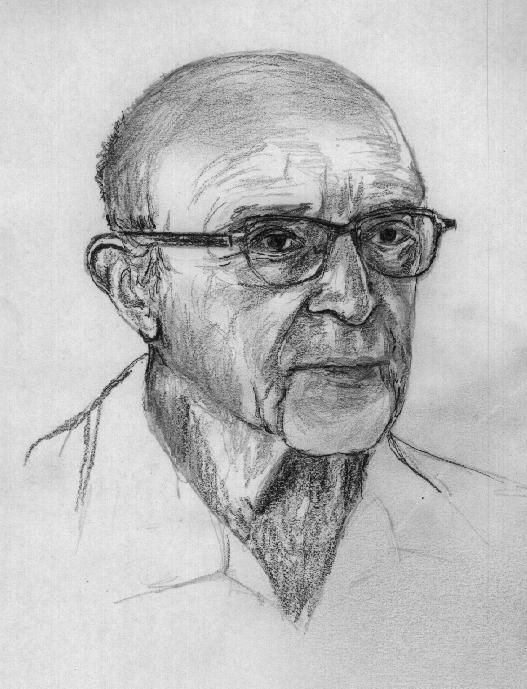
Fig. 1 — CC BY 2.5 · Foto: Didius

A tape recorder in the consulting room, around 1940, at Ohio State University. What sounds self-evident today was then a break with the entire professional culture: Carl Rogers recorded therapy sessions, had them transcribed, and laid the protocols before colleagues. Until then, psychotherapy was whatever the therapist reported about it afterwards.
Rogers was born on 8 January 1902 in Oak Park, Illinois, into a strictly devout Protestant family — six children, hard work, no alcohol, no theatre, little warmth; he himself later described the atmosphere as uncompromisingly religious and practical. The family moved to a farm, and the boy, solitary and bookish, found his first scientific subject in the moths he bred and in the handbooks of scientific agriculture: controlled feeding trials as an awakening. The road to testability began in the barn, not the seminar room.
He began agriculture at Wisconsin, switched to divinity, and studied at the liberal Union Theological Seminary in New York — an emancipation from home he sealed with a journey to China as a student delegate, from which he returned, as he wrote, with a worldview of his own. The last step followed: from the seminary he crossed the street to the psychology of Teachers College, Columbia University. The pastoral care without dogma he had been looking for acquired a methods section there.
For twelve years afterwards he worked at a child guidance clinic in Rochester with troubled children — cases, reports, court files, no academic stage. There arose the observation that carries his work: the expert’s interpretations helped less than what the clients found out about themselves when one let them. Rogers often told of the moment when a mother whose son he could not reach turned back at the door and asked whether he also counselled adults — and then began to speak of herself. The profession did not call such a thing therapy then. Rogers called it listening, and began to keep records of it.
In 1940 he became professor in Ohio; in 1942 appeared Counseling and Psychotherapy — with the complete verbatim protocol of an eight-session counselling as appendix, the first of its kind. In 1945 he moved to Chicago, where the university’s counselling centre became his laboratory; Client-Centered Therapy followed in 1951. Rogers thereby shifted the roles: it is not the expert who knows what the case is — the client knows, and the therapist’s task consists in producing the conditions under which he can say it. Even the word client instead of patient was programme, and remained so.
The 1957 paper cast these conditions as a testable claim: three attitudes of the therapist — genuineness, unconditional regard, empathy — are necessary and sufficient for therapeutic change. That was bold, for it meant the therapist’s school plays no role. In the same year he took up the double professorship in Wisconsin from which the sobering schizophrenia project grew — and on the same stage he held, in 1957 with B. F. Skinner, the field’s most famous debate, on whether human beings are to be controlled or can grow.
In 1964 he left the university for good and went to La Jolla in California — from professor to itinerant preacher of his own cause, as critics mocked; Rogers would scarcely have disputed the wording, only the valuation. Client-centred therapy became the person-centred approach, applied to encounter groups, to schools — Freedom to Learn —, to organisations and finally to political conflicts: in workshops he brought Catholics and Protestants from Belfast, Black and white South Africans to one table; at the last he travelled to Moscow. For this peace work he was nominated in 1987 for the Nobel Peace Prize — the news reached the hospital where he lay dying.
His institutional legacy he organised as unhierarchically as the teaching demanded: in 1968 he founded with colleagues in La Jolla the Center for Studies of the Person — no institute with a chair, but a workshop that exists to this day. In the family the line continued: his daughter Natalie Rogers developed from the person-centred approach an expressive arts therapy of her own and at times worked with her father in the large groups.
Rogers died on 4 February 1987 in La Jolla, after a fall and a heart attack, booked into projects to the end. The rankings of the most influential psychotherapists that the field has since compiled several times regularly carry him in first place — ahead of Freud. The man who contested the expert’s authority of interpretation is, posthumously, its greatest case.
The context was a war of schools with no arbitration board. The psychotherapy of the 1950s consisted of camps — psychoanalysts, the first behaviour therapists, eclectics of every sort — and each camp explained its successes out of its theory. At the same time a general attack stood in the room: Hans Eysenck had calculated in 1952 that the treated improved no more often than the untreated on the waiting list — psychotherapy as a whole had become liable to prove itself. Into this situation Rogers put a question in 1957, in the Journal of Consulting Psychology, that lay athwart all fronts: not which therapy works, but something riskier — are there conditions present in every effective therapy, regardless of school? If so, the quarrel of methods would be a side issue.
His answer comprises six points, of which three concern the therapist’s attitude and became famous. Congruence: in the relationship she is herself, without facade. Unconditional positive regard: she prizes the client without attaching conditions. Empathic understanding: she grasps his inner world as if it were her own — and does not lose the as if. The other three points scarcely anyone names, yet they carry the construction: two persons must be in contact, the client must be in a state of incongruence — vulnerable or anxious — and he must at least minimally perceive the therapist’s attitude. A theory of relationship, not a catalogue of virtues.
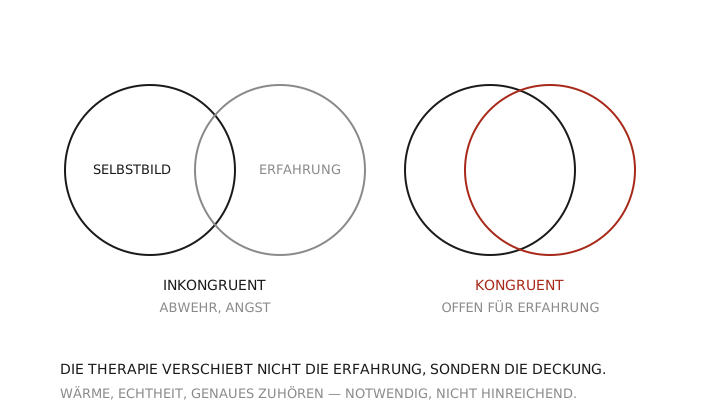
The decisive claim sits not in the list but in two words: necessary and sufficient. Necessary means: without them nothing works. Sufficient means: nothing more is needed — no interpretation, no technique, no diagnosis. The paper says expressly that professional training thereby loses its privileged position: if the conditions suffice, whoever can produce them can produce them. With that the claim was falsifiable — and Rogers himself insisted on testing it.
That is the part the reception regularly suppresses. Rogers counts as the counter-figure to measuring psychology, yet he was one of the founders of empirical psychotherapy research. From the 1940s he was the first to have sessions recorded in full and transcribed verbatim — against the profession’s bitter objection that this destroyed confidentiality —, developed with the Q-sort a procedure to quantify changes in self-image, and in 1954 presented, with Psychotherapy and Personality Change, a controlled investigation complete with wait-list comparison and measures others could recompute. The tapes were more than documentation: on them one could test for the first time what therapists actually do, rather than what they report doing.
The Wisconsin project, which he ran between 1958 and 1964 with hospitalised schizophrenia patients, was the hardest of these tests — and brought results he himself called sobering. The patient group for which the client-centred attitude was least built profited scarcely; the expected effects largely failed to appear, the project fell out over data and authorships, and the final volume of 1967 is as honest as it is unreadable. Rogers drew the consequence in his own way: he left the university and moved his work to where his conditions were at home — into counselling, groups, education.
The reception ran on two tracks. The schools of technique adopted the three conditions as basic equipment — scarcely a therapy training in the world that does not teach empathy, genuineness and regard — but contested the sufficient. Research, in turn, made Rogers’s question a field of its own: the study of the therapeutic relationship, the so-called alliance, across all schools. And the much-cited corollary of Eysenck’s attack — the “dodo bird verdict,” by which the major procedures scarcely differ on average — is in substance a Rogers thesis: if the schools are level, it must be the common factor that works, not the special one.
How the three attitudes are measured became a branch of research itself. Charles Truax and Robert Carkhuff built rating scales in the 1960s with which judges graded tape excerpts for empathy, warmth and genuineness — the conditions became countable, and with them the training: listening could now be drilled and marked. Later research added a revealing twist: it is not the external raters' judgment that best predicts outcome but the clients' own — whether someone feels understood decides more than whether a scorer finds the therapist empathic. Exactly that Rogers would have predicted: his sixth condition demanded from the start that the attitude arrive at the client.
The formula’s descendants work under other names today. Motivational interviewing, developed in addiction treatment and by now one of the most-studied conversational methods, names Rogers expressly as its foundation — its inventors describe it as a client-centred method with direction. Active listening, which Rogers described with Richard Farson for managers, has become the standard vocabulary of crisis lines, HR departments and parenting guides. Scarcely a workpiece of the field has seeped so completely into everyday life — so completely that the origin was forgotten along with the empirical halving of the claim.
What the attitude looks like in the concrete can be watched: in 1965 Rogers let himself be filmed for the teaching film Three Approaches to Psychotherapy with the same client as Fritz Perls and Albert Ellis — the patient “Gloria,” who passed through three schools in succession, became the most famous comparison case in the history of therapy, and generations of students have learned from those three half-hours that the same woman receives three different conversations in three consulting rooms. The film is Rogers’s thesis as visual aid — and its touchstone, for whoever shows it must explain how the better half-hour is to be recognised.
All of this became testable only through a technical decision Rogers took in the 1940s, and one that changed his field: he had sessions recorded and typed out word for word. Until then the literature on psychotherapy consisted of case reports the clinician wrote from memory after the hour — material in which no claim can be told apart from another. With the transcripts, third parties could for the first time read what had actually been said, categorise statements and count them across sessions. The whole of process research in the decades that followed, including the scales with which Rogers’s own conditions were later measured, hangs on that change. It is his methodological legacy, and it weighs more than the formula of 1957.
What stands today: the relationship, not the formula. The therapeutic alliance belongs to the most stable predictors of treatment success, across all procedures and confirmed in several large meta-analyses — the effects are moderate, but they are there, and the therapist’s empathy belongs to the same circle of findings. Rogers had the right variable in view decades before the field cared to measure it.
By now the necessary is under observation too. People improve in guided self-help, through workbooks and digital programmes, without any therapist anywhere radiating genuineness — which means either that the conditions are not necessary, or that they work more subtly than the formula holds them. And the cross-cultural critique asks whose self is actually being actualised here: the ideal of the client who listens to the inner voice and sheds the conditions of others bears the signature of its origin — it is the self-image of American individualism, exported as an anthropological constant. Rogers heard the objection himself and answered it practically with his late international groups; theoretically he did not.
What does not stand is the sufficient. For a series of disorders — compulsion, phobias, panic — specific procedures are demonstrably more effective than a solid relationship alone; there, exposure heals where understanding only accompanies. Open, moreover, is the causal reading: that good relationships and good courses go together can also mean that improvement improves the relationship. The conditions are conducive, often necessary, but not enough. Rogers put up a testable claim and thereby made it possible for it to be half refuted. That is more than can be said of most therapy schools of that era — and it is why this file carries him as an empiricist, not as a prophet of mildness.
In everyday use the term is almost always misunderstood, and in a friendly way: as an invitation to approve of everything. That was not the meaning.
Rogers distinguished between the person and their behaviour. Unconditional regard means that the attention given does not depend on whether someone is currently behaving as one would wish. It does not rule out disagreement. It rules out using attention as a reward.
The counter-concept makes this clearer: the condition of worth. Children learn early on under what circumstances they are accepted — when they are quiet, when they bring home good marks, when they do not get angry. Anyone who internalises these conditions begins to fend off parts of their own experience, because those parts endanger the price of belonging. Rogers called this the estrangement from one’s own experience, and in it he saw the root of what other schools treated as a symptom.
The therapeutic consequence is unspectacular and hard: to offer a relationship in which these conditions do not apply — so that what was locked away under them can become visible. The concept is only indirectly testable; what can be tested is the quality of the relationship as a whole, and that does predict treatment success.
Replication status: partially replicated.
The status separates the two halves of the 1957 claim. That the quality of the therapeutic relationship predicts treatment success is established across methods, disorders and countries; the meta-analyses reliably find moderate associations. That Rogers’s three conditions are sufficient has been refuted: for several disorders, specific methods beat the relationship alone.
Primary sources:
- Rogers, C. R. (1957). The necessary and sufficient conditions of therapeutic personality change. Journal of Consulting Psychology, 21(2), 95–103. — The testable version.
- Rogers, C. R. (1951). Client-Centered Therapy. Houghton Mifflin. — The method.
- Rogers, C. R., & Dymond, R. F. (Eds.) (1954). Psychotherapy and Personality Change. University of Chicago Press. — His own controlled investigation using the Q-sort.
- Rogers, C. R., et al. (1967). The Therapeutic Relationship and Its Impact. University of Wisconsin Press. — The Wisconsin project with schizophrenia patients and its sobering results.
Testing:
- Flückiger, C., et al. (2018). The alliance in adult psychotherapy: A meta-analytic synthesis. Psychotherapy, 55(4), 316–340. — The state of the evidence on the alliance; more than 300 individual studies.
- Elliott, R., et al. (2013). Research on humanistic-experiential psychotherapies. In Lambert (Ed.), Bergin and Garfield’s Handbook of Psychotherapy and Behavior Change (6th ed.). Wiley. — Effectiveness balance sheet for the humanistic methods.
German-language:
- Grawe, K., Donati, R., & Bernauer, F. (1994). Psychotherapie im Wandel. Von der Konfession zur Profession. Hogrefe, Göttingen. — The large German-language comparative study; sets out where client-centred therapy is inferior to specific methods.
Overview: https://en.wikipedia.org/wiki/Person-centered_therapy