The Journal29 August 202613 min read
A man in a permanent present
What H. M. gave science without ever being able to consent to it
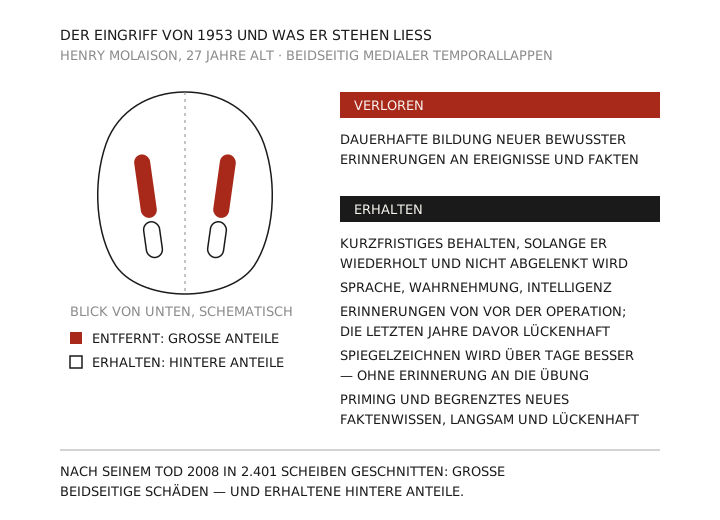
Henry Molaison is 27 years old when, in 1953, the neurosurgeon William Scoville removes parts of the medial temporal lobe on both sides, including large portions of the hippocampus. Molaison has suffered severe epileptic seizures since adolescence, and medication does not control them well enough. After the operation the seizures become rarer and milder. The price only shows itself afterwards: conversations, visits and new experiences disappear within a short time. In the literature he is known for decades simply as “H. M.”
The young neuropsychologist Brenda Milner travels down from Montreal. Her task is not merely to establish what is missing. She breaks “memory” apart into testable performances. Molaison can hold on to a number for as long as he rehearses it. He remembers a great deal from the time before the operation. Language, perception and general intelligence are not wiped out. What is massively disturbed is only the lasting formation of new conscious memories for events and facts.
No experiment preceded the operation
Molaison’s story does not begin with a research question but with an illness that had shaped his everyday life since adolescence. He had absence seizures and later severe generalised ones. Employment, independence and safety were already restricted before 1953. The operation did not arise from scientific curiosity; it was a risky therapeutic decision in a situation that offered the patient and his family few good options.
Scoville was a technically bold surgeon. He removed the tissue through approaches above the eye sockets. There were indications at the time that the structures involved had something to do with memory; their decisive role in lasting new learning was not yet clinically clear. The seizures did not disappear entirely, but they became less severe. The amnesia, by contrast, was profound and it stayed.
In hindsight the outcome looks foreseeable — but only because H. M. himself changed what we know. That is a historical hindsight bias: we read the decision with knowledge that arose from its consequences. An ethical judgement may take the state of knowledge at the time into account without playing down the harm. The question is not whether those involved acted “well” or “badly”, but what uncertainty existed, how risks were communicated, and what protective rules medicine has to derive from the case.
Learning without remembering the learning
The most famous experiment asks the participant to draw a star while hand and template are visible only in a mirror. At first Molaison makes many errors. Over several days he gets better — although each time he denies having seen the task before. The motor skill remains, the conscious episode is missing. A theoretical claim thereby becomes visible: memory is not a container. Procedural learning can work while episodic remembering is severely damaged.
Milner’s strength lay in the precise variation of tasks. Instead of asking globally whether H. M. had “a memory”, she tested which information survived under which conditions and across which span of time. The mirror-drawing task was so convincing because performance and conscious report came apart. Methodologically, though, a finding like this needs points of comparison: a better result can come from practice, random fluctuation, a changed strategy or cues from the experimenter. Repeated trials, measurable error curves and further tasks made the procedural reading plausible; research with other patients and with animal models later freed the conclusion from its dependence on a single human being.
A single case changes a theory most forcefully when it severs a connection that seemed necessary. Before H. M. one could assume that anyone who remembers nothing consciously cannot have learned anything. His improving performance showed a dissociation: A can be severely disturbed while B remains relatively intact. But only double dissociations and replications turn such a pattern into a robust architecture of the mind.
Later research drew further distinctions. Working memory, semantic knowledge, episodic memory, priming, habits and emotional learning rest on overlapping but not identical networks. In teaching, these systems are readily drawn as tidy boxes: “declarative” for knowledge that can be expressed in facts and events, “non-declarative” for skills, priming and conditioning, “episodic” for lived situations, “semantic” for general knowledge. The categories are useful, and they are neither anatomically separate nor pure in everyday life. A car journey contains motor routines, spatial orientation, rules, current goals and memories of earlier dangers all at once. H. M. made the plurality visible; he did not prove the existence of a set of independently operating modules.
The moment is not as short as it sounds
What that felt like Molaison described himself — and the sentence is more exact than any formula science has found for it:
Right now, I’m wondering. Have I done or said anything amiss? You see, at this moment everything looks clear to me, but what happened just before? That’s what worries me. It’s like waking from a dream.
The phrase “permanent present” is powerful and imprecise. Molaison did not lose new information every second. He could hold a conversation, follow a train of thought and retain numbers or words briefly, as long as attention and rehearsal kept the content active. When he was distracted, that fragile bridge often broke. It was precisely there that the difference between short-term maintenance and lasting storage became visible.
For outsiders this was confusing. A polite, coherent conversation creates the expectation that the other person will remember it later. With Molaison that everyday coupling was undone. His behaviour in the moment showed understanding; his later forgetting did not make the earlier conversation inauthentic. The encounter had taken place, even if he could not turn it into a retrievable episode.
This corrects a philosophical shortcut. Consciousness, memory and personhood are closely connected but not identical. A person without stable new autobiographical storage still possesses perception, needs, feelings, habits and a moral claim. Memory makes continuity possible; it is not the ticket of admission to the present. Autobiographical remembering does, however, permit something particular: carrying promises through time, regretting mistakes, connecting plans to experience. There is no sense in blaming Molaison for failing to act on information that could not be stored. His self did not disappear on that account. Stable manners, old knowledge, preferences and ways of reacting formed continuity — the self is partly remembered, partly embodied, partly written into routines and partly carried by others.
What he learned all the same
Molaison’s amnesia had a temporal structure. Many early memories remained accessible, while the years immediately before the operation were patchier. This graded retrograde amnesia supported the idea that the hippocampus first stabilises new content, while older content depends on it less over time. The exact theory of consolidation is still debated; the case alone does not settle it.
New semantic learning was not zero either. Under repeated conditions Molaison could take in a limited number of facts, and priming influenced his behaviour without his consciously remembering the source. He lived more than five decades after the operation, and his knowledge did not stay entirely frozen in 1953: studies found limited later factual knowledge and a certain familiarity with well-known people or terms. The learning was slow, fragmentary and far below ordinary levels — but not impossible. Such residual capacities forced researchers to build tasks in which “knowing”, “recognising”, “finding familiar” and “demonstrating a skill” did not mean the same result.
Between “can learn” and “can reliably retain everyday experience” there is nevertheless a large functional distance. For rehabilitation it is exactly that intervening space that matters. Routines, cues and errorless learning can support independence without claiming that the amnesia has been cured. Help works best when it draws on preserved mechanisms instead of making people fail again and again at the damaged function.
People who met Molaison repeatedly could seem familiar to him, even though he described no specific earlier encounter. Researchers are cautious here: friendliness was part of his stable style, and situational cues could provide orientation. Even so, the case shows that relationships have more layers than explicit memory for names and events. A tone of voice can produce a sense of safety, a setting can be learned, a person can be evaluated positively without the source of that feeling being consciously available. In ordinary life memory weaves these layers together so that we barely notice how different they are. Molaison’s injury made the seams visible. No romantic claim follows from this: affective learning too can be distorted. Put soberly, the conscious autobiographical report is an important form — but not the only form — in which the past influences present behaviour.
Brenda Milner and the birth of a discipline
The popular account occasionally presents Milner as a researcher who discovered the multi-store model in a single experiment. In fact the insight developed over years, in collaboration with Scoville, Wilder Penfield, Suzanne Corkin and many others. Milner combined clinical observation with experimental control and returned to Molaison again and again. Scientific progress here was a series of careful distinctions, not a flash of inspiration.
Her position was also unusual. As a young psychologist in a field dominated by men both medically and academically, she had to show that behavioural tests can test anatomical hypotheses as sharply as surgical findings do. The case thereby strengthened neuropsychology as a discipline standing between neurology and experimental psychology.
A counter-myth would nonetheless be wrong. Milner’s achievement did not consist in “owning” Molaison or in anticipating everything he would come to mean. She developed good questions, documented limits, and turned surprising residual abilities into a research programme. That is the more realistic form of scientific greatness.
The hippocampus is neither hard drive nor archive
Everyday metaphors like to present the hippocampus as a memory chip. The data speak rather for a binding and organising role: the features of an experience — place, time, people, perceptions — have to be linked in such a way that a coherent episode can later be reconstructed. In doing so the hippocampus works with widely distributed cortical regions.
That explains why older memories were partly preserved: after longer consolidation their retrieval could rest more heavily on cortical connections. This standard theory too, however, has variants. Some models assume that detailed episodic recollection permanently requires hippocampal involvement, while schematic knowledge becomes more independent. H. M.'s pattern constrains the possible theories; it does not settle every present-day controversy.
The anatomy itself was measured precisely only after his death in 2008. His brain was cooled, imaged over many hours and cut into 2,401 thin sections; from this came a digital three-dimensional archive that joined decades of behavioural data to an anatomical precision unattainable during his lifetime. The examination by Annese and colleagues confirmed extensive bilateral damage in the medial temporal lobe but showed preserved posterior hippocampal portions. The formula “hippocampus removed, memory gone” is therefore doubly wrong: anatomically the operation was more complex, and functionally several forms of learning survived. Corrections like these are not a weakness of the case history but science at its best.
Consent under conditions of forgetting
Research ethics demands informed and voluntary consent. With a person who soon forgets the explanation, a single signature is not enough. Consent becomes an ongoing process: explain in comprehensible language, check willingness in the moment, minimise burden, involve legal representation, take non-verbal refusal seriously. In Molaison’s case consent had to be repeated and backed up by guardianship arrangements. That practice developed over his long period of participation; today’s standards cannot simply be projected back onto every earlier year.
At the same time it would be paternalistic to infer incapacity automatically from a memory disorder. Decision-making capacity is task-specific. Someone can understand the purpose and immediate burden of a simple examination even if he will not remember it tomorrow. Protection and participation are not opposites; they have to be balanced anew for each situation.
After his death his name became public. Anonymisation had protected him during his lifetime and at the same time produced an abstract figure; naming Henry Gustav Molaison gave the story a biography back. It nonetheless raises a question: when does public visibility honour a contribution, and when does science appropriate a person one more time? The same applies to the data set. Tissue, images and test results make new research possible long after death. Who decides about access, presentation and commercial use? Historical generosity is not a blank cheque; biobanks need clear governance, data protection and rules for findings that nobody could have foreseen.
An open dispute arose in 2016 around exactly these questions. The journalist Luke Dittrich, a grandson of Scoville’s, accused Suzanne Corkin of destroying records concerning H. M. and of failing to coordinate his care with the nearest living relative; he also charged that the finding of preserved hippocampal portions had been held back for too long. MIT and more than two hundred researchers rejected the account as one-sided. The dispute is not settled. It belongs in the file all the same, because it shows how far responsibility for a patient extends beyond his death.
The daily life behind thousands of hours of testing
Laboratory reports compress years into tables. Molaison had to live every day with consequences that cannot be expressed as an error rate. New neighbours, deaths, changes of address or changes in his care could not become familiar to him in the ordinary way. He depended on his family and later on professional care. At the same time he could eat, speak, work through tasks, show humour and take part in social situations.
This simultaneity guards against two caricatures: the “man without a memory” who supposedly has no past, and the scientific hero whose suffering appears only as a fortunate opportunity for knowledge. Molaison had strong residual abilities and a severe disability; both belong in the same portrait. His willingness to cooperate is often reported as a character trait. Neither sainthood nor consent to every use follows from that. It is more appropriate to see the concrete dependency: researchers needed his cooperation, he needed an environment that oriented and protected him. Science here was a decades-long relationship with unequal power.
The case also changed practice. Before 1957 memory problems could appear as a diffuse consequence of general intellectual damage; Molaison’s preserved language and intelligence alongside a massive new-learning deficit showed that memory can be selectively impaired. Bilateral removals of medial temporal lobes have been avoided ever since because of the risk of amnesia, and preoperative memory testing, imaging and more focused procedures are meant to preserve function. Textbooks can nevertheless make the same mistake as with Phineas Gage: turning a complex person into an illustration for a box in a diagram. Whoever places H. M. beside the term “procedural memory” and nothing else loses the epilepsy, the operation, the dependency, the cooperation and the ethics.
What remains
Very well established are the severe anterograde amnesia, the relatively preserved short-term maintenance, the motor learning without conscious memory, and the complex bilateral lesion. Well supported is the central role of the medial temporal lobes in new declarative learning. Less certain are individual anecdotes, the exact reach of emotional familiarity, and all conclusions about his inner experience. The case can neither prove that every memory system is anatomically independent nor show how a healthy brain stores memories in detail. An extraordinary patient opens up hypotheses; broader studies test how far they generalise.
It is precisely this limitation that leaves Molaison’s contribution undiminished: he changed the question. After him it was no longer enough to measure memory as a single unified force. Researchers had to specify which kind of learning, which time frame, which form of retrieval and which neural system they meant. Carried over carefully, the same holds for dementia and other memory disorders: when biographical retrieval declines, dignity, feeling and the capacity for relationship do not vanish with it. The comparison does not equate the conditions; it only corrects the moral confusion of memory performance with human worth.
H. M. changed psychology because he did not forget everything — the preserved learning was theoretically as important as the loss. His story is also a reminder that science likes to name people after their deficit, and that a contribution reaching across five decades and beyond death demands more protection than a signature. The fairer sentence runs: Henry Molaison was a person with a profound amnesia who, through decades of cooperation, helped to rethink everyone else’s memory.
Sources, and why they are here
Scoville, W. B., & Milner, B. (1957). Loss of recent memory after bilateral hippocampal lesions. Journal of Neurology, Neurosurgery & Psychiatry, 20, 11–21.
The report with which the case entered science — written by the surgeon who performed the operation together with the psychologist who measured its consequences.
Milner, B., Corkin, S., & Teuber, H.-L. (1968). Further analysis of the hippocampal amnesic syndrome: 14-year follow-up study of H.M. Neuropsychologia, 6(3), 215–234.
The fourteen-year follow-up — and the source of the quotation in which Molaison describes his own condition.
Corkin, S. (2002). What's new with the amnesic patient H.M.? Nature Reviews Neuroscience, 3, 153–160.
The balance sheet after half a century of testing, by the researcher who accompanied him longest.
Corkin, S. (2013). Permanent Present Tense: The Unforgettable Life of the Amnesic Patient, H. M. Basic Books.
The portrait of the man behind the thousands of hours of testing — and the source for the daily life the article does not leave out.
Annese, J., Schenker-Ahmed, N. M., Bartsch, H., et al. (2014). Postmortem examination of patient H.M.'s brain based on histological sectioning and digital 3D reconstruction. Nature Communications, 5, 3122.
The anatomical clarification after his death: only here was it settled what had actually been removed — and that it was not quite what had been assumed for decades.