Topic 04
The Unconscious
PsychoanalysisCognitive Psychology
The oldest measurement of this topic stands not in Freud but in Ebbinghaus’s syllable records: the savings method measures what goes faster on relearning even though the recollection itself has long vanished — a memory beneath the reportable, decades before any concept of the implicit. And William James reserved, in the Principles, a fringe for consciousness — that which runs along without being meant. The beginnings of the field did not assert the unconscious; they measured it in passing.
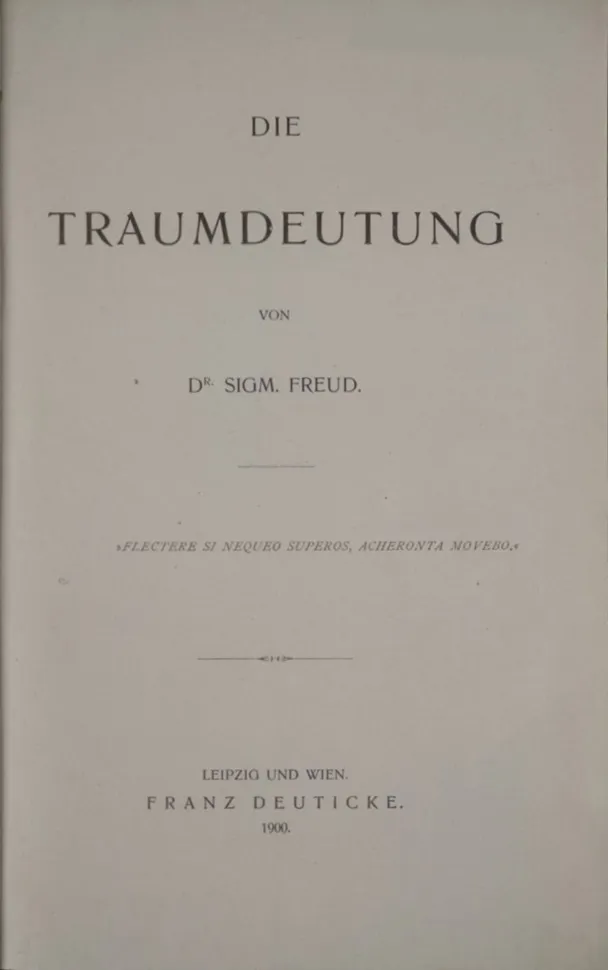
The claim that a considerable part of what moves a person is not available to that person is among the most consequential in the history of psychology. It is also the most poorly tested. In 1900 Freud offered a model in The Interpretation of Dreams in which a wish is distorted before it is allowed into consciousness; Jung measured, at the Burghölzli, the seconds a subject hesitated before a stimulus word and called the place a complex; in 1936 Anna Freud arranged the procedures by which the ego defends itself against its own experience into a catalogue that is still professional vocabulary.
What connects the three is less a theory than an observation: people regularly act against their stated intentions and give reasons that do not explain the course of events. What separates them is what follows from it. For Freud the unconscious is a place with an inventory of its own — repressed wishes that go on working. For Jung it becomes a collective inheritance of images. For Anna Freud the view shifts to the ego and to how it protects itself, which makes the concept smaller and more testable.
Cognitive psychology did not reject the claim; it rebuilt it. That processing happens without consciousness is now uncontroversial and well evidenced: perception, memory retrieval and judgement run largely without accompanying introspection. Kahneman’s System 1 is the best-known shorthand for it. Only this unconscious is not an archive of forbidden wishes but a fast, associative operation without intent — it represses nothing, it merely computes without giving an account of itself.
At one point the dispute has become empirical. Repression in the narrow sense — a distressing event actively made inaccessible, able to return later intact — has not been confirmed in laboratory studies. Whether that is a fact about the matter or about the set-up is unsettled, and the Loftus file shows why the question is not harmless: recovered memories have been used in court, and the conditions under which memories can form for events that did not happen are well studied.
A second point of contact is neurobiology. From the 1990s Mark Solms showed that dreaming and REM sleep are controlled by different brain mechanisms — which weakens Hobson’s purely physiological reading and brings Freud’s basic idea, that dreams have a motivation, back within testable reach. What that confirms is not the interpretation of dreams but the legitimacy of its question.
For this archive the topic is therefore not a quarrel between followers and opponents but a case of a term shifting under its own name. The word has stayed; its content has become something else; and the files document both states.
Sheets on this theme
- Case file 001Sigmund FreudProfile
- Case file 001Sigmund FreudCase file
- Case file 001Sigmund FreudNote
- Case file 001Sigmund FreudEvidence
- Case file 002Carl Gustav JungProfile
- Case file 002Carl Gustav JungCase file
- Case file 002Carl Gustav JungNote
- Case file 002Carl Gustav JungEvidence
- Case file 003Anna FreudProfile
- Case file 003Anna FreudCase file
- Case file 003Anna FreudNote
- Case file 003Anna FreudEvidence
- Case file 016Melanie KleinProfile
- Case file 016Melanie KleinCase file
- Case file 016Melanie KleinNote
- Case file 016Melanie KleinEvidence
- Case file 033Karen HorneyProfile
- Case file 033Karen HorneyCase file
- Case file 033Karen HorneyNote
- Case file 033Karen HorneyEvidence
- Case file 007Ulric NeisserProfile
- Case file 007Ulric NeisserCase file
- Case file 007Ulric NeisserNote
- Case file 007Ulric NeisserEvidence
- Case file 008Daniel KahnemanProfile
- Case file 008Daniel KahnemanCase file
- Case file 008Daniel KahnemanNote
- Case file 008Daniel KahnemanEvidence
- Case file 009Elizabeth LoftusProfile
- Case file 009Elizabeth LoftusCase file
- Case file 009Elizabeth LoftusNote
- Case file 009Elizabeth LoftusEvidence
- Case file 032Amos TverskyProfile
- Case file 032Amos TverskyCase file
- Case file 032Amos TverskyNote
- Case file 032Amos TverskyEvidence
From the journal
- 1900The Interpretation of Dreams is publishedEvery dream fulfils a wish in disguise, shaped by the dream-work.Sigmund Freud
- 1906Studies in Word AssociationAt the Burghölzli the hesitation before a stimulus word is measured — the spot is called a complex.Carl Gustav Jung
- 1932The Psycho-Analysis of ChildrenA child's play as the equivalent of free association.Melanie Klein
- 1936The Ego and the Mechanisms of DefenceThe ego's defences, ordered into a catalogue that is still professional vocabulary.Anna Freud
- 1945Toward, against, or awayKaren Horney describes neurotic conflict as rigid movement toward people, against them, or away from them.Karen Horney
- 1967Cognitive Psychology is publishedThe book gives a field its name and its order: processing in stages between stimulus and response.Ulric Neisser
- 1974Misinformation effect demonstratedOne verb more than doubled the reported broken glass.Elizabeth Loftus
- 1974Heuristics and errors of judgmentTversky and Kahneman show how useful shortcuts can create systematic errors under uncertainty.Amos Tversky
- 1979Prospect TheoryLosses weigh roughly twice as heavily as equal gains.Daniel Kahneman
- 1992Phantom FlashbulbsMean accuracy 2.95 of 7 — with confidence high throughout.Ulric Neisser