Case file 032 · Cognitive Psychology
Amos Tversky
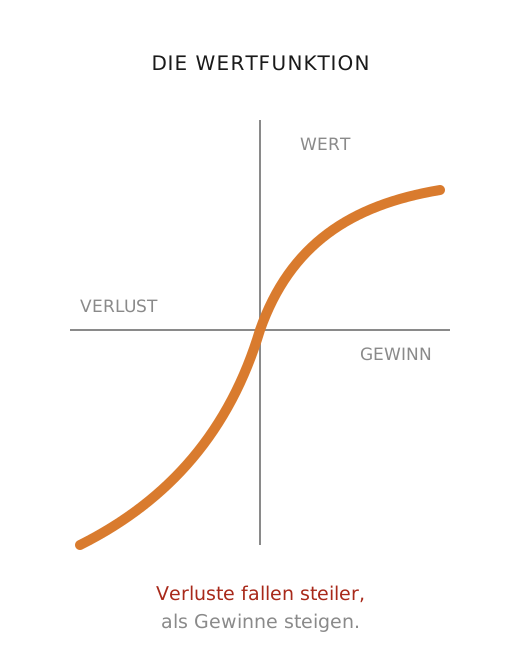
Fig. 1 — Drawing by the archive · free to use
Amos Nathan Tversky was born in Haifa in 1937. He served as a paratrooper in the Israeli army, studied at the Hebrew University of Jerusalem, and completed his doctorate at Michigan in 1965. His early work was mathematical psychology: how can similarity, choice, and measurement be formalised so that a theory can fail against observable decisions?
In 1969 Daniel Kahneman invited his younger colleague to a seminar. Their disagreement — Tversky initially thought people were fairly good intuitive statisticians; Kahneman did not — began one of psychology’s most productive partnerships. They wrote together at one desk and alternated first authorship. Their names head the 1974 heuristics paper, prospect theory in 1979, and the 1981 framing paper.
Tversky was more than Kahneman’s co-author. His work on similarity and “elimination by aspects” showed that choice need not involve weighing a complete ranking. People can discard options step by step: first everything without one important feature, then by the next.
Tversky was elected to the US National Academy of Sciences in 1985. He died of melanoma in 1996, aged 59. When Kahneman received the economics Nobel in 2002, he turned his lecture into a tribute to the absent partner. Nobel Prizes are not awarded posthumously; science is not divided by prize certificates.
The 1974 article is not one experiment but a map. Tversky and Kahneman grouped tasks from several research series under three heuristics: representativeness, availability, and anchoring. Their crucial claim had two parts: shortcuts are economical and generally effective — and under identifiable conditions they produce systematic errors.
Representativeness judges a case by how well it fits a type. A description of a quiet, detail-minded person can then feel more important than the base rates of librarians and salespeople. Availability substitutes ease of recall for frequency: dramatic examples come to mind faster and therefore seem common. Anchoring pulls estimates towards a previous number even when its origin is obviously arbitrary.
The programme changed the question. Not: are people rational or irrational? But: which task evokes which shortcut, and when does it help or hurt? Its robust centre survives, though not every classic demonstration is equally strong. Natural-frequency formats remove some errors; expertise helps in familiar environments; and social-priming claims later marketed as “unconscious thought” do not belong to this well-supported core.
The fair record is therefore “partial”, not “refuted”. Heuristics are neither small demons in the mind nor excuses for every bad judgment. They are testable hypotheses about which information people actually use. Tversky’s mathematical discipline lies here: a good story about error must become visible in a task, a comparison condition, and a prediction.
“Linda is 31, single, outspoken, and very bright. She studied philosophy, was concerned with discrimination, and joined demonstrations.” Which is more probable: that Linda is a bank teller — or a bank teller active in the feminist movement?
Many choose the second answer because it fits the story. Yet the intersection of two events can never be more probable than either event alone. “Bank teller and active” is a subset of “bank teller”.
The task shows the power and risk of narrative fit. The extra detail makes the description more plausible while mathematically it can only make it less probable. A useful everyday question follows: did the additional feature make the group larger — or merely more vivid?
Replication status: partial.
Core patterns in framing, anchoring, and several probability judgments have been repeated many times. Their magnitude depends on task, presentation, knowledge, and sample. This status covers the broad heuristics-and-biases programme; prospect theory is documented separately as replicated in the Kahneman file.
Primary sources:
- Tversky, A., & Kahneman, D. (1974). Judgment under uncertainty: Heuristics and biases. Science, 185, 1124–1131.
- Tversky, A., & Kahneman, D. (1981). The framing of decisions and the psychology of choice. Science, 211, 453–458.
- Tversky, A., & Kahneman, D. (1983). Extensional versus intuitive reasoning: The conjunction fallacy in probability judgment. Psychological Review, 90, 293–315.
- Tversky, A. (1972). Elimination by aspects: A theory of choice. Psychological Review, 79, 281–299.
Context:
- Gigerenzer, G. (1991). How to make cognitive illusions disappear: Beyond “heuristics and biases”. European Review of Social Psychology, 2, 83–115.
- Klein, R. A., et al. (2018). Many Labs 2. Advances in Methods and Practices in Psychological Science, 1, 443–490.