Case file 008 · Cognitive Psychology
Daniel Kahneman
Fig. 1 — CC BY-SA 2.0 · Photo: nrkbeta
_(cropped).jpg)
In occupied Paris, sometime in 1941 or 1942, a Jewish boy was out on the street after curfew, his yellow star turned inward. A German soldier in a black uniform beckoned him over, lifted him up, hugged him, showed him the photograph of a boy, gave him money and let him go. Daniel Kahneman described this scene as early evidence of what occupied him for a lifetime: that people are complicated, and their behaviour does not follow from one category.
Kahneman was born on 5 March 1934 in Tel Aviv, during a family visit of his mother’s, and grew up in France, where his father worked as a chemist in a cosmetics factory. The family survived the occupation in hiding, at the last in a chicken coop on the Riviera; the father — once interned already and released through his employer’s intervention — died in 1944 of untreated diabetes, a few weeks before the Allied landing. In 1948 the family moved to Palestine, days before the founding of the state of Israel. Whoever looks for the reference points of this biography finds them early.
He studied psychology and mathematics in Jerusalem and served in the psychology branch of the Israeli armed forces. There he saw for the first time how certain assessors can be when their judgements are worthless: officers predicted recruits' aptitude from a group exercise with great conviction — and the predictions scarcely held. Kahneman later called this the illusion of validity, and as a twenty-year-old designed a structured interview that broke the assessors' impressions into separate, individually scored traits. It worked better than any free judgement and remained, in developed form, in use for decades — his first contribution to psychology was a checklist against his own guild.
After a doctorate at Berkeley he returned to Jerusalem as a lecturer. In 1969 he invited the younger colleague Amos Tversky into his seminar — the beginning of the collaboration that made both famous. For more than a decade they wrote together, often sentence by sentence at one desk: the survey of judgement heuristics in Science in 1974, prospect theory in Econometrica in 1979, the framing papers in 1981. Kahneman often described the workshop of those years — two men, one notepad, endless walking and laughter — and just as openly the estrangement of the later ones, when fame and attributions divided unevenly. The reconciliation came narrowly: Tversky died in 1996 at 59; the 2002 Nobel in economics is not awarded posthumously. Kahneman pointed out in every tribute that the work had been joint.
For dealing with opponents he invented a format of his own: adversarial collaboration. Instead of exchanging rebuttals, contestants were to design an experiment together whose outcome both acknowledge in advance as probative — and publish together whatever comes out. Kahneman practised it himself several times, among others with critics of his judgement research, and campaigned to the end for translating disputes into study designs rather than footnotes.
His second working life he led at Princeton and on his own account. With Anne Treisman, the attention researcher who became his second wife, he moved between the coasts; with the economist Angus Deaton he measured the relation of income and well-being; and with Thinking, Fast and Slow (2011) he wrote the book that carried the distinction of System 1 and System 2 into everyday language — including a chapter whose priming evidence did not survive the replication crisis and which he publicly corrected in 2017. His last book, Noise (2021, with Olivier Sibony and Cass Sunstein), returned to the subject of his military years: the scatter of judgements that no one notices.
Among his late honours was the Presidential Medal of Freedom, the highest civilian award of the United States, presented by Barack Obama in 2013. It recognised a researcher whose work had permanently connected psychology and economics.
Kahneman died on 27 March 2024 at the age of 90. He never considered himself an optimist of reason — asked whether his work made his own decisions wiser, he regularly answered that his System 1 was as stubborn as anyone’s; the gain lay solely in being able to name the errors calmly, preferably other people’s. It is the rare case of a researcher whose lasting contribution is a precisely measured humility.
Standard economic theory assumed that people maximise expected utility: they evaluate end states of their wealth and choose the option with the highest weighted value. That was not a claim about psychology but an axiomatic system — since von Neumann and Morgenstern the foundation on which economics, actuarial science and decision theory stood. Anomalies were known — Maurice Allais had exhibited choice patterns violating the axioms as early as 1953 — but counted as marginal. In 1979 Kahneman and Tversky asked a plain question — is the foundation true? — and answered it with tasks one can put to students.
The collaboration behind it has its own founding scene: in 1969 Kahneman invited the younger colleague Tversky into his Jerusalem seminar to argue about whether people are intuitively good statisticians. Tversky defended the field’s friendly view; Kahneman, schooled on the misjudgements of his military assessors, disagreed. The argument became a decade of joint writing — often sentence by sentence at one desk, with a laughter colleagues heard through the door. The heuristics survey in Science in 1974 was the first world fame; prospect theory, published in 1979 of all places in Econometrica, the journal of the other side, was the attack on the foundation — placed where its defenders could not overlook it.
The method was unspectacular and for exactly that reason checkable. Subjects were given choices between lotteries, often hypothetical, in clearly stated pairs: a 50 per cent chance of 1,000, or 450 for sure? Wherever utility theory predicts one choice and the majority chooses otherwise, there is a finding. It was psychophysics of decision — the same measuring logic with which the field has scaled brightness and weights since Fechner, applied to money and risk.
Three patterns appeared regularly. First: what is evaluated is not the end state but the change against a reference point — gain or loss, not wealth. Second: losses weigh more heavily than equal gains, by the group’s estimates roughly twice as heavily — loss aversion, the theory’s most famous single piece. Third: probabilities are not weighted linearly — small probabilities are overweighted, middling and large ones underweighted. Together the three assumptions yield a value function with a kink at the reference point — steeper on the loss side — and explain in one stroke why the same people buy lottery tickets and insurance: both purchases trade in overweighted small probabilities.
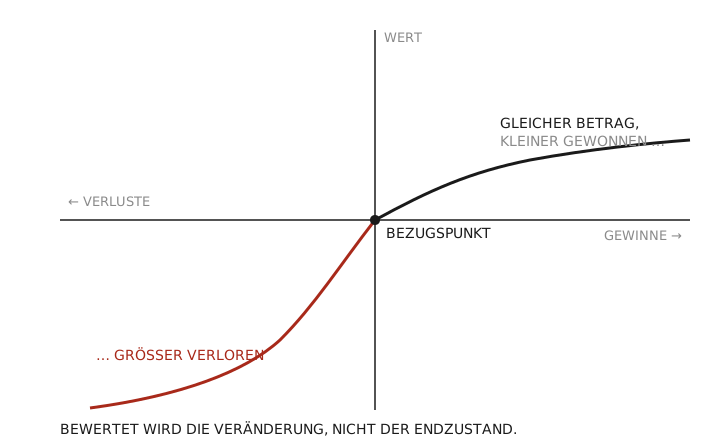
From the kink in the value function follows a pattern the theory sums up as a fourfold scheme: for gains of middling probability people are risk averse — they take the sure 450 over the fifty-fifty chance of 1,000. For losses of the same magnitude this reverses: given the choice between a sure loss of 900 and a ninety per cent chance of losing 1,000, the majority chooses the risk — the small hope of escaping altogether outweighs the threatened extra loss. And at small probabilities both turn once more: hope makes risk-seeking (the lottery ticket), fear makes risk averse (the policy). Four quadrants, one reference point, one curved weighting — the scheme needs no more to order betting shops, insurance markets and the behaviour of litigants in settlement negotiations.
From this follows the effect that made the theory famous. The same situation, framed once as a gain and once as a loss, leads to opposite decisions. In the Asian disease problem of 1981 the majority chooses the sure option when the talk is of people “saved,” and the risky one when the same numbers are phrased as “dying.” The arithmetic is identical. The answer is not. For a theory of rational choice this is the emergency: rationality requires at minimum that the description of a situation not reverse the decision.
The paper’s title, incidentally, was chosen to be meaningless with deliberation — “prospect theory” means nothing and was not supposed to: a distinctive label, by Kahneman’s later account, is more useful than a descriptive one in case the theory should ever become famous. That too was applied judgement psychology.
The reception turned the paper into a discipline. Richard Thaler, then a young economist with a private list of economic oddities, found in prospect theory the tool to order them — the endowment effect, demonstrated in the experiment with the coffee mugs whose owners priced them on average about twice as high as the buyers, became the textbook case: loss aversion in the shopping basket. From this connection grew behavioural economics and its political application, nudging; in 2002 Kahneman, a psychologist, received the Nobel Prize in economics, in 2017 Thaler. The theory itself Kahneman and Tversky refined in 1992 as cumulative prospect theory, with rank-dependent weighting — the version decision research computes with today.
In economics the reach of loss aversion could be measured against puzzles the standard theory had left open. Shlomo Benartzi and Thaler used it to explain the equity premium puzzle — the historically excessive return gap between stocks and bonds: whoever checks their portfolio yearly and weights losses double demands a premium for volatility that matches the century’s average. Terrance Odean found the disposition effect in the account data of retail investors: winners are sold too early, losers held too long — no one likes to realise a loss, even when tax logic demands the opposite. These are field proofs of a laboratory theory, and they belong to the reasons economics in the end gave the psychologist its prize.
The textbook version likes to equate all this with "people are irrational." Kahneman and Tversky claimed something more precise: the deviations are systematic and predictable. A random error would be no finding; a pattern is one. And they never claimed the patterns were stupid — an organism that weights losses double has rarely been wrong in evolutionary history.
The sharpest professional objection came not from economics but from psychology itself. Gerd Gigerenzer held against the programme that it counts deviations from a norm that is itself questionable: many of the reported errors disappear when probabilities are phrased as frequencies — “one in a hundred” instead of “the probability is one per cent” — and simple rules of thumb often do better in uncertain environments than elaborate calculations. Kahneman and Tversky replied that the shift produced by frequencies is limited and the basic patterns remain. The dispute was never formally settled; what has remained from it is a procedure Kahneman later advocated — expressly collaborating with one’s opponent on a jointly agreed experiment.
What stands today: the core findings, and well. The large replication study Many Labs 2 tested the framing pattern in 2018 on thousands of participants in dozens of countries and found it clearly confirmed; an international direct replication of the original 1979 problems reached the same result in 2020. Loss aversion, reference dependence and the weighting of small probabilities belong to the robust findings of the field. Not uncontested: since 2018 a professional debate has been running about the reach of loss aversion — for small amounts the effect disappears, and critics hold it narrower than the popular version claims. The file records the dispute as what it is: a drawing of boundaries, not a refutation.
Kahneman’s second research life applied the measuring logic of prospect theory to experience itself. In the cold-water experiments of the 1990s, subjects held a hand in painfully cold water once for sixty seconds and once for ninety — with the last thirty seconds minimally warmer. Asked which procedure they wished to repeat, the majority chose the longer one: the remembering self evaluates episodes by peak and end, not by duration. The peak-end rule and duration neglect were confirmed in outpatient procedures and grounded Kahneman’s late distinction between the experiencing and the remembering self — the same message as 1979, one level deeper: even looking back on one’s own life, a person does not compute linearly.
What does not stand concerns a later book and comes from the author himself. In Thinking, Fast and Slow Kahneman had rested a chapter on studies of social priming that did not survive the replication crisis. In 2017 he wrote publicly that he had placed too much faith in underpowered studies, and no longer considered the findings in question robust. It is one of the few corrections of this kind an author has made himself, in due form and under no compulsion — and it does not affect prospect theory. For an archive that keeps replication records, the gesture is itself a finding: this is what it looks like when the system that thinks slowly contradicts its own book.
Of the heuristics Kahneman and Tversky described in 1974, anchoring is the most uncomfortable, because it works even when you know about it.
The set-up was close to cheeky. Before an estimation question the two spun a wheel of fortune in front of the subjects that showed a number between 0 and 100. Then they asked: is the proportion of African states in the United Nations greater or smaller than this number? And after that: how large is it? The answers depended on the number on the wheel, although everyone had seen that it came up by chance.
The mechanism is not credulity. Someone asked to estimate looks for a starting point and adjusts from there — and the adjustment is regularly too small. The anchor need be neither credible nor relevant for this; it only has to have been there first.
Where this becomes practical is obvious once you look for it: the struck-through price next to the new one, the first number in a salary negotiation, the sum demanded in a statement of claim. In negotiation research the effect is one of the most reliable results there is. Knowing about it protects only so far — which is why the recommendation is not to ignore anchors but to set your own first.
Replication status: replicated.
The core findings of Prospect Theory have been confirmed in large, preregistered multi-lab studies. Many Labs 2 tested the framing pattern of the Asian disease problem, among others, in 2018 with thousands of participants across dozens of countries and found a clear, stable effect. Loss aversion and reference dependence are among the dependable results of decision research.
The status applies to the 1979 theory, not to every finding Kahneman later reported — see the self-correction below.
Primary sources:
- Kahneman, D., & Tversky, A. (1979). Prospect theory: An analysis of decision under risk. Econometrica, 47(2), 263–291. — Value function, reference point, probability weighting.
- Tversky, A., & Kahneman (1974). Judgment under uncertainty: Heuristics and biases. Science, 185(4157), 1124–1131. — Representativeness, availability, anchoring; the wheel-of-fortune experiment.
- Tversky, A., & Kahneman, D. (1981). The framing of decisions and the psychology of choice. Science, 211(4481), 453–458. — The Asian disease problem.
Replication:
- Klein, R. A., et al. (2018). Many Labs 2: Investigating variation in replicability across samples and settings. Advances in Methods and Practices in Psychological Science, 1(4), 443–490. — Confirms the framing pattern at scale; shows at the same time which other classic findings did not survive.
Self-correction:
- Kahneman, D. (2017). Open comment on priming research, published in the discussion of Schimmack, Heene & Kesavan, Reconstruction of a train wreck. — Kahneman states that he gave the underpowered priming studies in Thinking, Fast and Slow too much credence.
German-language:
- Kahneman, D. (2012). Schnelles Denken, langsames Denken. Siedler, Munich. — The popular account; chapter 4 is affected by the self-correction.