Topic 02
The Replication Crisis
BehaviorismCognitive PsychologySocial PsychologyClinic & Therapy
Since the 2010s the open question has been how many of psychology’s established findings survive repetition. In 2015 the Open Science Collaboration published an attempt to replicate 100 studies from three leading journals; in around a third of cases the originally significant result could be shown again, and the effect sizes came out considerably smaller on average.
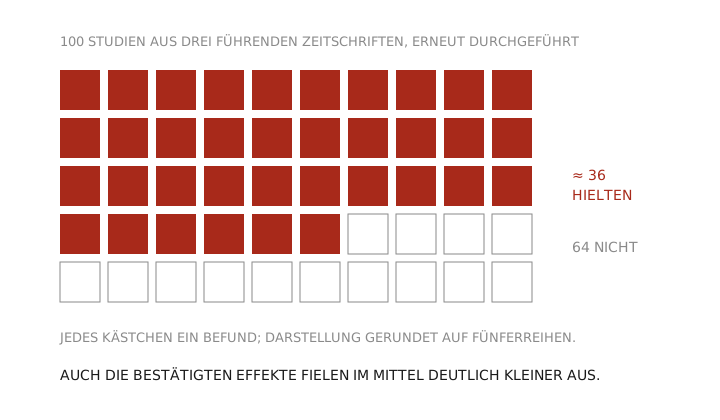
For an archive of psychology this is not a side issue but an organising principle: every file in this collection carries a replication status. The three social-psychology cases show the full range — from a robustly repeated paradigm through an arrangement only partly secured to a study whose foundation the archival work has taken apart.
The crisis is not a blow from outside but the result of a self-examination. It has a clearly nameable trigger: Daryl Bem’s 2011 paper, which concluded in a respected journal and with the usual methods that people can anticipate future events. The methods were standard, the result scientifically highly implausible — which raised the question of what else those methods can produce.
The diagnoses that followed concern incentives rather than the integrity of individual researchers. Underpowered samples, analyses with many open decisions, a publication practice that prints only significant results: each on its own is a small negligence, together they produce a literature in which too many findings look too good.
What has come of it belongs to the crisis as well. Preregistration, shared data, multi-lab studies with thousands of participants: Many Labs 2 tested twenty-eight classic findings across dozens of countries in 2018 and separated cleanly what holds from what does not. Kahneman’s Prospect Theory passed; a chapter of his own popular book did not, which he acknowledged publicly in 2017.
For this archive a rule follows from that, not a mood. A finding that has not been replicated is not thereby false, and one that has been replicated is not thereby true — it is merely better supported. The replication status on every file is a statement about the evidence, not a verdict on the person who produced the finding.
The Clinic and Therapy folder shows the same movement in a field rarely connected with it. Cognitive behavioural therapy is the best-studied talking treatment there is — and for that very reason it shows how strongly publication bias and study quality shift the balance: the effects of the early work were too large, the corrected ones are smaller and hold. Positive psychology, which comes from the same corner, has lost more heavily. And the reversal of learned helplessness by its own authors belongs in this chapter, because it shows what a self-correction looks like that was not forced by a crisis but by better methods.
Sheets on this theme
- Case file 004Iwan PawlowProfile
- Case file 004Iwan PawlowCase file
- Case file 004Iwan PawlowNote
- Case file 004Iwan PawlowEvidence
- Case file 005John B. WatsonProfile
- Case file 005John B. WatsonCase file
- Case file 005John B. WatsonNote
- Case file 005John B. WatsonEvidence
- Case file 006B. F. SkinnerProfile
- Case file 006B. F. SkinnerCase file
- Case file 006B. F. SkinnerNote
- Case file 006B. F. SkinnerEvidence
- Case file 007Ulric NeisserProfile
- Case file 007Ulric NeisserCase file
- Case file 007Ulric NeisserNote
- Case file 007Ulric NeisserEvidence
- Case file 008Daniel KahnemanProfile
- Case file 008Daniel KahnemanCase file
- Case file 008Daniel KahnemanNote
- Case file 008Daniel KahnemanEvidence
- Case file 009Elizabeth LoftusProfile
- Case file 009Elizabeth LoftusCase file
- Case file 009Elizabeth LoftusNote
- Case file 009Elizabeth LoftusEvidence
- Case file 032Amos TverskyProfile
- Case file 032Amos TverskyCase file
- Case file 032Amos TverskyNote
- Case file 032Amos TverskyEvidence
- Case file 010Stanley MilgramProfile
- Case file 010Stanley MilgramCase file
- Case file 010Stanley MilgramNote
- Case file 010Stanley MilgramEvidence
- Case file 011Solomon AschProfile
- Case file 011Solomon AschCase file
- Case file 011Solomon AschNote
- Case file 011Solomon AschEvidence
- Case file 012Philip ZimbardoProfile
- Case file 012Philip ZimbardoCase file
- Case file 012Philip ZimbardoNote
- Case file 012Philip ZimbardoEvidence
- Case file 029Aaron T. BeckProfile
- Case file 029Aaron T. BeckCase file
- Case file 029Aaron T. BeckNote
- Case file 029Aaron T. BeckEvidence
- Case file 030Albert EllisProfile
- Case file 030Albert EllisCase file
- Case file 030Albert EllisNote
- Case file 030Albert EllisEvidence
- Case file 031Martin SeligmanProfile
- Case file 031Martin SeligmanCase file
- Case file 031Martin SeligmanNote
- Case file 031Martin SeligmanEvidence
From the journal
- 1903Pavlov presents classical conditioningAfter pairing with food, a neutral stimulus triggers salivation on its own.Iwan Pawlow
- 1920Little Albert experimentAfter seven pairings, fear of the rat, generalised to similar things.John B. Watson
- 1938The Behavior of OrganismsVariable reinforcement produces the highest rates and the greatest resistance to extinction.B. F. Skinner
- 1951Asch's conformity experiments beginAbout 37 per cent of the critical judgments followed the false majority.Solomon Asch
- 1957Rational PsychotherapyThe ABC scheme appears in print — six years before Beck's first cognitive paper.Albert Ellis
- 1963Behavioral Study of Obedience26 of 40 — 65 per cent — went to the highest level of 450 volts.Stanley Milgram
- 1967Cognitive Psychology is publishedThe book gives a field its name and its order: processing in stages between stimulus and response.Ulric Neisser
- 1967Learned HelplessnessThree groups, the same shocks, one difference: control.Martin Seligman
- 1971Stanford Prison ExperimentStopped on day six of a planned fourteen; first release after about 36 hours.Philip Zimbardo
- 1974Misinformation effect demonstratedOne verb more than doubled the reported broken glass.Elizabeth Loftus
- 1974Heuristics and errors of judgmentTversky and Kahneman show how useful shortcuts can create systematic errors under uncertainty.Amos Tversky
- 1977Therapy Beats the Pill41 patients, twelve weeks — talking treatment holds up against imipramine.Aaron T. Beck
- 1979Prospect TheoryLosses weigh roughly twice as heavily as equal gains.Daniel Kahneman
- 1992Phantom FlashbulbsMean accuracy 2.95 of 7 — with confidence high throughout.Ulric Neisser
- 2011Bem publishes evidence for precognitionThe methods were standard, the result scientifically highly implausible.
- 2011Flourish appearsFrom happiness to flourishing: five components instead of one measure.Martin Seligman
- 2015Open Science Collaboration replicates 100 studiesAround a third of 100 studies could be shown again; effects came out considerably smaller on average.