Case file 010 · Social Psychology
Stanley Milgram

Fig. 1 — Public domain · Wikimedia Commons

Stanley Milgram was born on 15 August 1933 in New York City, the son of Jewish immigrants from Eastern Europe — the father a baker from Hungary, the mother from Romania, the family’s workshop a Bronx bakery. The world war that struck the relatives in Europe ran through his childhood as radio news and family dread; his biographer Thomas Blass preserves the speech the thirteen-year-old gave at his bar mitzvah in 1946, in which the boy linked his own coming of age to the fate of the European Jews. Whoever wishes may read the entire later work as a footnote to that speech; Milgram himself never disowned the connection.
He attended James Monroe High School in the Bronx — the same school as Philip Zimbardo, with whom he remained friends for life; the two classmates later became the two names on which the field declines its question of the situation. His first degree, at Queens College, was in political science; at that point he had taken no psychology at all.
For admission to the doctoral programme in social psychology at Harvard he had to make up the missing courses — the first application was rejected, and Milgram plugged the gap in a single summer with half a dozen introductory courses at three New York colleges. He took his doctorate in 1960 under Gordon Allport, with a piece of fieldwork that contained his later programme in miniature: a country comparison of conformity between Norway and France, measured with acoustic judgement tasks on the pattern of Asch. Formative was the work with Solomon Asch himself, whom he assisted at Harvard and later in Princeton: Asch’s conformity experiments supplied the experimental logic that Milgram transferred to obedience to authority — from the majority that errs to the one who commands.
From 1960 to 1963 he taught at Yale, where the obedience studies were made — conceived in the year of the Eichmann trial, run in twenty-four conditions with hundreds of citizens of New Haven. They made the man of not yet thirty world-famous and at the same time cost him the classical career: after returning to Harvard in 1963 he was denied tenure there in 1967 — the controversy over the ethics of his experiments counts as one reason; his admission to the American Psychological Association had already been delayed while complaints were examined. From 1967 he was professor at the Graduate Center of the City University of New York — a good address, but not the one he had been trained for, and Milgram knew it.
Milgram’s work is not exhausted by the obedience studies, and the second half is more inventive than the first. The small-world experiment of 1967 sent letters from Nebraska to Boston, to be passed on only through personal acquaintances — the chains that arrived needed on average about half a dozen stations, and from the finding came the formula of six degrees of separation, long before networks were a field. The lost-letter technique read political attitudes off addressed letters left lying; the study of the familiar stranger took the commuter platform as laboratory; the subway study, for which his students had to ask people for their seats, measured the cost of the smallest breach of rule — Milgram himself reported how hard the sentence was to get out. To these came mental maps of New York and Paris, a field experiment with specially produced television episodes on the effect of screen violence, and finally the cyranoid method, in which one person speaks with the words of another fed into their ear. He also made the teaching film Obedience (1965), which shows original footage of the experiments — and which is to this day what most people have seen when they believe they know the experiment.
Television, too, recognised the material: the CBS dramatisation The Tenth Level, with William Shatner as the Milgram figure, brought the obedience studies into the evening schedule in 1976 — the researcher advised the production and quarrelled with the result.
The style was part of the method: Milgram wrote essays as well as journal papers, photographed, composed stories for television, and treated the city as his real institute. The guild repaid him doubly — as the charge of wanting theory, and as lasting readability: Obedience to Authority (1974) is read as scarcely another monograph in the field, and The Individual in a Social World collects a body of fieldwork that did not exist before him.
He died on 20 December 1984, at 51, in New York, of his fifth heart attack — in the same city cosmos he had spent his life surveying. The tapes, questionnaires and films of the obedience series lie today in the Yale archives; that they carried, half a century on, the re-evaluation of his most famous study is the point that suits him: he had kept everything.
The question had a date before it had a design. In 1961 Adolf Eichmann sat before the court in Jerusalem, and the world argued over whether desk perpetrators are monsters or functionaries. Milgram, son of Jewish immigrants and fresh from assisting Solomon Asch, posed the trial’s question as a laboratory question: how far does an ordinary person go when a legitimate authority instructs them to harm another? Asch’s experimental logic — a single person against a prepared social pressure — was rebuilt for it: instead of a majority naming wrong lines, a single man in a grey technician’s coat saying the experiment requires it.
The study published in 1963 in the Journal of Abnormal and Social Psychology comprised 40 male participants between 20 and 50 from New Haven and its surroundings, recruited through newspaper advertisements and direct mail. They received 4.50 dollars — 4 dollars' compensation plus 50 cents' carfare — and expressly for showing up alone, regardless of what followed. The selection was deliberately ordinary: postal clerks, teachers, salesmen, engineers, labourers — no students, for the finding was not to hang on the special case of the campus.

The cover story ran that this was an investigation of the influence of punishment on learning. A rigged draw always made the subject the teacher; the role of the learner was taken by a confederate introduced as a 47-year-old accountant — friendly, stoutish, a heart condition mentioned in passing. The learner was strapped to an apparatus in the next room; the teacher received, for authentication, a sample shock of 45 volts — the only real electricity in the entire programme, administered to the one who afterwards believed he was distributing it.
The shock generator carried 30 switches from 15 to 450 volts in fifteen-volt steps, labelled from Slight Shock through Danger: Severe Shock to a wordless XXX. The device was a prop of craftsmanly perfection — buzz, needle swing, an engraved manufacturer’s plate — built to be believed. At every error of the learner the teacher was to move one step higher and to announce the voltage aloud before pressing: the procedure forced obedience to hear itself. In the baseline condition the learner could not be seen; at 300 volts he pounded on the wall, from 315 volts every response ceased.
If the teacher hesitated, the experimenter gave four standard prods in fixed order: Please continue, The experiment requires that you continue, It is absolutely essential that you continue, You have no other choice, you must go on. Only after the fourth futile prod was the session ended. Remarkable is what the authority did not do: it did not threaten, promised nothing, never raised its voice. The pressure consisted of a grey coat and the sentence that this is how it is done.
The result contradicted every prediction: 26 of the 40 participants — 65 per cent — went to the highest level of 450 volts. Not one broke off before 300 volts; five stopped at 300. Milgram had beforehand asked psychiatrists, students and middle-class adults to estimate how many would go to the end — the forecasts lay in the range of a pathological fraction of about one per cent. The profession had misjudged not the people but the power of the situation.
Equally part of the finding is what the numbers do not show: Milgram describes sweating, trembling, stuttering and nervous laughter up to outright seizures. Obedience here meant not indifference but extreme stress with continued compliance — people who protested, pleaded with the experimenter, raised the question of responsibility, and then pressed the next switch.
The 1963 study was only the opening of a series of more than twenty conditions with hundreds of participants in total, which Milgram summed up in 1974 in Obedience to Authority — and the variations are the truly analytic part. Move the victim closer and obedience fell: to about 40 per cent in the same room, to about 30 per cent when the learner’s hand had to be pressed onto the plate. Let the experimenter give his orders by telephone and the rate dropped to roughly a fifth — and some participants cheated with lower switches, obedient in appearance, disobedient in substance. Two rebelling peers cut obedience to a tenth; an ordinary man without the coat, giving the same orders, found hardly any following. In an office building in Bridgeport, without the Yale aura, still nearly half went to the end. Women obeyed as often as men. The finding was thus never “everyone obeys,” but: obedience is a control variable of the situation — nearness of the victim, nearness of the authority, unanimity of the surroundings.
Milgram’s own explanation, the agentic state — under authority a person switches into a mode of experiencing themselves as the instrument of another’s will and no longer attributes the act to themselves — has weathered time worse than his data: it does not explain why obedience responds so finely to nearness and unanimity, and counts today as a description rather than a mechanism.
The reception began as a quarrel over ethics. Diana Baumrind contested the design’s permissibility in the American Psychologist in 1964: one may not put people into a state in which they believe they have killed someone. Milgram defended himself with his follow-up surveys — the great majority said they did not regret taking part — but the argument that consent cannot heal a deception of this depth remained standing; the study became the second founding case of research ethics beside Little Albert, and the ethics committees that exist since would not approve it today.
The archival turn came half a century later, out of the holdings themselves. Gina Perry listened through the surviving tapes for Behind the Shock Machine (2012) and found an experimenter who pressed considerably more often and more freely than the script allowed — in some sessions the four standard sentences became long negotiations. She documented, further, that a substantial share of participants was fully debriefed only months later; some went home for a long time believing they had given electric shocks to a man with a heart condition. And the archival work sharpened a finding that had slumbered in Milgram’s own follow-up: those who believed the shocks were real obeyed less often. The reading of the series thus hangs also on what the participants really believed — and that can be answered from the files only incompletely.
Because the arrangement itself can no longer be approved, research has looked for substitute stages. In a version from 2006, participants sat before a virtual woman everyone knew to be made of software — and still responded with sweating, rising pulse and hesitation when asked to administer shocks to her; some broke off. A French television production rebuilt the arrangement in 2010 as a game show, with an audience and a host in the experimenter’s place, and arrived at obedience rates of the same order as Milgram’s. Strictly speaking neither remake tests the same question: one measures stress in the face of an obvious fiction, the other is not a controlled study but a television format. They do show, however, that the arrangement’s force does not depend on the deception about the pain.
What stands today is therefore more differentiated than either legend. Jerry Burger repeated a defused version in 2009 up to the 150-volt mark — the point at which the learner first demands release — and found rates close to the historical ones; a Polish replication of 2017 likewise. The behavioural findings of the basic design count as robust. What is being reinterpreted is the why: Alexander Haslam and Stephen Reicher read the tapes not as blind obedience but as engaged followership — participants obeyed insofar as they held the enterprise of science legitimate, and the fourth, harshest prod (“You have no other choice”) was, on the records, the least effective of all. It is not corpse-like obedience that carries the 65 per cent, but borrowed conviction. For the question of 1961 that is no all-clear — it is the more precise description of what bureaucracies do with people: they give them a reason.
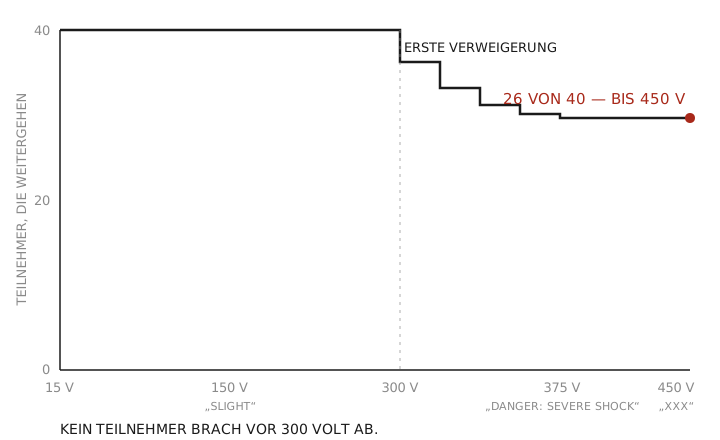
The figure of 65 per cent comes from one condition. Over the years Milgram ran some two dozen variations with roughly 780 participants in total, and the obedience rate varied considerably across them: it dropped sharply when the experimenter gave instructions only by telephone, when the study was run in a plain office rather than at Yale, or when two disobedient peers were present. Quoting only the 65 per cent leaves the situation out of the quotation.
The ethical criticism began immediately. In 1964, in the American Psychologist, Diana Baumrind accused Milgram of exposing his participants to lasting strain and of using the debriefing afterwards as a justification. The debate helped shape the development of today’s ethics committees.
Since 2012 methodological criticism has come from the archive as well. For Behind the Shock Machine, Gina Perry worked through the Yale holdings and documented that the experimenter, John Williams, frequently departed from the four standard prods and improvised, at times with considerably more pressure than the protocol allowed. Stephen Gibson reached similar findings analysing the tapes.
How many participants believed the shocks were real at all remains disputed. Milgram surveyed this after the fact by questionnaire; Perry’s analysis suggests a far higher proportion of doubters than the published figures.
The interpretation itself is also contested. Alexander Haslam and Stephen Reicher read the findings not as blind obedience but as engaged followership: participants continued because they identified with the scientific goal — the fourth prod, the one phrased as an order, most often produced refusal rather than compliance.
What none of this touches: that ordinary people under institutional pressure go far beyond their own self-assessment is the robust core.
What is disputed is the mechanism, not the effect.
Replication status: partial.
A full repetition is not permissible under today’s ethical standards. Jerry Burger solved this in 2009 with the 150-volt solution: since in Milgram’s data virtually everyone who passed the 150-volt mark also went on to 450 volts, Burger stopped immediately after that step and extrapolated.
Burger’s sample comprised 70 people (29 men, 41 women) aged 20 to 81, with a two-stage screening and the exclusion of anyone with a background in psychology. 70 per cent continued past 150 volts, against 82.5 per cent in Milgram’s comparable condition — the difference was not statistically significant. The basic finding therefore held, in attenuated and methodologically restricted form.
Why not replicated: Burger measures a stretch of the route, not an end point. The extrapolation to 450 volts rests on Milgram’s own data, not on new observation. Added to this are the archival findings on how faithfully the original experimenter followed the protocol, which blur the basis of comparison itself.
Primary sources:
- Milgram, S. (1963). Behavioral Study of Obedience. Journal of Abnormal and Social Psychology, 67(4), 371–378.
- Milgram, S. (1974). Obedience to Authority: An Experimental View. Harper & Row.
Replication and criticism:
- Burger, J. M. (2009). Replicating Milgram: Would People Still Obey Today? American Psychologist, 64(1), 1–11.
- Baumrind, D. (1964). Some thoughts on ethics of research. American Psychologist, 19(6), 421–423.
- Perry, G. (2012). Behind the Shock Machine. Scribe.
- Haslam, S. A., & Reicher, S. D. (2012). Contesting the “Nature” of Conformity. PLoS Biology, 10(11), e1001426.