Topic 01
Obedience and Authority
PsychoanalysisSocial PsychologyLearning & Personality
How participation becomes a matter of course the Learning and Personality folder explains from a third side. Festinger’s dissonance predicts that one draws one’s conviction after what one has already done — whoever has pressed the first switch finds reasons for the second. And Bandura’s moral disengagement names the manoeuvres by which decent people get responsibility off their hands: rename, distribute, minimise, dehumanise. Neither line explains the beginning of obedience, but its continuation.
Obedience and conformity look like the same thing and are not. With Solomon Asch a unanimous group names an obviously wrong answer, and nobody asks the participant to join in — the pressure comes from everyone else agreeing. With Stanley Milgram a single person in a coat sits alongside and says the experiment requires you to continue. There, a majority acts; here, a claim to authority.
Psychoanalysis had a different language for the same ground. Anna Freud’s identification with the aggressor describes how suffering a threat turns into taking on the threatening role — no order, no majority, but a shift inside. Three approaches, three vocabularies, one subject.
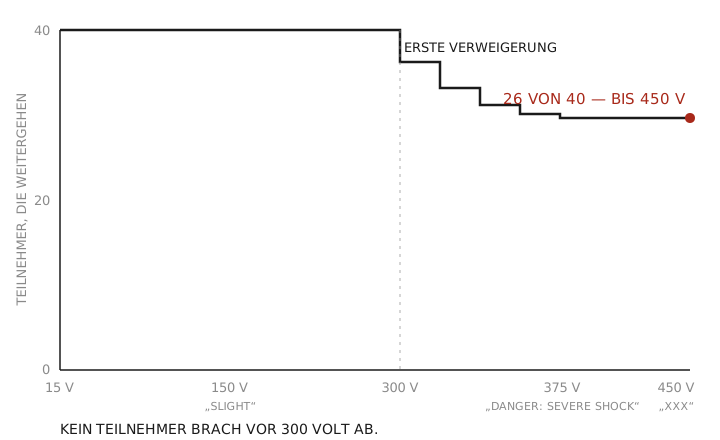
What links the experimental files under this topic is their reception. Both are routinely cited as evidence that people are easily moulded. Both authors claimed something more precise: Asch stressed that two thirds of all critical answers stayed correct, and with Milgram it was the most order-like prod that most often ended the session.
The third file under this topic is the one the reception has got wrong most thoroughly. The Stanford Prison Experiment of 1971 has no control group, no standardised measurement, and an experimenter who was at the same time the prison superintendent. Thibault Le Texier’s archival work of 2018 established from Zimbardo’s own papers that guards were coached to act tough — which removes the basis for the reading that the roles alone produced the behaviour.
What remains of the three files is not a lesson about malleability but a more precise question: what exactly is it that makes people do what they believe to be wrong? Asch’s answer is unanimity — a single dissenting ally was enough to cut conformity sharply. Milgram’s answer is proximity: across eight variations obedience fell as soon as the victim was visible or the experimenter absent. Both answers name a condition, not a trait.
For practice something else follows than the sentence that anyone can become a perpetrator. What follows is that conditions can be arranged: a dissenting voice in the room, a visible consequence, an authority who is not present. It is precisely these quantities that have stayed stable across the replications of the last twenty years, while the dramatic overall readings have not.
Sheets on this theme
- Case file 001Sigmund FreudProfile
- Case file 001Sigmund FreudCase file
- Case file 001Sigmund FreudNote
- Case file 001Sigmund FreudEvidence
- Case file 002Carl Gustav JungProfile
- Case file 002Carl Gustav JungCase file
- Case file 002Carl Gustav JungNote
- Case file 002Carl Gustav JungEvidence
- Case file 003Anna FreudProfile
- Case file 003Anna FreudCase file
- Case file 003Anna FreudNote
- Case file 003Anna FreudEvidence
- Case file 016Melanie KleinProfile
- Case file 016Melanie KleinCase file
- Case file 016Melanie KleinNote
- Case file 016Melanie KleinEvidence
- Case file 033Karen HorneyProfile
- Case file 033Karen HorneyCase file
- Case file 033Karen HorneyNote
- Case file 033Karen HorneyEvidence
- Case file 010Stanley MilgramProfile
- Case file 010Stanley MilgramCase file
- Case file 010Stanley MilgramNote
- Case file 010Stanley MilgramEvidence
- Case file 011Solomon AschProfile
- Case file 011Solomon AschCase file
- Case file 011Solomon AschNote
- Case file 011Solomon AschEvidence
- Case file 012Philip ZimbardoProfile
- Case file 012Philip ZimbardoCase file
- Case file 012Philip ZimbardoNote
- Case file 012Philip ZimbardoEvidence
- Case file 026Gordon AllportProfile
- Case file 026Gordon AllportCase file
- Case file 026Gordon AllportNote
- Case file 026Gordon AllportEvidence
- Case file 027Leon FestingerProfile
- Case file 027Leon FestingerCase file
- Case file 027Leon FestingerNote
- Case file 027Leon FestingerEvidence
- Case file 028Albert BanduraProfile
- Case file 028Albert BanduraCase file
- Case file 028Albert BanduraNote
- Case file 028Albert BanduraEvidence
From the journal
- 1900The Interpretation of Dreams is publishedEvery dream fulfils a wish in disguise, shaped by the dream-work.Sigmund Freud
- 1906Studies in Word AssociationAt the Burghölzli the hesitation before a stimulus word is measured — the spot is called a complex.Carl Gustav Jung
- 1932The Psycho-Analysis of ChildrenA child's play as the equivalent of free association.Melanie Klein
- 1936The dictionary study appears18,000 words from the lexicon — the raw material from which the five factors came.Gordon Allport
- 1936The Ego and the Mechanisms of DefenceThe ego's defences, ordered into a catalogue that is still professional vocabulary.Anna Freud
- 1945Toward, against, or awayKaren Horney describes neurotic conflict as rigid movement toward people, against them, or away from them.Karen Horney
- 1951Asch's conformity experiments beginAbout 37 per cent of the critical judgments followed the false majority.Solomon Asch
- 1959One dollar and twentyWhoever lied for a dollar believed it afterwards — the weaker justification works the stronger.Leon Festinger
- 1961The Bobo doll experimentChildren struck the doll in the model's own movements — learned by watching alone.Albert Bandura
- 1963Behavioral Study of Obedience26 of 40 — 65 per cent — went to the highest level of 450 volts.Stanley Milgram
- 1971Stanford Prison ExperimentStopped on day six of a planned fourteen; first release after about 36 hours.Philip Zimbardo
- 2011Bem publishes evidence for precognitionThe methods were standard, the result scientifically highly implausible.
- 2015Open Science Collaboration replicates 100 studiesAround a third of 100 studies could be shown again; effects came out considerably smaller on average.