Case file 002 · Psychoanalysis
Carl Gustav Jung
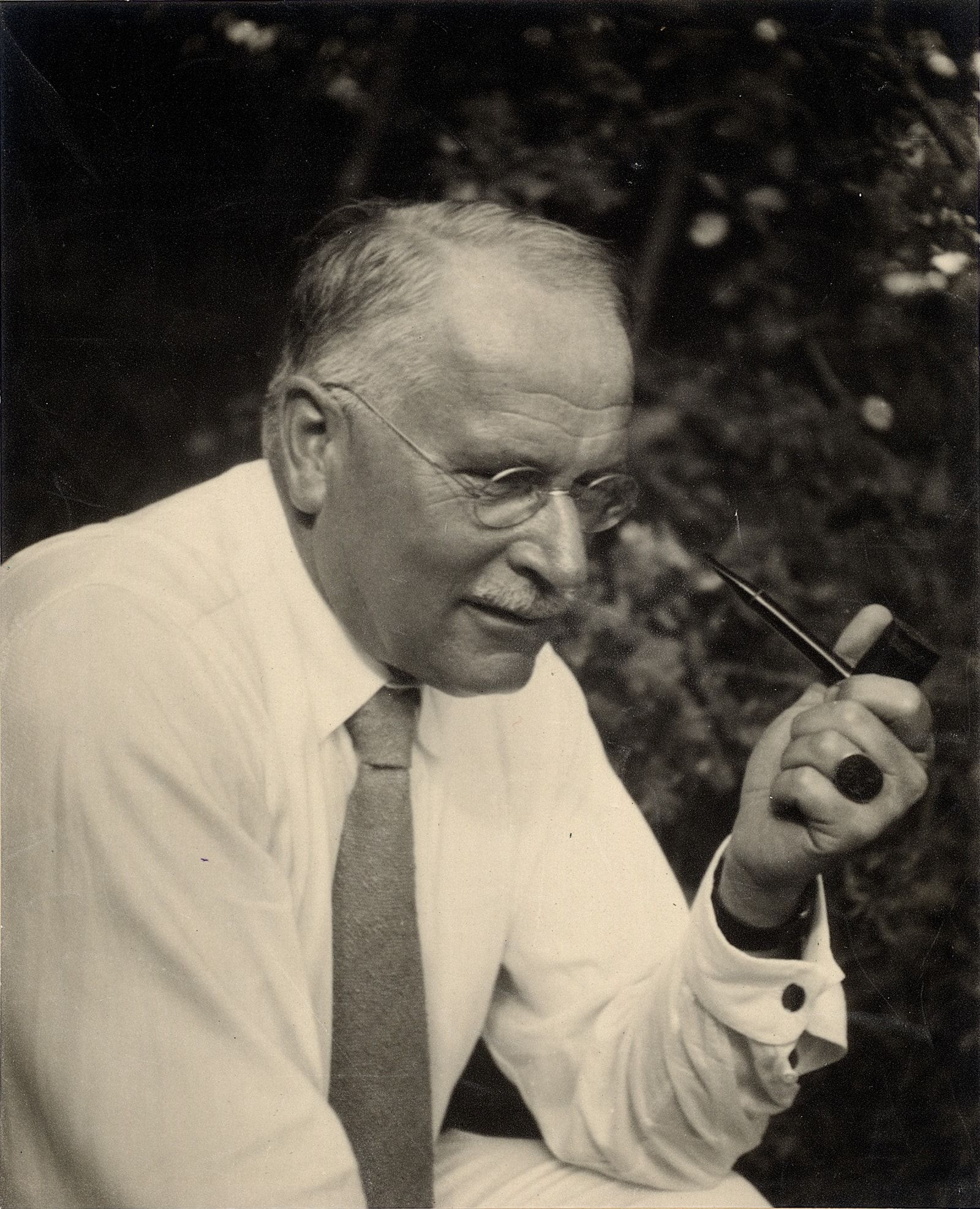
Fig. 1 — PDM-owner · Wikimedia Commons
At the Burghölzli in Zurich, around 1905, a patient sat before a stopwatch, instructed to answer each of a hundred words read aloud with the first thing that came to mind. Carl Gustav Jung measured how long he hesitated. Where the answer faltered, where it repeated itself, where the pulse rose, he suspected a complex — a feeling-toned cluster of ideas withdrawn from conscious control. It was psychoanalysis with a watch in its hand.
Jung was born on 26 July 1875 in Kesswil in the Thurgau, the son of a Reformed pastor, and grew up in parsonages by the Rhine Falls and near Basel — a solitary child who, as he reports in his memoirs, carved himself a little manikin of wood and hid it in a pencil case in the attic, together with inscribed pebbles: his first, private ritual. That he still thought this episode worth telling seventy years later says much about the work — the conviction that the psyche produces symbols of its own accord has, in his case, a childhood date.
He studied medicine in Basel and in 1900 joined Eugen Bleuler’s Burghölzli clinic in Zurich as an assistant physician — at the time one of the few asylums that did not merely house psychoses but studied them. In 1903 he married Emma Rauschenbach, daughter of an industrialist; the marriage made him financially independent, which is not incidental to the shape of his career — Jung could afford to give up positions.
The Diagnostic Association Studies he carried out there from 1904 with Franz Riklin made him internationally known. They were also the bridge to Freud: Jung saw in the delayed reactions a measurable proof of repression. In 1907 the two met in Vienna and talked, according to the traditional account, for thirteen hours straight. Freud saw in the man sixteen years his junior the crown prince of the movement — and the proof that psychoanalysis was not an exclusively Jewish science, a calculation spelled out bluntly in both men’s letters. In 1909 they travelled together to the Clark University lectures in America; in 1910 Jung became the first president of the International Psychoanalytical Association.
Six years later the bond was broken. Over what exactly, the sources diverge — the profile names the versions, the case file weighs them. In 1912 Jung published Transformations and Symbols of the Libido, which de-sexualised the concept of libido; in 1913 the correspondence ended with Freud’s proposal to abandon personal relations entirely; in 1914 Jung resigned the presidency of the Association and gave up his lectureship in Zurich.
There followed a period he himself called his confrontation with the unconscious: years of crisis in which he recorded visions and inner voices, transferred them in ink and gold leaf into a leather-bound folio, and built towers of stones in his garden. The Red Book was published only in 2009, almost fifty years after his death, and changed the picture of those years: what some read as a controlled self-experiment, others read as a documented psychosis. From this phase come the concepts he stands for today — archetype, collective unconscious, individuation — and the tower at Bollingen on the upper lake of Zurich, which he extended with his own hands over decades, without electricity or running water, as the built counterpart of the theory.
Psychological Types appeared in 1921. Jung built up a practice in Küsnacht that lasted until his death, taught at the ETH Zurich from 1933, and travelled to East Africa, India and the Pueblo peoples of New Mexico — expeditions he understood as fieldwork on the collective unconscious. In 1944, after a heart attack, he recorded weeks of visions that he counted among the decisive experiences of his life; the late work — the alchemy studies, the idea of synchronicity developed with the physicist Wolfgang Pauli — cannot be understood without this closeness to his own borderland. In 1948 the C. G. Jung Institute was founded in Zurich; analytical psychology now had its own school.
His role in the years after 1933 — presidency of an internationally reorganised medical society, statements about an “Aryan” and a “Jewish” psychology — remains the subject of its own unfinished debate, and the file leaves it expressly open: there are the incriminating texts, there are the protective explanations, there are Jewish students who defended him, and historians who consider all of this compatible.
In 1959 a BBC interviewer asked whether he believed in God. Jung’s answer — he did not need to believe, he knew — became his most quoted sentence and is as double-edged as the work. He died on 6 June 1961 in Küsnacht on the lake of Zurich, a few days after finishing his last manuscript: the opening essay of a book meant to explain the unconscious to a lay audience.
The question behind Psychological Types of 1921 grew out of a quarrel. Jung wanted to explain why intelligent people interpret the same facts in irreconcilable ways — and he had a fresh example: his own break with Freud, and Freud’s with Alfred Adler. Both times the struggle had been over the same patients, the same cases, the same literature, and both times two systems stood at the end that no longer even understood one another. If theories depend on the temperament of their authors, Jung thought, then psychology first needs a theory of temperament. The suspicion was aimed at himself too: the doctrine of types is the book of a man trying to grasp why he could not remain a Freudian.
He wrote at it for nearly a decade, in the years after the break that he himself called his confrontation with the unconscious. The result is not a laboratory report but a walk through intellectual history: Tertullian against Origen in the history of the church, nominalists against realists in scholasticism, Schiller’s naive against his sentimental poetry, Nietzsche’s Apollonian against his Dionysian. Everywhere Jung found the same pair — two basic postures that talk past each other because their energy flows in opposite directions.
His construction has two storeys. First the basic attitude: introversion or extraversion, depending on whether the energy flows toward the subject or the object. Above it four functions — thinking, feeling, sensation, intuition — one of which dominates while its counter-function is pushed into the unconscious. The combinations yield eight types. The terms introversion and extraversion, everyday language today, entered psychology at this point; hardly any technical term of the twentieth century has had a steeper career.
Jung presented the first public version of the idea at the Munich Psychoanalytic Congress of 1913 — the same meeting at which he encountered Freud for the last time. Then the model knew only the two attitudes, and Jung still assigned them to the camps of the quarrel: hysteria extraverted, Freud’s view; dementia praecox introverted, his own. The full-grown system of 1921 quietly corrected and refined that assignment — among other things by the rule that beside the dominant function a second works as auxiliary, from which the later testing industry derived its letter combinations. The book reached English in 1923 in H. G. Baynes’s translation; it is through that edition that the doctrine of types began its real world career.
There was no sample, no scale and no statistics. The material was case observation, literary history and the history of philosophy. What Jung delivered was an ordering of concepts, not a measuring instrument. He said so himself — the types were points of orientation like the marks of a compass, not a set of pigeonholes to sort people into — and this warning shared the fate of all warnings in prefaces.
Jung did measure, though — only earlier, and something else: the association studies of his Burghölzli years worked with stopwatch, word lists and galvanic skin response, and it is one of the ironies of this file that the author of the unmeasurable book of types was the first psychoanalyst with a laboratory instrument.
Others made it a measuring instrument. Katharine Cook Briggs had read Jung’s book in the English translation of 1923 and recognised in it her own, privately developed system for ordering characters. Together with her daughter Isabel Briggs Myers — neither with any training in psychology, a fact the reception long kept quiet — she built the Myers-Briggs Type Indicator out of Jung’s categories from the 1940s onward. The questionnaire added a fourth pair of opposites to Jung’s three and has sorted every person into one of sixteen letter-types ever since. It became one of the world’s best-selling personality instruments, standard inventory of HR departments, career counselling and management seminars. Jung himself had no part in it.
Against this translation one can test what in the construction bears weight. And the result falls into two parts.
The dimension held — more thoroughly than Jung could have known. Hans Eysenck made extraversion a measurable axis of his personality model from the 1940s and sought it a physiology: introverts, ran his arousal thesis, are more strongly aroused from within and therefore avoid additional stimulation — a hypothesis that has not held up consistently in this simple form, but which carried the axis definitively out of the art of interpretation and into laboratory measurement. In the lexical tradition, which distilled the structure of personality out of thousands of trait words, the same axis surfaced again; and in today’s five-factor model, extraversion is one of the five robust factors, reproduced in factor analyses across languages and cultures, with evidence of heritability and stability over decades. Jung had seen the axis correctly — described as a continuum, it would have withstood every test. Even for the densely populated middle of the distribution, which his grid does not provide for, later research found a word he would probably have allowed as a punchline: the ambivert.
The type did not hold. In population samples, personality traits distribute unimodally, not bimodally — there are no two clusters of introverts and extraverts with a gap between them, but a continuum whose middle is the most densely populated. Whoever cuts a questionnaire through the middle of such a distribution divides people who are more similar to each other than to their own groups. Exactly that shows up on retest: a substantial share of test takers is assigned a different type within a few weeks, without anything about them having changed. The methodological literature has demonstrated this repeatedly since the 1990s; it has changed little about the procedure’s spread, because the type has what the continuum lacks — it tells a story, and it offends no one. Sixteen ways of being fine.
The web then gave the procedure a second life larger than its first. Online descendants of the type logic — above all the sixteen-type tests that dress Jung’s letters in friendly role names like “Advocate” or “Logician” — are taken millions of times a year, and the four letters have become, in dating profiles and application guides, a kind of star sign with a scientific finish. The testing industry appeals to a “type dynamics” of dominant and subordinate functions that is genuinely laid out in Jung’s book — but for which, a century on, no empirical evidence exists either. It is the strangest turn of this file: the more thoroughly research discarded the grid, the further it spread.
Why the descriptions feel so apt has been investigated by psychology itself — on a neighbouring case from astrology. In 1948 Bertram Forer gave students a supposedly personal personality analysis he had assembled from an astrology booklet; all received the same text, and almost all held it to be accurate. Sentences that fit everyone and sound like a finding are experienced as individual insight. The type profiles work with the same material: they are generally phrased, benevolent throughout, and leave the matching to the reader. That explains why a procedure without retest reliability has satisfied users — the confirmation comes not from the test but from the reading.
For the archive the case thus has a rare clarity: it shows that the same observation can be confirmed and refuted at once, depending on the form in which it is tested. The reception turned an ordering of concepts into a business model and the continuum into a grid; research discarded the grid and kept the continuum. Both cite the same book.
There remains the problem the doctrine of types carried with it from the start, and which Jung treated more openly than his later users: the describer of the types is one himself. Asked, Jung counted himself among the introverted thinking type — and whoever reads his book with that disclosure in mind recognises the hand: in it, the introverts are the misunderstood, the extraverts the ones who came out too loud. A theory of temperament written from within a temperament cannot subtract its own origin. That is no refutation; it is the reminder of why the field later insisted on procedures that remove the author from the measurement.
The textbook version says Jung invented the personality types. More precise is: he described a load-bearing dimension and cast it in a form that cannot carry it — and the warning he supplied is the most thoroughly ignored part of the book.
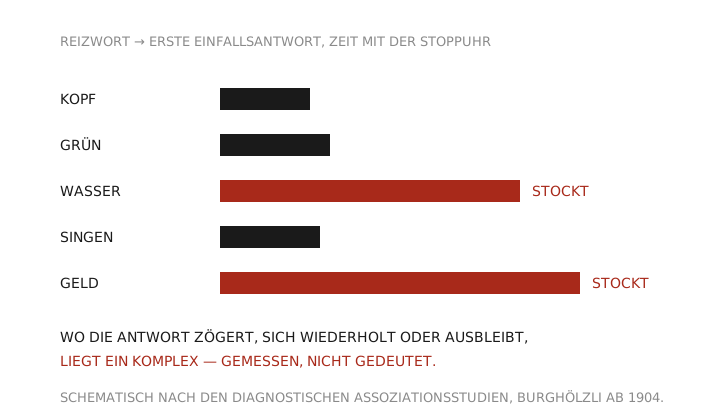
The word complex comes from Jung, not Freud — and it is the only one of his terms to have emerged from a measuring procedure. At the Burghölzli he read stimulus words to subjects and timed the response. For most words it came after barely two seconds. For some the person hesitated, stumbled, repeated the stimulus word or did not answer at all.
Jung’s conclusion: around certain themes, ideas group themselves with a strong feeling tone, and these groups behave like small part-personalities. They cannot be switched off at will, they colour perception, and they announce themselves physically — Jung later coupled the procedure to a galvanometer and measured skin conductance alongside. The complex was thus not a mere postulate but something that made a needle move.
From there a straight line runs to the present, if under another name. The word association experiment is a forerunner of every procedure that infers inner states from reaction times — up to the Implicit Association Test, used in prejudice research since 1998 and resting on the same basic assumption: that the delay reveals more than the answer. Its informativeness is contested too. The idea of measuring hesitation is over a hundred years old and still not settled.
Replication status: partially replicated.
The status separates the two halves of the construction. The introversion– extraversion axis has been found again and again independently of Jung and stands today as Extraversion in the five-factor model. The division into types is not confirmed: personality traits are distributed unimodally, and assignment to a type is not stable over time.
On the break with Freud the sources are equivocal, and that belongs in the file. Three accounts stand side by side: the theoretical dissent over libido, which Jung set out in 1912 in Wandlungen und Symbole der Libido; the institutional conflict over leadership of the psychoanalytic movement; and the personal level, in which Jung’s relationship with his patient Sabina Spielrein and both men’s handling of it play a part. The published correspondence clearly supports the first two, the third only as a side strand. Anyone telling one of the three as the cause is simplifying.
Primary work:
- Jung, C. G. (1921). Psychologische Typen. Rascher, Zurich. — The basic attitudes and the four functions.
- Jung, C. G., & Riklin, F. (1906). Diagnostische Assoziationsstudien. Barth, Leipzig. — The word association experiment; the empirical part of the work.
- Jung, C. G. (2009). The Red Book — Liber Novus. Norton. — The years after the break, accessible for the first time.
Testing the typology:
- McCrae, R. R., & Costa, P. T. (1989). Reinterpreting the Myers-Briggs Type Indicator from the perspective of the five-factor model of personality. Journal of Personality, 57(1), 17–40. — Shows both: that the scales correlate with established factors and that the type division has no empirical basis.
- Pittenger, D. J. (1993). Measuring the MBTI… and coming up short. Journal of Career Planning and Employment, 54(1), 48–52. — The compact account of retest stability.
On the break:
- McGuire, W. (Ed.) (1974). The Freud/Jung Letters. Princeton University Press. — The primary source, in which the break can be followed letter by letter.
- Bair, D. (2003). Jung: A Biography. Little, Brown. — Comprehensive biography; also places Jung’s role after 1933.
Overview: https://en.wikipedia.org/wiki/Carl_Jung