Topic 07
Development and Attachment
PsychoanalysisDevelopment
No question in this archive has come a longer way than what early experience makes of a person. At the start stood a doctrine that reasoned backwards from the consulting room: what the adult on the couch recounts betrays what must have happened to the child. At the end stand coding systems, longitudinal studies spanning decades and a twenty-minute laboratory procedure. The road between runs through war, theft and a break with one’s own school.
The first systematic observation was delivered, of all things, by catastrophe. Anna Freud’s war nurseries in London — index card by index card, child by child — recorded that it was not the bombs that marked the children but the separation from the mother: children who sat in the shelters with their families fared better than the evacuated ones. The well-meant rescue proved the greater burden. It was the first research on separation, conducted in an institution that would not have existed without the separations.
John Bowlby turned the finding into a theory and paid for it with his guild. His thieves study counted what analysis interpreted; his WHO report carried the separation question around the world; and he fetched his explanation not from Freud but from Lorenz and Tinbergen — attachment as a biological system, not a by-product of drives. The British Psycho-Analytical Society treated him thereafter as a renegade. Robertson’s hospital film of 1952, a clock in the picture against the suspicion of selective editing, in the end opened the children’s wards to parents — the most consequential application of this theme.
The theory became testable through an observer. Mary Ainsworth sat in living rooms, first in Uganda, then in Baltimore, and out of hundreds of hours of observation developed the Strange Situation: eight episodes, twenty minutes, classification by behaviour at the reunion. Her coding discipline — weeks of training, drift checks — made the procedure a world standard and its studies at once expensive and small. The categories are strategies, not diagnoses: the avoidant child, too, has learned something sensible.
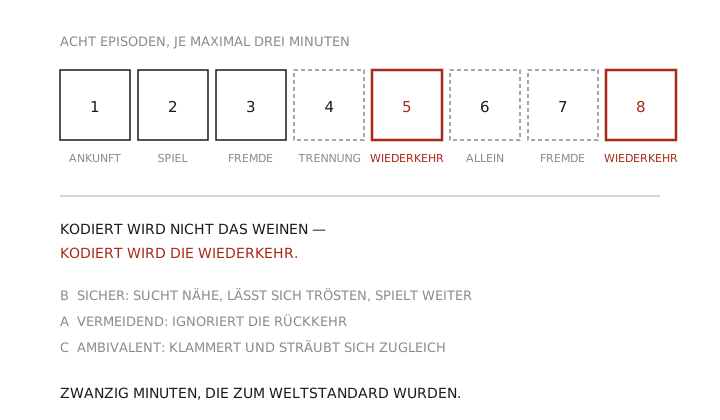
The corrections came and struck the strong versions. Michael Rutter took monotropy apart and separated separation from deprivation; the Romanian orphans after 1989 became the test nobody had planned — with catch-up curves that show how much can be recovered and where the limits lie. And the paperback edition of the WHO report, deployed for decades against mothers in paid work, belongs to the history of effect as much as the findings do: reach has its price.
What remains is a layered balance. Early experience shifts probabilities and seals no fates; sensitivity can be fostered, with small, real effects; the predictive power of the early classification is genuine and modest. Between the dark infant of Kleinian theory and the measurable child of attachment research lies the road of this theme — from interpretation to observation, without the question having grown any smaller.
Sheets on this theme
- Case file 001Sigmund FreudProfile
- Case file 001Sigmund FreudCase file
- Case file 001Sigmund FreudNote
- Case file 001Sigmund FreudEvidence
- Case file 002Carl Gustav JungProfile
- Case file 002Carl Gustav JungCase file
- Case file 002Carl Gustav JungNote
- Case file 002Carl Gustav JungEvidence
- Case file 003Anna FreudProfile
- Case file 003Anna FreudCase file
- Case file 003Anna FreudNote
- Case file 003Anna FreudEvidence
- Case file 016Melanie KleinProfile
- Case file 016Melanie KleinCase file
- Case file 016Melanie KleinNote
- Case file 016Melanie KleinEvidence
- Case file 033Karen HorneyProfile
- Case file 033Karen HorneyCase file
- Case file 033Karen HorneyNote
- Case file 033Karen HorneyEvidence
- Case file 023Jean PiagetProfile
- Case file 023Jean PiagetCase file
- Case file 023Jean PiagetNote
- Case file 023Jean PiagetEvidence
- Case file 024John BowlbyProfile
- Case file 024John BowlbyCase file
- Case file 024John BowlbyNote
- Case file 024John BowlbyEvidence
- Case file 025Mary AinsworthProfile
- Case file 025Mary AinsworthCase file
- Case file 025Mary AinsworthNote
- Case file 025Mary AinsworthEvidence
- Case file 034Eleanor J. GibsonProfile
- Case file 034Eleanor J. GibsonCase file
- Case file 034Eleanor J. GibsonNote
- Case file 034Eleanor J. GibsonEvidence
From the journal
- 1900The Interpretation of Dreams is publishedEvery dream fulfils a wish in disguise, shaped by the dream-work.Sigmund Freud
- 1906Studies in Word AssociationAt the Burghölzli the hesitation before a stimulus word is measured — the spot is called a complex.Carl Gustav Jung
- 1932The Psycho-Analysis of ChildrenA child's play as the equivalent of free association.Melanie Klein
- 1936The Ego and the Mechanisms of DefenceThe ego's defences, ordered into a catalogue that is still professional vocabulary.Anna Freud
- 1936The Origins of Intelligence in ChildrenThree children, one cloth, six stages — object permanence becomes observable.Jean Piaget
- 1944Forty-four juvenile thievesAmong the affectionless thieves, early and lengthy separations clustered.John Bowlby
- 1945Toward, against, or awayKaren Horney describes neurotic conflict as rigid movement toward people, against them, or away from them.Karen Horney
- 1960The visual cliffEleanor Gibson and Richard Walk make depth perception testable without any risk of falling.Eleanor J. Gibson
- 1969Attachment appearsThe first volume of the trilogy — attachment as a biological system, not a by-product of drives.John Bowlby
- 1978Patterns of Attachment appearsTwenty minutes of laboratory, three patterns — and the key lies in the reunion.Mary Ainsworth