Case file 024 · Development
John Bowlby
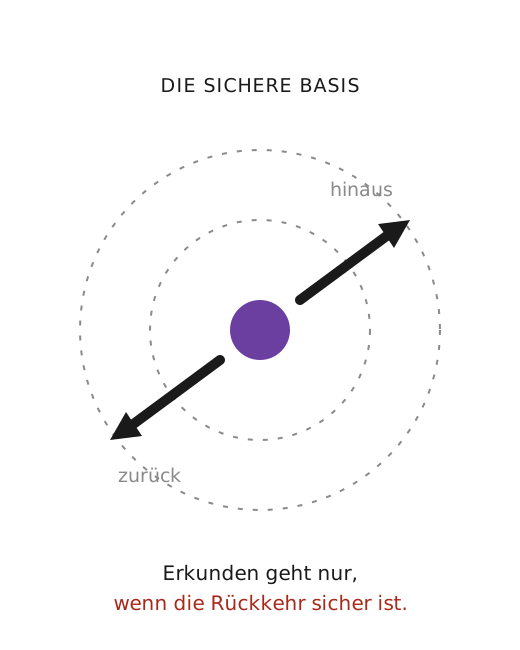
Fig. 1 — Drawing by the archive · free to use
The child who invented attachment theory was raised by the rules of his class: a nanny instead of a mother, one hour of parental contact a day, boarding school at seven. When his beloved nanny Minnie left the family, John Bowlby was four — he later described the loss as as painful as that of a mother, and his biographers read the work as a lifelong investigation of his own childhood by scientific means. The file records the reading as what it is: obvious, unprovable, and never disputed by Bowlby himself.
Bowlby was born on 26 February 1907 in London, the fourth of six children of the surgeon Sir Anthony Bowlby, physician to the royal household. He first studied psychology and natural sciences at Cambridge, then worked for a year in a progressive school for difficult children — the experience that, by his own account, put him on the track: two boys there, one indiscriminately affectionate and one affectionless, both had torn family histories. Medicine at University College Hospital followed, psychiatric training at the Maudsley, and analytic training — with Melanie Klein as supervisor and a falling-out that became programme: when Bowlby wanted to involve the ill mother of a child patient in the treatment, Kleinian doctrine informed him that the real mother was not the object. For Bowlby she was precisely that.
From 1936 he worked at the London Child Guidance Clinic, where the material of the thieves study arose; the war he spent as an army psychiatrist on officer selection — statistics he learned there. In 1946 he went to the Tavistock Clinic, built up the department for children and parents and renamed it programmatically: Department for Children and Parents. There began the collaboration that links this series of folders — James Robertson, coming from Anna Freud’s war nurseries, filmed for Bowlby the separation reactions of small children in hospital, and the WHO report Maternal Care and Mental Health of 1951 made the finding official worldwide: the small child needs a warm, continuous relationship, and its destruction has consequences like a vitamin deficiency of the soul. The report was translated into dozens of languages, changed visiting regulations and institutional practice — and drew the criticism Bowlby never quite shook off: that a warning about separation could be, and was, turned into an argument for mothers at the stove.
The theory meant to explain the finding Bowlby fetched from outside psychoanalysis. Through Julian Huxley he came to Lorenz’s greylag geese and Tinbergen’s methodology; Harlow’s wire-mother monkeys supplied the laboratory piece. Attachment, ran the synthesis, is no secondary drive derived from feeding but a behavioural system of its own, evolutionarily built — seek proximity in danger, explore from the secure base, with internal working models as the deposit of experience. Psychoanalysis did not thank him for it: the lectures in which he presented the theory to the British Society from 1957 met closed rejection — Anna Freud and the Kleinians united as rarely — and Bowlby became a stranger in his own house. He answered with the trilogy: Attachment (1969), Separation (1973), Loss (1980), three thousand pages of persistence.
The break with his own guild had an institutional side that is rarely told: Bowlby remained a member of the British Psychoanalytical Society, served for a time as its training secretary and kept the connection while his theory counted there as treason. He later called the dispute tiring and went on working — the stance of a man who held opinions less important than data.
Rescue came from empirical work, and it had begun in his own team: Mary Ainsworth, his co-worker from 1950, carried the theory to Uganda and Baltimore and built it the measuring procedure it lacked. When the longitudinal studies and meta-analyses came, Bowlby stood where an analyst has rarely stood: on the winning side of the replication record. The late years brought the honours of the establishment that had cut him, and a last book that closed the circle: a biography of Darwin, whose chronic illness Bowlby read as a history of attachment.
That his sentences carried so far was also a matter of format. The WHO report appeared in 1953 in an abridged paperback edition, was translated into many languages and sold in large printings — not a monograph but a booklet for parents and authorities. The price is recorded in the case file: what stood in the short version as a maxim was for decades deployed against mothers in paid work. Bowlby distanced himself from this late and briefly, and the file records both — the reach and its cost.
Whoever worked with him describes an imperturbably courteous man who treated contradiction as working material and wrote his trilogy standing at a lectern, every morning, for decades.
Bowlby died on 2 September 1990 at his holiday house on the Isle of Skye, aged eighty-three. His bequest to the field is a reversal: the school that expelled him for taking the real mother seriously today cites attachment research as its best empirical evidence — the outcast became, posthumously, the crown witness.
The question arose in a London clinic, not in a laboratory: why do some children steal — and why are some of them conspicuously cold about it? The psychoanalysis of the 1930s answered with the child’s world of phantasy, pedagogy with weakness of character, social work with poverty. Bowlby, then a young psychiatrist at the London Child Guidance Clinic, had a fourth suspicion for which there were no data: perhaps it lies in what happened to these children in their first years.
The investigation he built from it is, by today’s standards, a methodological curiosity, and for its time an innovation. Bowlby took 44 children and adolescents referred for stealing and set against them 44 comparison cases — likewise clinic children, likewise troubled, but without thefts. He gathered histories from files and parental interviews, had intelligence tested, and sorted the thieves by character type. One group stood out: what he called the affectionless characters — children without discernible affection, without shame, without attachment to anyone.
The comparison group was Bowlby’s real innovation. Before him, psychoanalytic proof consisted of case histories without a counter-test: one told the case, interpreted it, and was done. Bowlby set the thieves an equally large group against and asked what distinguishes the two — a control-group way of thinking that was unusual in a London children’s clinic of the 1940s and which he had not, by his own account, acquired in his training, but from comparing statistics. From today’s vantage the study is weak; in the context of his guild it was a methodological advance.
The finding that changed the field stands in a plain cross-tabulation. Among the fourteen affectionless thieves, twelve had experienced an early, prolonged separation from the mother, in the first five years of life, often over months: hospital, institution, foster family. In the comparison group this was the great exception. Bowlby drew the conclusion his 1944 paper announces in its heading and the rest of his life built out: early, prolonged separation from the attachment figure damages the capacity for affection.
Methodologically the study is weak, and the file says so plainly, because Bowlby said so later himself. The histories were gathered retrospectively, from files and memories — with everything memory research knows about that; the diagnosis of affectionlessness was made by the same man who held the hypothesis; nothing was blinded; the case number of the key group is in the low double digits; and separation in these families was confounded with everything else that misery brings. It is a hypothesis study, not a proof — and it was treated like a proof, because the WHO report of 1951 made it the basis of a worldwide recommendation.
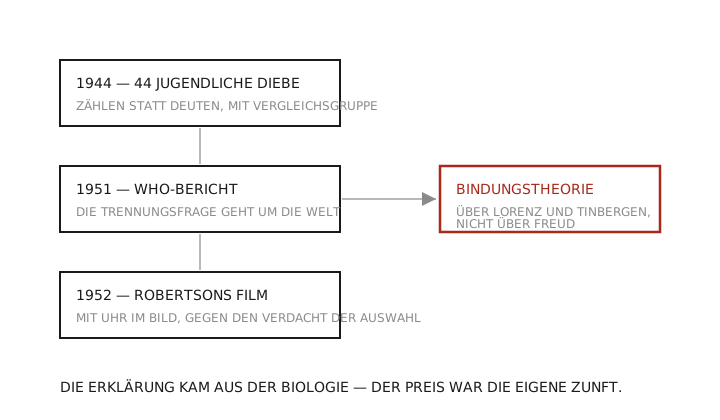
Between study and theory lies the WHO commission, which explains the effect. In 1950 the World Health Organization asked Bowlby for a report on homeless children in post-war Europe; he travelled to clinics and institutions, read the available literature — including René Spitz’s films on hospitalism in infant homes, with shattering mortality figures — and delivered in 1951 a text that turned scattered observations into a recommendation. That thin case material became policy by way of a world organisation is the real reception history of this file; in it lies both the rescue of countless institutionalised children and the confusion this file’s note writes against.
Exactly there the sharpest test begins, and it came from a well-wisher. Michael Rutter dismantled in 1972, in Maternal Deprivation Reassessed, the concept on which everything hung: “deprivation,” he argued, is a catch-all for different things. Separation through the mother’s death, his data showed, scarcely predicts delinquency; separation through disruption, quarrel and chaos predicts it markedly — it is not the mother’s absence that harms but the destruction of relationships and the lack of a durable substitute. Rutter also showed that children have several attachments and that the mother is not the only possible figure. The criticism thus struck the monotropy version of the theory and the short formula of the WHO report, not its core; Rutter himself remained a defender of attachment research and later became its most important empiricist.
The second test was supplied by history, without meaning to. After 1989, studies of Romanian institutional children adopted by English families documented what extreme early deprivation does — and what it does not: whoever came out before the sixth month caught up; whoever stayed for years carried measurable consequences into adulthood, including a pattern of indiscriminate social behaviour close to Bowlby’s affectionless characters. It is the most burdensome confirmation a theory could wish for, and the only kind of experiment no one would be allowed to run.
A quarrel in the neighbourhood belongs in the file too, because it concerns reach. Bowlby’s early version knew monotropy — one principal attachment figure, hierarchically above the others — and a sensitive window of about two and a half years. Both have been softened: children build several attachments at once, to fathers, siblings, nursery staff, and the windows are gradients rather than doors. Attachment research has thereby corrected its founder without discarding him — the normal case of a working science, and in this archive the exception.
For practice the file has an uncomfortable double message that both camps are reluctant to quote. Early experience counts — institutional care without a reliable attachment figure is no neutral custody, and the adoption data show that months can make the difference. At the same time nothing is decided: children catch up when they get relationships, and attachment patterns change with circumstances. Whoever quotes Bowlby to reproach mothers quotes half of him; whoever quotes him to demonise day care quotes the wrong half.
The practical effect of this file ran through a film and against considerable resistance. In 1952 Robertson filmed a two-year-old girl during an eight-day stay in hospital, without cuts, at fixed recording times and with a clock in the picture, so that nobody could claim the distressing scenes had been selected. The screening before the medical society became a scandal: the paediatricians held the child to be an untypical case and the film to be unfair. It prevailed nonetheless, slowly and then completely. At the end of the 1950s a government report in Britain recommended unrestricted visiting for parents on children’s wards; today admitting parents alongside their child is standard, and in many hospitals a parent’s bed belongs to the children’s room. It is the most consequential application in this folder — and it rests not on a statistic but on an observation nobody could argue away.
What stands today is therefore a layered balance. The thieves study itself counts as methodologically superseded and historically decisive — it is the prehistory, not the proof. The thesis that early relational experience shapes later capacity for relationship is confirmed in longitudinal studies across forty years and meta-analyses across cultures and belongs to the best-attested stock of developmental psychology — with effects that are moderate and not fateful: attachment patterns are changeable, later relationships correct. What does not stand is the strictness of the early version: no critical window with a guillotine, no sole standing for the mother, no denial of reversibility. The rest of the folder tests it further — Ainsworth’s procedure turns Bowlby’s suspicion into a measurable quantity.
Scarcely any finding in the field has acted so directly in living rooms as Bowlby’s report of 1951. It changed hospital regulations — parents today may stay with their children —, ended dormitories for infants in homes, and placed the foster family above the institution. That is the good half of the effect, and it is large.
The other half belongs in the file too. The report spoke of the mother, and post-war societies read it as an instruction: out of "the child needs a reliable attachment figure“ came ”the mother belongs in the house." Feminist critics named this sharply from the 1970s, and they were right about what the text invited — even though Bowlby himself never claimed it had to be the biological mother, and later research documented fathers, grandparents and nursery staff as attachment figures. Europe’s day-care debates cannot be understood without this confusion.
The note therefore records a rule this archive often needs: a finding about children is never only a finding about children. It arrives as a recommendation in a society that already knows what it wants to hear — and the wording co-decides which politics can invoke it. Whoever writes “mother” where “attachment figure” is meant has co-authored the confusion.
Replication status: partial. The thieves study itself is methodologically superseded; the thesis that early relational experience shapes later capacity for relationship is broadly confirmed — in a weakened, not fateful, form.
Primary sources. Bowlby, J. (1944). Forty-four juvenile thieves: their characters and home-life. International Journal of Psycho-Analysis, 25, 19–53 & 107–128. Bowlby, J. (1951). Maternal Care and Mental Health. Geneva: WHO. Bowlby, J. (1969/1973/1980). Attachment and Loss, 3 vols. London: Hogarth.
The revision. Rutter, M. (1972). Maternal Deprivation Reassessed. Harmondsworth: Penguin. — Separation is not separation: disruption and missing substitutes carry the effect, not the mother’s absence as such.
The extreme case. The English and Romanian Adoptees Study (Rutter, Sonuga-Barke and others, from 1998) follows children from Romanian institutions after adoption across decades: duration of deprivation decides, catching up is possible, severe early deprivation leaves measurable traces into adulthood.
Prehistory in this archive. The observations of the Hampstead nurseries (Anna Freud & Dorothy Burlingham) and James Robertson’s film A Two-Year-Old Goes to Hospital (1952) — see the Anna Freud file.