Topic 03
Research Ethics
BehaviorismDevelopmentSocial PsychologyClinic & Therapy
The Development folder supplies this question with its hardest case, and without an experimenter: the Romanian institutional children adopted into England after 1989 are the experiment no one would have been allowed to run — severe early deprivation, varying duration, decades of follow-up. What was learned from it about catching up and about what remains is robust, and it was paid for with suffering that research did not cause but did use. The ethics of such natural experiments — who may observe what they could not prevent — stands beside Milgram and Zimbardo as this topic’s quieter half.
Psychology’s research ethics grew out of its own studies, and the files under this topic are the occasions. John B. Watson conditioned fear into an infant in 1920 and did not train it away. Stanley Milgram let participants believe they were inflicting pain on someone. Philip Zimbardo was prison superintendent and experimenter in his own study at once.
Diana Baumrind’s 1964 objection to Milgram framed the underlying problem: a debriefing afterwards does not undo a strain, and consent to a study whose real design you do not know is not informed consent. Out of that debate came the ethics committees that now review every proposal.
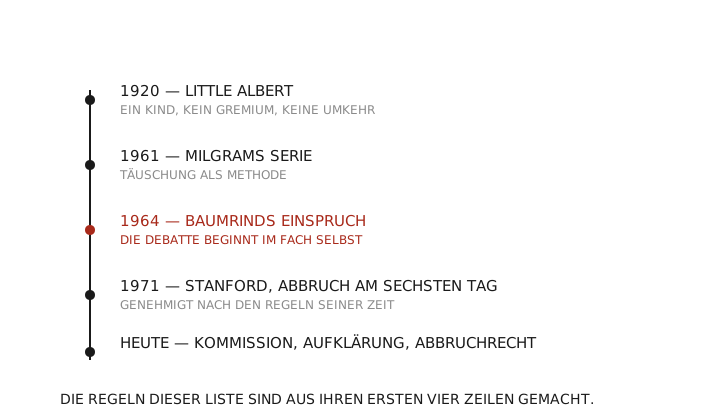
The price of those rules belongs in an honest account. Little Albert cannot be repeated under today’s standards, and Milgram only in attenuated form — Jerry Burger’s 2009 reconstruction stops at 150 volts and extrapolates. What ethics protects, it also withdraws from testing. These files therefore stand not only for past wrongs but for an open question: how do you check findings whose collection you have rightly forbidden?
Honesty requires saying that the rules did not come from insight but from occasions. The United States' National Research Act of 1974 and the Belmont Report of 1979 did not follow the psychological experiments in this archive but the Tuskegee study, in which an effective treatment was withheld from black men for forty years. The ethics committees that review every proposal today are the result of a scandal in medicine, and psychology joined them.
Deception is the point on which the field is still divided. Without it, Milgram’s question and Asch’s set-up cannot be posed — someone who knows the group is in on it does not behave like someone who does not. Current practice therefore does not forbid deception outright but ties it to conditions: no other route to the question, no substantial burden, debriefing immediately afterwards.
Whether debriefing is enough is an empirical question and not a moral formula. Milgram had his participants surveyed a year later; the large majority said they did not regret taking part. That is a self-report from people who know who is asking, and it does not excuse the set-up — but it belongs in the file, because the widespread story of uniformly traumatised subjects is not supported.
The Clinic and Therapy folder adds two cases to this theme that are not about deception. The first concerns the animal: Seligman’s triadic experiments deliberately exposed one group of dogs to pain they could not escape, because that was precisely the condition — in this form they would no longer be approved today, and their author later said he could no longer bear to watch the work with dogs. The second concerns use: the same research was drawn on after 2001 by psychologists who developed interrogation procedures for an intelligence service. The independent report of 2015 found no evidence that Seligman knew of this use; it does not thereby answer the question of what responsibility a researcher bears for the application of their findings.
Sheets on this theme
- Case file 004Iwan PawlowProfile
- Case file 004Iwan PawlowCase file
- Case file 004Iwan PawlowNote
- Case file 004Iwan PawlowEvidence
- Case file 005John B. WatsonProfile
- Case file 005John B. WatsonCase file
- Case file 005John B. WatsonNote
- Case file 005John B. WatsonEvidence
- Case file 006B. F. SkinnerProfile
- Case file 006B. F. SkinnerCase file
- Case file 006B. F. SkinnerNote
- Case file 006B. F. SkinnerEvidence
- Case file 023Jean PiagetProfile
- Case file 023Jean PiagetCase file
- Case file 023Jean PiagetNote
- Case file 023Jean PiagetEvidence
- Case file 024John BowlbyProfile
- Case file 024John BowlbyCase file
- Case file 024John BowlbyNote
- Case file 024John BowlbyEvidence
- Case file 025Mary AinsworthProfile
- Case file 025Mary AinsworthCase file
- Case file 025Mary AinsworthNote
- Case file 025Mary AinsworthEvidence
- Case file 034Eleanor J. GibsonProfile
- Case file 034Eleanor J. GibsonCase file
- Case file 034Eleanor J. GibsonNote
- Case file 034Eleanor J. GibsonEvidence
- Case file 010Stanley MilgramProfile
- Case file 010Stanley MilgramCase file
- Case file 010Stanley MilgramNote
- Case file 010Stanley MilgramEvidence
- Case file 011Solomon AschProfile
- Case file 011Solomon AschCase file
- Case file 011Solomon AschNote
- Case file 011Solomon AschEvidence
- Case file 012Philip ZimbardoProfile
- Case file 012Philip ZimbardoCase file
- Case file 012Philip ZimbardoNote
- Case file 012Philip ZimbardoEvidence
- Case file 029Aaron T. BeckProfile
- Case file 029Aaron T. BeckCase file
- Case file 029Aaron T. BeckNote
- Case file 029Aaron T. BeckEvidence
- Case file 030Albert EllisProfile
- Case file 030Albert EllisCase file
- Case file 030Albert EllisNote
- Case file 030Albert EllisEvidence
- Case file 031Martin SeligmanProfile
- Case file 031Martin SeligmanCase file
- Case file 031Martin SeligmanNote
- Case file 031Martin SeligmanEvidence
From the journal
- 1903Pavlov presents classical conditioningAfter pairing with food, a neutral stimulus triggers salivation on its own.Iwan Pawlow
- 1920Little Albert experimentAfter seven pairings, fear of the rat, generalised to similar things.John B. Watson
- 1936The Origins of Intelligence in ChildrenThree children, one cloth, six stages — object permanence becomes observable.Jean Piaget
- 1938The Behavior of OrganismsVariable reinforcement produces the highest rates and the greatest resistance to extinction.B. F. Skinner
- 1944Forty-four juvenile thievesAmong the affectionless thieves, early and lengthy separations clustered.John Bowlby
- 1951Asch's conformity experiments beginAbout 37 per cent of the critical judgments followed the false majority.Solomon Asch
- 1957Rational PsychotherapyThe ABC scheme appears in print — six years before Beck's first cognitive paper.Albert Ellis
- 1960The visual cliffEleanor Gibson and Richard Walk make depth perception testable without any risk of falling.Eleanor J. Gibson
- 1963Behavioral Study of Obedience26 of 40 — 65 per cent — went to the highest level of 450 volts.Stanley Milgram
- 1967Learned HelplessnessThree groups, the same shocks, one difference: control.Martin Seligman
- 1969Attachment appearsThe first volume of the trilogy — attachment as a biological system, not a by-product of drives.John Bowlby
- 1971Stanford Prison ExperimentStopped on day six of a planned fourteen; first release after about 36 hours.Philip Zimbardo
- 1977Therapy Beats the Pill41 patients, twelve weeks — talking treatment holds up against imipramine.Aaron T. Beck
- 1978Patterns of Attachment appearsTwenty minutes of laboratory, three patterns — and the key lies in the reunion.Mary Ainsworth
- 2011Bem publishes evidence for precognitionThe methods were standard, the result scientifically highly implausible.
- 2011Flourish appearsFrom happiness to flourishing: five components instead of one measure.Martin Seligman
- 2015Open Science Collaboration replicates 100 studiesAround a third of 100 studies could be shown again; effects came out considerably smaller on average.