Case file 021 · Gestalt & Field
Kurt Lewin
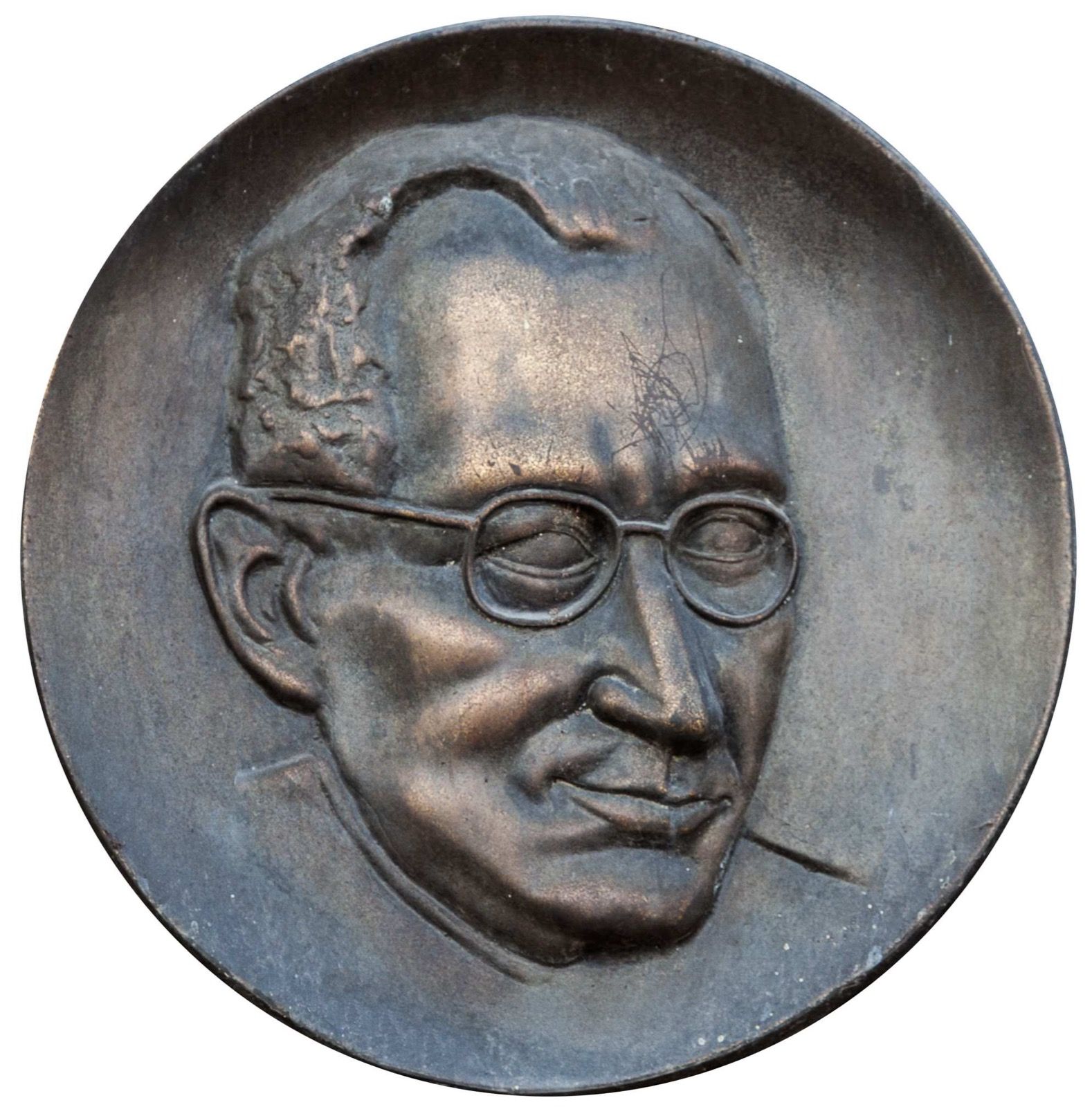
Fig. 1 — CC BY-SA 4.0 · Foto: Pko

A Berlin café, mid-1920s: at the table sits a professor with his doctoral students, and the waiter, who has kept the long order without a note, is asked the trick question after the bill is paid: what was on it? The waiter no longer knows — the head deletes settled bills. Lewin’s doctoral student Bluma Zeigarnik turned the observation into an experimental series, and the series into a law with her name: the unfinished stays taut in memory, the finished relaxes. It is the shortest version of Lewin’s programme — action stands under tension, and tension can be studied.
Lewin was born on 9 September 1890 in Mogilno in the province of Posen, the second of four children of a Jewish merchant family that moved to Berlin in 1905 — in part to secure the children better schools than the antisemitic country town would yield. He studied medicine in Freiburg, switched via Munich to philosophy and psychology in Berlin, and took his doctorate in 1916 under Carl Stumpf — by then he already stood in the field. Lewin served the whole war, was wounded, decorated with the Iron Cross, and lost his brother; his first noted essay, the War Landscape of 1917, describes how the front reorganises space — the same meadow is landscape to the stroller and terrain to the soldier. Field theory has a trench date.
In the Berlin of the Weimar years he became, beside Wertheimer and Köhler, the third force of the Psychological Institute in the City Palace — and its most convivial head. Around Lewin gathered a group such as the field has rarely had: the café “Quasselstrippe,” doctoral students from half of Europe, among them Zeigarnik, Tamara Dembo, Anitra Karsten, Maria Ovsiankina — it is no accident that the classic Berlin Lewin studies mostly carry women’s names. Together they translated the Gestalt idea from seeing to willing: actions have tension systems, the interrupted presses for resumption, substitutes discharge — an experimental psychology of the will where before concepts had been administered.
The Berlin studies had a property that marks Lewin’s whole career: they began in everyday life. The waiter without memory for settled bills, the child that must walk around the stone to sit on it, the prisoner for whom the cell changes its invitations as release approaches — Lewin read situations as physicists read experimental set-ups and named things after what they intend for you: Aufforderungscharakter. The word survived emigration as “valence” and sits today in every theory of motivation.
In 1933 Lewin emigrated at once — he had grasped the situation earlier than most and wrote it in letters of shattering clarity. Via Cornell he came in 1935 to the Child Welfare Research Station of the University of Iowa; there arose the leadership-style studies that fill his case file, and the toolkit of the American years: field theory in textbook form (Principles of Topological Psychology, 1936, with the formula that behaviour is a function of person and environment), the gatekeeper studies with which he rebuilt American eating habits in the war, and the concept of action research — research that changes what it studies and learns from it.
In 1945 he founded the Research Center for Group Dynamics at MIT — the institutional birth of modern small-group research — and helped in the same stroke to build the Commission on Community Interrelations of the American Jewish Congress: prejudice research with a mandate to change. From a workshop in Connecticut in 1946 came the idea of the training group; the National Training Laboratories that grew from it opened in 1947 — Lewin did not live to see it. He died on 12 February 1947 in Newtonville, Massachusetts, of a heart attack, aged fifty-six, between two meetings of a week that looked like his diary: overfull.
Two tools of his Berlin period deserve the note, because they ran ahead of his method: Lewin filmed — everyday scenes of children, the sitting on the stone, the reaching, the failing — and he drew: the famous egg-shaped diagrams in which person, goals and barriers appear as regions of a field. Both habits founded traditions — behavioural observation by camera became the standard of developmental psychology, and whoever draws a force field on a whiteboard in an organisation today is drawing Lewin.
His most-quoted sentence — there is nothing so practical as a good theory — is genuine and stands for a body of work that never acknowledged the separation of basic and applied. Social psychology carries him as founding father, organisational development as house saint, and his doctoral students — Festinger first among them — bore the field into the next generation. What runs posthumously under his name, however, is not all his; the case file checks.
The question of 1939 was the decade’s question of the day, folded to laboratory size: what does leadership do to a group — does people’s behaviour lie in their character or in the climate one places them in? Europe was delivering the full-scale version as catastrophe; Lewin, six years into emigration, built the miniature in Iowa. With his co-workers Ronald Lippitt and Ralph White he founded after-school clubs for schoolboys — mask-making, model-building, soap-carving — and made leadership style the experimental variable: adult leaders were trained to run the same group by changing scripts.
Three scripts were available. The autocratic leader determined every activity and every work partner, praised and blamed personally, and stayed aloof from the group’s doing. The democratic one let the group vote on projects and division of labour, explained alternatives, and evaluated by the matter at hand. The laissez-faire leader — the condition was added third, after one leader had involuntarily undershot the democratic script — provided materials and otherwise kept out. Decisive was the architecture: the styles migrated between clubs after weeks, so that each group passed through several climates — the same boys, another atmosphere. Observers recorded interactions continuously, by the minute and by category.
That children’s clubs of all things supplied the material was not chance but programme. Lewin sat at a research station for child welfare, and he held children to be the more honest subjects: less practised in showing observers the expected. Above all the format allowed what could scarcely have been carried through with adults — following the same group for months and switching the condition in mid-life. The study is thus also an early piece of longitudinal field experiment: not a laboratory morning but a club year under protocol.
The findings became textbook stock. Under autocracy, hostility rose steeply in some clubs — aggression against one another, scapegoats, destroyed products — while in others the group froze into an apathy that discharged in the leader’s absence. Under democracy the tone was friendlier, the work more original, and it continued when the leader left the room — the difference Lewin valued most: the autocratic product hung on the overseer, the democratic one on the matter. Laissez-faire, finally, produced neither freedom nor achievement but idling — the condition the popular reception most likes to forget, because it disturbs the comfortable equation of little leadership with much freedom. And individual boys changed their behaviour with the climate so completely that the study was read as an early proof of the situational thesis, long before Milgram.
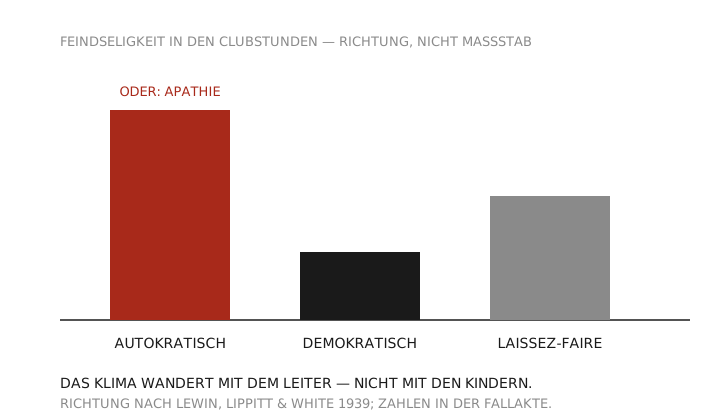
The reception ran at two speeds. In the field, the study founded experimental small-group research — the word group dynamics comes from Lewin’s workshop — and became the starting point of leadership research, which soon made dimensions out of the trichotomy: task-oriented against person-oriented, directive against participative. In public it became the scientific authentication of democracy in the year the war began — boys' clubs as a miniature of the world situation, with express interpretation by the authors themselves. Exactly here the methodological critique begins, and it is as old as the study: the samples were small, the labels value-laden — who would not rather be called democratic —, the leaders knew what was to be demonstrated, and the measures mixed observation with interpretation. The study shows that climates can be manufactured and that behaviour goes with them; which leadership achieves what, and when, it does not show.
The tension concept behind it all has its own testing history. The Zeigarnik effect — the unfinished stays more available than the finished — proved only unreliably repeatable in later decades; it hangs, as emerged, on involvement and evaluative pressure, and the file carries it as a moody classic. The basic idea survived in modernised form: today’s psychology of goals — open intentions that crowd into thought, resolutions that bind tension, Gollwitzer’s implementation intentions as a discharge technique — reckons with the same quantities Lewin’s Berlin circle introduced, only with better measurements. The café observation became no constant, but a language.
The war application deserves its own lines, because it shows the method. Commissioned by the Committee on Food Habits — on which Margaret Mead also worked — Lewin compared lecture against group decision: housewives who resolved by show of hands, after a discussion, to try organ meats did so several times more often than equally informed listeners to a lecture. The active ingredient was not information but public self-commitment in one’s own reference group — the finding from which commitment techniques, participation formats and half of health communication later grew. And the concept of the gatekeeper, invented for the person who decides what reaches the family table, migrated into communication science and today describes newsrooms and platforms.
The archival turn of this file concerns, of all things, the most famous piece of the afterlife. In the management literature Lewin runs as the inventor of the three-phase model of change — unfreeze, change, refreeze, cited in every second change handbook as “Lewin’s model.” The source work of Cummings, Bridgman and Brown traced in 2016 that this model does not exist in Lewin’s writings in that form: the three terms fall once, in passing, in a paper of 1947; the canonical stage scheme with its diagrams was erected by successors of the 1980s and retroactively ascribed to the dead founding father — an invented authority, as this archive otherwise carries with invented bells and drawn pyramids. The man who thought change as continuous field displacement was posthumously made crown witness of a freezing model that contradicts his theory.
Out of the same workshop comes a procedure that dissolves the separation of research and application and has a literature of its own today. Lewin called it action research: one investigates a social field by changing something in it and measuring the change — diagnosis, intervention, feedback, new diagnosis. It first became practical in firms and in work against prejudice, and in 1946, at a training course in New England, a by-product fell out that grew larger than the programme: participants listened in the evening as the staff recorded their behaviour, objected — and out of this feedback arose the training group, from which the whole industry of group dynamics emerged. Lewin did not live to see the first cohort; he died in February 1947.
The conceptual frame behind it is his field theory: behaviour as the result of person and environment in a common field of forces, not as an outflow of traits alone. As a formal theory it did not prevail — its vectors and topologies remained imagery and never became a calculus.
What stands today: the direction, not the trichotomy. That leadership behaviour causally shifts group climate belongs to the secured inventory — field experiments and meta-analyses of leadership research confirm it, and the finding that destructive leadership passes aggression downward has rediscovered the Iowa patterns in organisations. The clean superiority of “the” democracy, by contrast, has dissolved into a landscape of conditions: participation works differently by task, time pressure and culture, and the trichotomy serves today as introductory didactics, not as theory. What remains is the study’s greatest bequest: its proof that social climates can be manufactured experimentally — the method on which Asch, Milgram and Zimbardo live in the neighbouring folders of this collection. Lewin’s clubs were the field’s first deliberately built social climate; everything further in this archive is built to their plan.
Whoever types “Lewin” into a management handbook finds the three-phase model first: unfreeze, change, refreeze, gladly as a diagram with an ice cube. The state of the sources is sobering — the three words fall in Lewin once, in passing, in a paper of his death year; the stage scheme, the diagrams and the claim that here lies the theory of change come from textbook authors of the 1980s, who ascribed a tidy model to the dead founding father because the tidy teaches better.
The note records the irony twice. First, the freezing image contradicts Lewin’s own theory, which grasps social states as quasi-stationary equilibria — held by running forces, never frozen; whoever wants to change, said his field theory, should lower the restraining forces rather than raise the pressure. Second, the attribution repeats exactly the mechanism this archive documents with the pyramid Maslow never drew and the bell Pavlov never rang: posterity builds the handy artefact and sticks the great name on it.
For the file there follows a rule of checking that would have pleased Lewin, the practitioner of the good theory: where a model fits a slide suspiciously well, the look into the primary source pays. Usually something less convenient stands there — and something more usable.
Replication status: partial. That leadership styles causally shift group climate is confirmed many times over; the clean trichotomy and the blanket superiority of democratic leadership have dissolved into a landscape of conditions.
Primary sources. Lewin, K., Lippitt, R., & White, R. K. (1939). Patterns of aggressive behavior in experimentally created "social climates". Journal of Social Psychology, 10(2), 271–299. — The leadership-style study. Lewin, K. (1936). Principles of Topological Psychology. New York: McGraw-Hill. — Field theory in textbook form. Lewin, K. (1947). Frontiers in group dynamics. Human Relations, 1(1), 5–41. — The paper of his death year, from which posterity distilled the phase model.
Berlin groundwork. Zeigarnik, B. (1927). Das Behalten erledigter und unerledigter Handlungen. Psychologische Forschung, 9, 1–85. — The tension idea in the experiment; the later replication record of the Zeigarnik effect is mixed.
Source criticism. Cummings, S., Bridgman, T., & Brown, K. G. (2016). Unfreezing change as three steps: Rethinking Kurt Lewin’s legacy for change management. Human Relations, 69(1), 33–60. — The demonstration that the canonical three-phase model is a posthumous construction.