Case file 022 · Gestalt & Field
Wolfgang Köhler
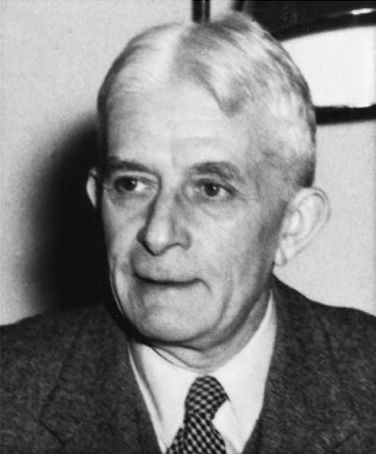

In April 1933, days after the dismissal of James Franck and hundreds of Jewish scholars, an article appeared in the Deutsche Allgemeine Zeitung under the title “Conversations in Germany.” Its author, full professor of psychology in Berlin, publicly defended his Jewish colleagues in it and called the dismissals a loss for Germany. Wolfgang Köhler wrote the text knowing he might be arrested the next morning; he spent the night, friends have recorded, playing chamber music in a state of waiting. It was the last openly regime-critical article by a non-Jewish German professor — and the beginning of two years of attrition at whose end stood emigration.
Köhler was born on 21 January 1887 in Reval, today’s Tallinn, the son of a German school director; the family soon returned to the Reich. He studied in Tübingen, Bonn and Berlin, where in 1909 he took his doctorate under Carl Stumpf with a thesis on the psychology of hearing — beside psychology he had heard physics under Max Planck, and physics remained the keynote: Köhler thought all his life in fields, equilibria and systems. In Frankfurt in 1910 he sat as a subject before Wertheimer’s tachistoscope; the subject became the co-founder and later the school’s systematiser.
In 1913 he took over the anthropoid station of the Prussian Academy on Tenerife — a research post for comparative psychology which the outbreak of war turned into an involuntary seven years: the German, suspect to the English, could no longer get off the island and made of the stranding the work of his life, the Mentality of Apes. A sequel occupies the history of the field to this day: the psychologist Ronald Ley assembled evidence in the 1980s that the station had also served as a German observation post for Allied shipping — the espionage thesis is neither proven nor dispelled, and the file carries it as an open marginal note.
Back in Germany the ascent was steep: in 1920 acting, in 1922 full director of the Berlin institute on Stumpf’s chair — at thirty-five on the field’s most important post. Die physischen Gestalten of 1920 had established him as theorist: the attempt to extend the Gestalt concept into the physics of fields — the same order on both sides of the skull, the isomorphism thesis, the school’s most speculative piece. The Berlin years made the institute in the City Palace the world centre of Gestalt psychology: Wertheimer and Lewin as colleagues, the Psychologische Forschung as organ, guest professorships in America, and in 1929 the English textbook Gestalt Psychology as embassy document.
After 1933 Köhler defended the institute month by month — he refused the Hitler salute at the start of lectures, protected assistants, wrote petitions — until the authorities took his co-workers and he drew the consequence in 1935: resignation, emigration, a professorship at the small Swarthmore College in Pennsylvania. That the field’s most prominent non-Jewish resister received no great institute in America but a college laboratory belongs to the quiet injustices of the emigration; Köhler never complained, and worked on there on perception, figural after-effects and brain fields — the electrophysiological tests of his field thesis in the 1950s went against him, and he bore that too without complaint.
In America he became a crosser of school lines: with the behaviourists he argued in essays and at congresses — polite, unbending, in the third language of his life — and the William James Lectures he had given at Harvard in 1934 appeared as The Place of Value in a World of Facts: the attempt to rescue value too as a Gestalt phenomenon. On the side he played the piano at concert level and counted in Swarthmore as the professor who taught physics, philosophy and decency in personal union.
Swarthmore became a quiet relay station of the field’s history: among those who learned there with him and Asch was the young Ulric Neisser, who carried the Gestalt questions on into cognitive psychology — the line from Wertheimer’s tachistoscope to Neisser’s book of 1967 runs in the flesh through Köhler’s seminar room.
What he left behind was not carried on. After his resignation the Berlin institute got a directorship in line with the new course, the remaining staff scattered, and the Gestalt line broke off in Germany — it did not return in any appreciable measure after 1945. The field that continued it was the American one; the concepts came back as translation.
The late honours collected the respect of both lives, the scientific and the civic: in 1956 the American Psychological Association’s highest award, in 1959 its presidency, and celebratory lectures in which the emigrant spelled out the Gestalt questions to the Americans once more. Köhler died on 11 June 1967 in Enfield, New Hampshire. Of the three who sat before the tachistoscope in 1910 he was the last — and the only one who had passed both examinations this file deals with: that of the apes and that of the Germans.
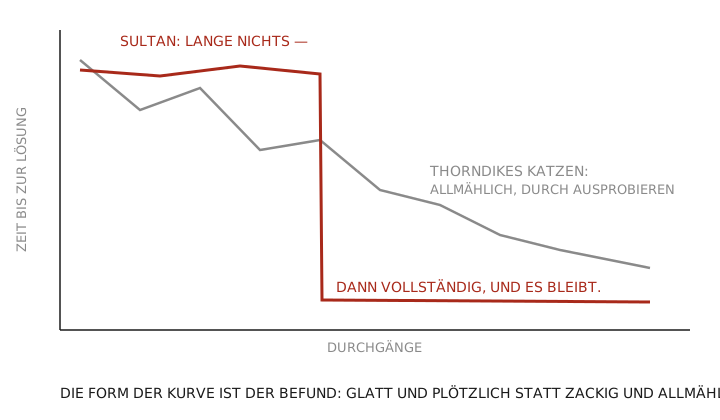
The question had been put by Thorndike and, it seemed, settled. His cats had freed themselves from puzzle boxes around 1900, and their learning curves fell gradually — no aha, only slowly sorted-out fumbling. Animal intelligence, ran the doctrine, is trial and error with a memory for reward; from here a straight line leads to Watson’s programme. Köhler held the very set-up to be the real deception: a puzzle box whose mechanism the animal cannot see into forces blind fumbling — it proves not that the animal cannot do otherwise, but that the task permits nothing else. His counter-question: what does an animal do when all the elements of the solution lie openly visible before it?
The place of the answer was a gift of the world situation. The Prussian Academy maintained an anthropoid station on Tenerife; Köhler took it over in 1913, the war cut him off from Europe, and a planned research year became six. The scenes he arranged there have entered the field’s picture memory: the banana out of reach at the ceiling, the boxes scattered in the enclosure; the fruit beyond the bars, the stick inside the cage; and as master’s examination two tubes, each too short, that could be fitted into one another. The apes tried, failed, leapt in vain — and then, often after a pause of stillness, the solution came in one stroke and complete: Sultan, the most gifted of the group, pushed the box under the banana, later stacked two and three, and in the most famous scene joined the two tubes after playing with them for a while, seemingly uninvolved. Köhler called this insight: a restructuring of the field in which the objects take on new roles — the branch becomes tool, the box becomes stairs. The sudden, smooth, repeatable execution, he noted, looks different from any fumbling; and whoever had once solved transferred the solution to new situations.
Köhler knew that “sudden” is no measurement, and gave insight criteria that can be tested: the pause before the solution, in which the trying ceases; the smooth, uninterrupted execution once it starts; the repeatability next time without new searching; and the transfer to altered situations. He also filmed what could be filmed — the box and stick scenes of the station are among the field’s earliest research films, and that one can watch Sultan’s double tube to this day has spared the file the fate of many classics: existing only as a retelling.
The records owe their vividness to a circumstance the legend suppresses: time. Köhler had no semester deadline but years, and he used them for what comparative psychology relearned only much later — continuous observation of the same individuals, with names, histories and temperaments. Sultan was the resourceful one, Tschego the deliberate, Rana the roundabout; the Mentality of Apes reads in stretches like character studies, and exactly that made it checkable in the small: whoever knew the animals could see that the box solution did not come from the standard repertoire. The station, incidentally, ran the first long-term keeping of chimpanzees for research — with everything that raises in today’s questions; the file records that side of the holdings too.
Beside the tool scenes ran a second, more sober series that was theoretically the harder one: the transposition experiments. Hens and chimpanzees learned to choose the lighter of two greys; if one then offered the learned light shade beside a still lighter one, the animals mostly chose the new one — they had learned not "respond to grey number seven“ but the relation ”the lighter." For Köhler this proved that even simple animals learn relations rather than elements — Gestalt perception in the henyard. Behaviourism struck back as is proper: Kenneth Spence constructed in 1937 an elegant explanation from overlapping gradients of reinforcement that predicts transposition without any concept of relation — including the additional prediction that it tips at large distances, which was confirmed. The quarrel over the hens became a model case of competing theories: both sides explained the same finding, and only the additional predictions separated them. The modern balance gives neither side everything: relational coding exists, and gradients do too.
The book of 1917 became, in the English version of 1925, the field’s world bestseller — and a front line. For the Gestalt school it was proof that intelligent behaviour is structure-seeing, in animal as in man; for learning psychology a provocation to be dismantled. The objections gathered over decades: Köhler’s records are narratives, not measurement series; the prehistory of his animals was uncontrolled — wild-born chimpanzees had branches and climbing in their repertoire, and later work showed that apes without relevant prior experience fail at the same tasks. The sharpest stroke came from Robert Epstein in 1984, in Skinner’s spirit: pigeons separately taught to push boxes and to climb on boxes combined both, on camera, into the “insightful” solution of the banana scene — the aha can be assembled from learning history, at least in principle. The demonstration did not prove that Sultan’s insight was training; it proved that the appearance of suddenness replaces no theory.
With that the file was not closed but sharpened. Modern comparative cognition — with control groups, raw data and video instead of field diary — has partly rehabilitated Köhler’s basic observation: chimpanzees solve novel tool tasks, plan across intermediate steps and transfer solutions; crows bend hooks and combine tools; and the debate over how much of this is fast learning and how much restructuring is conducted today with single-case analyses that are methodologically closer to Köhler’s records than the interwar years allowed. Insight research on humans, in turn — from the restructuring aha of the psychology of thinking to the neurophysiological signatures of the solution flash — traces its ancestry directly to Tenerife. The concept held; its pure form of 1917 counts as too smoothly told.
What has not held of the school is the explanation Köhler himself held to be the most important. Gestalt psychology asserted an isomorphism: the ordered impression arises because electrical fields form in the brain whose course corresponds in form to what is seen — perception as physics in the cortex. Köhler spent his American years measuring these fields. The test came out against him: in the 1950s research groups placed metal strips and pins in the visual cortex of experimental animals in order to short-circuit such fields — the animals went on seeing shapes. Perception psychology has kept the phenomena and dropped the field theory; today they are explained through the wiring of nerve cells, not through distributions of current in tissue.
The road there is well documented, because Köhler laid it himself: the after-effects he measured from 1944 with Hans Wallach — a pattern looked at for a while shifts the perception of the next one — were meant as evidence for the field assumption. The effects exist; the explanation they were to carry does not.
What stands today is therefore a double lesson. First the methodological one: Köhler’s objection to Thorndike — the task co-decides which intelligence can become visible — has entered comparative psychology as the principle of the fair test, and grounds to this day why one puts tasks within an animal’s reach before denying it capacities. Second the substantive one: between blind fumbling and pure insight lies a continuum of prior experience, play and sudden combination — the truth about Sultan lies in the middle, and it is more interesting than either legend. The file notes at the last what is rare for its genre: the study of 1917 was never replicated in the strict sense, because the station no longer exists — but its scenes have been varied a thousandfold, and no variation has erased the core finding that great apes solve tasks for which their learning history contains no ready answer. Only the word “suddenly” has lost its innocence.
The textbook version files Köhler under apes and boxes. What it almost always leaves out is the second chapter of his record: Köhler was, in 1933, the field’s only non-Jewish full professor to dissent publicly — with a newspaper article against the dismissal of his Jewish colleagues, written in expectation of arrest, and with two years of attritional warfare over his institute, in which he refused the Hitler salute and wrote petitions until his co-workers were taken from him.
The note records this not as a moral vignette but as a data point on a question this archive raises in several folders. Milgram’s condition comparisons show when people obey; Zimbardo’s basement shows how institutions derail; the professoriate of 1933 shows the base rate of resistance — it lay near zero. Köhler is the rare documented outlier, and his circumstances are instructive: a man with international standing, without family within the authorities' reach, with an offer abroad in his pocket, and with a self-image that held physics and decency to be related disciplines. Situations explain much, this collection keeps saying — and outliers explain what situations leave open.
That the same man may have reported ships from his ape station in the First World War, the file bears alongside. The espionage thesis is unproven; were it true, it would form with the article of 1933 not a paradox but a biography: loyal to his country, disloyal to its crimes. People are complicated — it is this archive’s oldest finding.
Replication status: partial. The observations have been varied many times and confirmed in their core — great apes solve novel tool tasks without a fitting learning history —; the reading as pure, experience-free insight has not survived the tests.
Primary sources. Köhler, W. (1917). Intelligenzprüfungen an Anthropoiden. Berlin: Königliche Akademie der Wissenschaften; expanded 1921 as Intelligenzprüfungen an Menschenaffen (English The Mentality of Apes, 1925). Köhler, W. (1920). Die physischen Gestalten in Ruhe und im stationären Zustand. Braunschweig: Vieweg. — The isomorphism thesis; not supported by the electrophysiology of the 1950s.
The counter-experiment. Epstein, R., Kirshnit, C. E., Lanza, R. P., & Rubin, L. C. (1984). 'Insight' in the pigeon: antecedents and determinants of an intelligent performance. Nature, 308, 61–62. — Trained pigeons restage the box scene; suddenness loses its probative force.
Continuation. Modern comparative cognition on tool use and problem solving in chimpanzees and corvids carries Köhler’s tasks forward with control groups; overviews in Call & Tomasello, and on human insight research in Öllinger & Knoblich.
Civil courage. Henle, M. (1978). One man against the Nazis — Wolfgang Köhler. American Psychologist, 33(10), 939–944. — The documented story of the 1933 article and the Berlin years after. On the espionage thesis: Ley, R. (1990). A Whisper of Espionage. — Evidence, no verdict; the file leaves it open.