The Journal29 August 202610 min read
The word “doll” does not appear in the ruling
What the Clarks achieved in court — and what is attributed to them
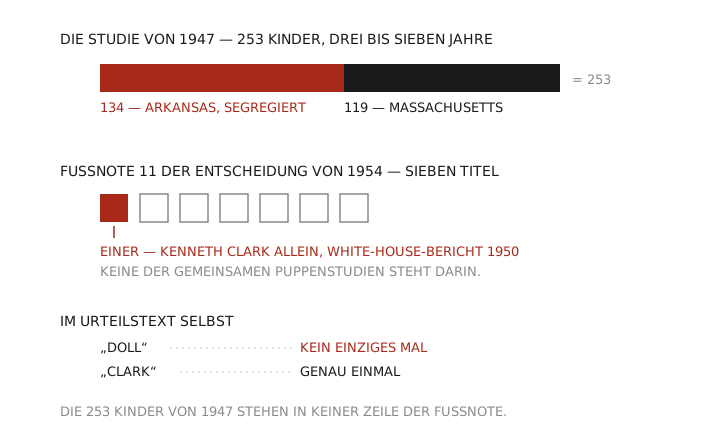
In front of the child lie dolls, identical except for the colour of skin and hair. Then come the questions. Which one would you like to play with? Which one is nice? Which one looks bad? And finally: which one looks like you? Between 1939 and 1950 Mamie and Kenneth Clark put this task to hundreds of Black children. Their best-known study, published in 1947, covered 253 children aged three to seven — 134 in segregated Arkansas, 119 in Massachusetts.
Many of the children assigned positive qualities to the white doll and negative ones to the Black doll; some preferred the white doll. When asked which one resembled them, a number hesitated and showed visible distress. Seven years later the Supreme Court declared separate schools unconstitutional, and it has been taken for granted ever since that these dolls tipped the balance. The word doll appears nowhere in the text of the decision. The name Clark appears in it exactly once.
It began with a master’s thesis of 1939
Mamie Phipps came from Arkansas to Washington, D.C., and studied at Howard University. She first considered mathematics, then turned to psychology. Her 1939 master’s thesis was titled “The Development of Consciousness of Self in Negro Pre-School Children” and examined how Black pre-school children develop an awareness of racial belonging. The later doll research was not a spontaneous idea of her husband’s. It grew out of that programme.
Kenneth Bancroft Clark was born in 1914 in the Panama Canal Zone, grew up in Harlem and also studied at Howard. He took his doctorate at Columbia University in 1940, Mamie Phipps Clark three years later in the same faculty. Together they developed several procedures: children were asked to colour in figures, to choose pictures, or to sort dolls by skin colour. What mattered was the separation of the types of question — racial identification on one side (which doll looks like you), preference and evaluation on the other (which is nice, pretty or bad). It was precisely this separation that made the conflict observable: belonging to a group that society devalues.
The Clarks read the results not as a trait of Black children but as an effect of a society that tied whiteness to status and safety. Historical writing nevertheless went on to speak, for the most part, of “Kenneth Clark’s doll test”. That follows a familiar pattern of scientific credit: women, and Black women researchers above all, disappear behind more prominent male spokesmen. Naming Mamie Clark’s contribution correctly is not merely symbolic repair. It changes how the project is to be understood — as a joining of developmental psychology, the reality of schooling and the provision of care.
The dolls were made as similar as possible apart from skin and hair colour, and the order of the questions aimed successively at preference, attribution of qualities and self-identification. Some of the children were studied in the North, some in the segregated South — the division of the 1947 sample between Arkansas and Massachusetts was designed for exactly that.
From today’s vantage point many questions of design arise. Was the order of the dolls varied? How did the wording shape the answer? Was the Black doll really equally familiar in material, hair and availability? What effect did the skin colour of the examiner have? Such factors can alter results without cancelling the social reality behind them.
The samples, too, carry less weight than their later influence suggests. They were not representative of “all Black children”; individual groups were small, and regions and age bands differed. The historical effect of the studies was many times greater than their statistical reach. A responsible appreciation therefore separates symbolic force from precision of measurement.
| Detail | Value |
|---|---|
| Period of the Clarks' research | 1939–1950 |
| The 1947 study | 253 children, three to seven years old |
| of them in segregated Arkansas | 134 |
| of them in Massachusetts | 119 |
| Titles in footnote 11 of the opinion | seven, one of them by Kenneth Clark |
| Joint doll studies in footnote 11 | none |
| The word “doll” in the text of the opinion | not once |
| The name Clark in the text of the opinion | exactly once |
From Clarendon County to Washington
The research met a legal strategy. The NAACP attacked the doctrine of “separate but equal”, under which separate facilities could count as equivalent. In practice schools for Black children were often worse equipped — but the legal challenge went deeper. Even separation with matched resources declared a group, by act of the state, not to belong in common with others.
One of the cases the Supreme Court later consolidated into Brown began in Clarendon County, South Carolina. It began small: in 1947 Levi Pearson petitioned for school buses for the district’s Black children. Out of a demand for transport grew an attack on segregation itself. The families who signed on as plaintiffs risked their work, their credit and their safety. The Clarks supplied expertise; the social cost of the proceedings was borne by the signatories.
Kenneth Clark tested children in Summerton and testified in several proceedings. His findings were used as an indication of the psychological harm of separate schooling, and opponents disputed both methods and conclusions. In the legal setting the research was thereby given a task it had never been built for: it was to help a court judge social causation. Psychology in the courtroom therefore demands particular clarity. A finding can support a claim without proving it on its own. Expert witnesses have to name uncertainty, even when a morally important cause would profit from plain speaking. Overstatement persuades in the short term and damages trust in the field in the long term.
What footnote 11 actually says
In 1954 the Supreme Court referred, in footnote 11 of its decision, to seven social-science titles. Exactly one of them is by a Clark, and by Kenneth Clark alone: his report for the 1950 Midcentury White House Conference on Children and Youth. The couple’s joint doll studies are not cited. Among the entries is a 1948 survey by Max Deutscher and Isidor Chein, in which social scientists were asked what psychological consequences enforced separation had.
The much-quoted Social Science Statement — written by Kenneth Clark together with Isidor Chein and Stuart W. Cook and signed by numerous specialists — was attached as an appendix to the plaintiffs' brief. It does not appear in the footnote. And the opinion itself says, taking over a finding from the district court in Kansas, that a sense of inferiority affects a child’s motivation to learn. Dolls are mentioned nowhere.
A sense of inferiority affects the motivation of a child to learn.
Popular accounts nonetheless tell of the dolls deciding the case. It is attractive as drama: a child points at a doll, nine judges change the country. In fact the proceedings rested on decades of legal strategy, on historical arguments, on witness testimony and on the contradiction between segregation and equal citizenship. The correction does not diminish psychology’s contribution — it prevents political rights from appearing to depend on whatever the current state of the research happens to be. Even if a doll test had found no effect, state-enforced racial separation would not have become just.
What the test can measure — and what it cannot
Doll choice is not a direct measure of self-worth. The operationalisation assumes that a preference for a toy makes a self-evaluation visible — and that is exactly the weakest point of the arrangement. Self-worth comprises global and domain-specific evaluations and changes with the situation. A child can know that its own group is devalued and still possess strong family belonging and pride. It can repeat a dominant aesthetic without rejecting itself as a whole.
The experimental situation is therefore part of the finding. A choice between two dolls forces manifold identities into a binary order, and repeated questions about “good” and “bad” signal that a hierarchy is expected — a textbook case of demand characteristics. The test maps social valuations and sharpens them experimentally. What it cannot do: diagnose a child’s identity, reduce racism to a preference, or predict an individual future.
The equation “chose the white doll = self-hatred” also individualises the problem. It makes the child the site of the disorder although the hierarchy comes from outside. A better interpretation asks which social regularities make the answer appear rational or safe. Children do not copy messages passively: they observe which doors open for whom, listen to adults, protect their belonging and develop explanations. A preference can contain admiration, fear, knowledge of status and self-evaluation all at once.
There is also a fine structure that the arrangement’s black-and-white scheme cannot capture at all. Colorism — the preference for lighter skin within racialised groups — operates in the media, in partner choice, in working life and in criminal justice, and has its own colonial history in each country. Later formats therefore work with several skin tones or with photographs rather than two dolls; they still find preferences for lighter tones, but not the same patterns everywhere. That is precisely what makes visible how strongly the binary arrangement helped structure the result.
Television reports still stage the task as a moment of emotional revelation. Individual children’s answers are broadcast while statistical uncertainty and any follow-up conversation are absent. This creates attention and once again parades children as evidence. An ethical repetition needs parental consent, age-appropriate assent from the child, protection from humiliation and a plan for distressing reactions — the scientific question has to justify the emotional cost.
The Northside Center and the years after Brown
After her doctorate Mamie Clark looked for a post in which she could work with children; racism and sexism narrowed her options. In February 1946 the Clarks founded the Northside Center for Child Development in Harlem. It offered psychological and educational help to children and families who were excluded from other institutions or poorly served by them: learning support, assessment, therapy, family support. The Center refutes the notion that the Clarks regarded children primarily as political evidence. One can fight racism as a structure and help a particular child deal with its consequences. Therapy must not merely demand adjustment to injustice; political change must not leave those affected waiting for a better future.
The effect of Brown was enormous and incomplete. In 1955 the Supreme Court ordered implementation with the notoriously open formula “with all deliberate speed”. Many states offered massive resistance: schools were closed, district boundaries redrawn, white families moved away or switched to private institutions. Integration required further litigation, protest and federal intervention. Today formal racial separation can be forbidden while residential segregation, funding models and selective programmes produce unequal schools. Psychological messages arise without any sign on the door: who sits in the demanding course? Whose history is in the textbook? Who is disciplined more often?
In 1971 Kenneth Clark was elected the first Black president of the American Psychological Association. As a public intellectual he wrote about ghettoisation, power and the limits of slow reform, and over the years he grew more pessimistic about the pace of real integration. Conservative critics accused social science of political partisanship; others objected that talk of psychological damage portrayed Black children as damaged all over again. What is documented is a field of tension, not a personality profile: Clark believed in empirical evidence and recognised at the same time that knowledge achieves little without a change in power.
What remains
Secure is the finding in its weak, correct form. Children recognise social status signals early and can translate them into apparently simple preferences; children in integrated settings, too, showed distressing colour evaluations, since racist messages travel by way of media, neighbourhood and adults far beyond schools. Not secure is the strong form with which the studies became famous: that a doll choice measures a child’s self-worth. Nor does the legal legend hold. Footnote 11 contains a single title by Kenneth Clark, none of the doll studies, and the opinion argues from state classification, from equal citizenship — and, in a single sentence, from motivation and learning.
In everyday life the error can be recognised by a change of wording: as soon as “children know the ranking” becomes “this child hates itself”, the validity of the arrangement has been exceeded and responsibility has migrated from society to the child. The Clarks themselves never took that step. Their work stays strongest when the dolls are read not as a lie detector but as a small stage on which a large social order becomes visible for a moment. And when one knows at the same time that the injustice would have existed without that stage.
Sources, and why they are here
Clark, K. B., & Clark, M. P. (1947). Racial identification and preference in Negro children. In Readings in Social Psychology.
The best known of the doll studies — source of the 253 children, the age range and the split between Arkansas and Massachusetts.
Clark, K. B., & Clark, M. P. (1950). Emotional factors in racial identification and preference in Negro children. Journal of Negro Education, 19(3), 341–350.
The later joint paper; it shows how the Clarks read their own findings — as an effect of society, not as a property of the children.
Clark, K. B. (1950). Effect of Prejudice and Discrimination on Personality Development. Midcentury White House Conference on Children and Youth.
The only title by a Clark that stands in footnote 11 of the opinion — and by Kenneth Clark alone.
Deutscher, M., & Chein, I. (1948). The psychological effects of enforced segregation: A survey of social science opinion. The Journal of Psychology, 26, 259–287.
Also cited in footnote 11; it shows what the court leaned on instead of the doll studies.
Clark, K. B., Chein, I., & Cook, S. W. (1952/2004). The effects of segregation and the consequences of desegregation: A social science statement. American Psychologist, 59(6), 495–501.
The Social Science Statement attached to the plaintiffs' brief — and precisely what does not appear in the footnote.
Brown v. Board of Education, 347 U.S. 483 (1954), especially 494 and n. 11.
The text of the opinion itself — source of the quotation and of the counts of “doll” and “Clark”.
Brown v. Board of Education II, 349 U.S. 294 (1955).
The implementation decision with the formula “with all deliberate speed”, on which the resistance caught fire.
Lal, S. (2002). Giving children security: Mamie Phipps Clark and the racialization of child psychology. American Psychologist, 57(1), 20–28.
Puts Mamie Phipps Clark's own share and the Northside Center in the foreground; the basis of the criticism of attribution.
U.S. National Park Service: Kenneth and Mamie Clark Doll.
Documents the surviving test dolls as objects — the material side of a design that is usually only recounted.