The Journal30 August 202613 min read
The Group as a Tool, Not an Audience
Pichon-Rivière, the bond, and an experiment in Rosario
From 27 to 29 June 1958, around a thousand people from different professions and disciplines gathered in Rosario, spread across some thirty groups, for three days, under the auspices of the Instituto Argentino de Estudios Sociales. There was no stage and no audience. The work happened in small groups, each with a task and a coordinator, and what was observed was not only what got discussed but what the group did with its task. The event entered history as the Experiencia Rosario and counts as the founding scene of Argentine social psychology.
The man who had organised it was a co-founder of Argentine psychoanalysis who had since moved away from it. Enrique Pichon-Rivière was looking for a unit smaller than “society” and larger than “the psyche”: the vínculo, the concrete bond between self, other and social world. A symptom can appear in one person and still express a relationship or an institution. That is a powerful correction to individualism — and an invitation to over-read, as soon as every illness is made a symbol of the group.
From Geneva by way of the Chaco to Buenos Aires
Pichon-Rivière was born on 25 June 1907 in Geneva, into a French-speaking family from Lyon, and came to Argentina as a small child. The family lived in the Gran Chaco and later in Corrientes, a region of Guaraní speech, immigration, indigenous history and stark social contrasts. He learned French first, then Guaraní and Castilian.
Biographical accounts like to derive his group theory straight from this. It is plausible as background, not as a demonstrated cause; children with multilingual experience do not automatically become social psychologists. Nor is the “outsider’s view” a neutral vantage point: a European immigrant family in the Chaco held privileges that indigenous inhabitants did not. Belonging to several worlds does not abolish social hierarchy. That very point later became a principle of his work — every observation has a location, including that of the coordinator, who belongs to the situation he interprets.
In 1924 he began studying medicine in Rosario; he took his degree in Buenos Aires in 1936. He then worked for more than fifteen years at the Hospicio de las Mercedes, later the Hospital Borda. The vast institution housed people over very long stretches of time; diagnosis, custody and social exclusion were tightly bound together. He took an interest in epilepsy, schizophrenia and melancholia, and in 1938 set up there the first service for adolescents in the Americas.
What actually happened in the asylum
The best-known origin story of the operative groups has it that during a strike or a staffing shortfall Pichon-Rivière trained patients to take on nursing and organisational duties; hierarchies became mobile, and out of that the method was born.
What is documented is a soberer version: under the director González Bosch he trained the nursing staff — people without psychiatric training who carried the daily life of the wards. He taught them to observe, to report, and to discuss their observations together. The patient version circulates alongside it, and as with many founding anecdotes the details vary.
Both versions condense the same principle: knowledge can circulate within a group, and roles are not wholly fixed by diagnosis or professional status. And both raise the same question that would have to precede any repetition today. Distributing tasks downwards can foster participation or shift a burden. Patients must not serve as unpaid replacement labour, nor nurses as a buffer for unfilled posts. What matters is that participation is voluntary and safe and that it benefits those taking part.
The asylum was therefore not merely the place where he applied a theory. It made visible that behaviour answers ward rules. Apathy can be a symptom and the consequence of a daily life without decisions; agitation can express illness and protest against confinement.
Argentine psychoanalysis — and the parting from it
On 15 December 1942 Pichon-Rivière founded the Asociación Psicoanalítica Argentina together with Ángel Garma, Celes Cárcamo, Arnaldo Rascovsky, Marie Langer and Guillermo Ferrari Hardoy. Over the following decades Buenos Aires became one of the densest sites of psychoanalytic culture anywhere. European emigration, urban middle classes and local intellectual traditions worked together; psychoanalysis became not only a clinical method but an everyday language for family, politics and art.
Part of that milieu was his closeness to the avant-garde. From 1936 he had a working relationship with the surrealist painter Juan Batlle Planas, and he wrote about the poet Lautréamont. His flat at Santa Fe 1379 became for a time a meeting place for artists and the home of a magazine. That explains the metaphorical richness of his theory, not its validity. A strong metaphor can generate hypotheses and at the same time make measurement harder. And people with psychosis must not be romantically read as natural surrealists; suffering is not aesthetic raw material.
In 1937 he married Arminda Aberastury, the pioneer of child psychoanalysis in Argentina and from 1953 a training analyst of the APA; the couple had three sons and separated in 1957. Biographies of famous men often treat wives as private company, though they were scientists in their own right. The separation itself belongs to the biography, but without reliable sources it is no material for retrospective interpretation. What counts historically is who published, taught, organised and trained — a relational theorist deserves to be remembered relationally.
Theoretically he moved away from the institution he had helped to found. Classical psychoanalysis spoke of object relations: inner representations of important others structure wishes and fears. In their place Pichon-Rivière put the vínculo, a unit that contains inner fantasy, actual communication and cultural role at once. A boss is not merely a screen for the father; he holds real power over work. That guards against a therapy which dissolves social reality into childhood fantasy — and carries the opposite risk of treating every inner experience as nothing but a system effect.
Portavoz and emergente: when one person speaks for all
From the vínculo follows Pichon-Rivière’s best-known and riskiest concept. He called a person the portavoz, the spokesperson or bearer of a group process: through a symptom, a sentence or a conflict, she voices something present in the group in latent form. The conspicuous individual does not invent the problem on her own; she makes it visible. What she voices is the emergente — an event in which the current process surfaces.
In a family a child may count as “difficult” while parental conflict, unclear boundaries and fear help organise the behaviour. In a team one person may voice the anger that the others share and avoid. After an unwelcome announcement somebody makes a joke, and both the laughter and the silence mark the shared unease.
The related dynamic is that of the deposited conflict: groups can hand unwanted feelings to one person, who then becomes “the sick one”, “the aggressor” or “the incompetent one”, while the rest experience themselves as healthy and reasonable. Systemic therapies speak of the identified patient; in Kleinian psychoanalysis, which Pichon-Rivière drew on, the related mechanism is called projective identification.
The concept helps as long as it opens an inquiry. It turns harmful the moment the person loses her own suffering. A psychosis is not simply a message from the family; biology, trauma and individual development remain diagnostically serious. There is also a testability problem: a therapist can read any rejection of his interpretation as group defence and thereby become irrefutable. A joke can also be just a joke. A hypothesis is made more robust by repetition, enquiry and effect — do several members recognise the pattern, does it explain behaviour, does it lead to better work? And ethically, systems analysis must not displace responsibility: if a person commits violence, the group is relevant, but the act stays hers.
How an operative group works
What a group even is, Pichon-Rivière laid down in a single sentence — and the sentence is a list of conditions:
un conjunto restringido de personas que, ligadas por constantes espacio temporales, articulado en su mutua representación interna, se propone en forma implícita y explícita una tarea que conforma su finalidad, interactuando a través de complejos mecanismos de asunción y adjudicación de roles
An operative group gathers people around a concrete task: to learn, to plan, to treat, to produce, to investigate a problem. The coordinator follows not only the content but the obstacles, roles and patterns of communication that advance or block the group’s grip on its task. So it is not an aimless round of self-exploration — and not a meeting in which the task is everything. Beneath the explicit work an implicit work runs on: the handling of anxiety, competition, dependence and change.
For this the tradition distinguishes pre-tarea, tarea and proyecto. In the pre-task a group appears to be dealing with the topic while avoiding the anxieties of real change; in the task it works on the problem; in the project it turns what it has learned towards the future. Say a team is to improve how it handles error. In the pre-task it discusses communication in the abstract without naming a single mistake of its own. In the task it examines actual procedures and responsibilities. In the project it changes reporting lines and accountabilities. The categories are heuristics, not objective phases: groups move back and forth between them, and criticism of the coordinator is not automatically pre-task.
What slows a group down, Pichon-Rivière traced to two basic anxieties: the fear of losing the familiar and the fear of being attacked by the new. A group clings to an inefficient routine because it secures status, competence or belonging, while the new procedure looks both threatening and beyond control. The formulation applies broadly and for exactly that reason is prone to arbitrariness. Not every resistance is unconscious anxiety; sometimes the plan is bad, the resources are missing, the risks are real. Good leadership therefore does not interpret at once but first tests the substantive objection.
How a group orders the world he captured in the shorthand ECRO — esquema conceptual, referencial y operativo, a conceptual, referential and operative schema. A team may believe that good leadership never shows uncertainty; that assumption then structures every exchange. Learning means correcting the schema against reality, and not in a straight line but in a spiral: approach, destabilisation through contradiction, rebuilding, return at another level. Errors are material in this picture, not deficiency. It remains open how an ECRO is to be measured and distinguished from a story told after the fact.
The inverted cone and the coordinator’s power
For observation the tradition uses an inverted cone: at its tip lies the latent, inferred through visible processes. Its vectors are belonging, cooperation, relevance to the task, communication, learning and telé — the affective readiness to work with particular others, a term Pichon-Rivière took over from Jacob Moreno.
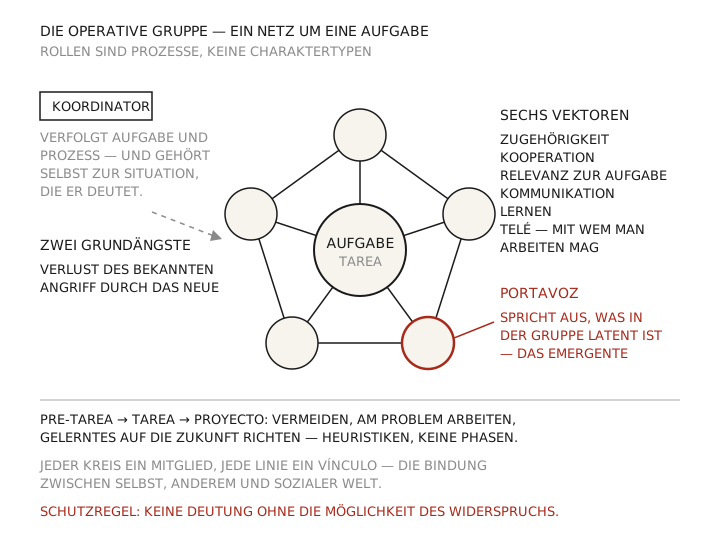
The diagram is not a validated test that outputs objective group scores; the concepts overlap, and the judgement hangs on the coordinator. What stays useful is the multidimensionality. A group can communicate a great deal and learn little, hold tightly together and avoid the task, cooperate and shut out critical voices. A single satisfaction score would hide all of that. Telé too demands sobriety: a person may be avoided because she recalls an earlier conflict — or because she does in fact interrupt others. Transference and real behaviour work together, and no affective interpretation may be passed off as secret knowledge about others.
That brings the most delicate role into view. The coordinator keeps task and process in sight, formulates hypotheses, and is not meant to make the group dependent on him. His power stays real all the same: who is allowed to speak, which emotion is named “resistance”, and when progress has occurred can all be defined by him. Group work therefore needs transparent aims, supervision and robust opportunities to object. A good hypothesis is provisional and handed back to the group: “We have been talking about side issues for twenty minutes, ever since responsibility became unclear.” It does not claim to possess the unconscious truth.
Rosario and the school
The Experiencia Rosario turned a clinical method into a social procedure. People from different disciplines worked in small groups; coordination and observation were meant to let knowledge circulate horizontally instead of being handed down from a podium. It was there that the methodology of the operative groups was first presented in public.
What Rosario was not: a randomised experiment. There was no control group, no before-and-after measurement, no effect size. Its value lay in the intervention and in the institutional experience — and in the demonstration that the method works beyond the clinic, in education and in community settings. With that widening, however, grew precisely the question Rosario left open: how do you test it?
Institutionally Pichon-Rivière answered with a training school of his own. Around 1953 he founded the Escuela de Psiquiatría Social, which from 1967 was called the Escuela de Psicología Social. It trained coordinators and spread the operative groups through Argentina and Latin America. Private schools make innovation possible, but they also tie knowledge tightly to a founder and a vocabulary of its own. Where internal recognition replaces outside scrutiny, orthodoxy sets in. A living tradition has to operationalise its concepts, compare itself with other theories of the group, and document its failures. Pichon-Rivière died on 16 July 1977 in Buenos Aires.
Where the method ends up
In learning settings, operative groups can work knowledge over actively instead of absorbing lectures passively. In health-care teams they make anxiety, hierarchy and conflicts over the task discussable. Community projects use them for shared problem-solving. In companies, though, the same method can raise productivity without changing power: employees speak openly, management uses the information. Before starting, therefore, the commission, the confidentiality and the consequences must be settled. Who receives reports? Can participation be declined? Will structural problems be worked on, or will staff merely be adjusted to them? A method is not emancipatory by virtue of its origin; its political effect hangs on the institutional contract.
Nor does every goal call for a group. Some skills need direct instruction, some personal disclosure a protected one-to-one setting. The method has to follow the task, not the other way round — which would be the most consistent application of Pichon-Rivière’s own principle.
Theoretically he joined unconscious dynamics to a dialectical view of society: contradictions are not a fault but an engine. That synthesis was enormously influential in Latin America and carries a familiar risk. A vocabulary that explains every phenomenon risks little. A politically progressive theory is moreover not automatically effective in the clinic, and an effective technique not automatically socially just; both tests remain necessary, and separately.
What remains
What is documented is a tradition of practice and training with a wide reach, not a body of outcome research. Operative groups are more weakly evaluated internationally than manualised group procedures, and terms such as emergente or ECRO are clinically fertile but hard to code reliably. That is no free pass: randomised trials are not always feasible for organisational interventions, but comparison groups, before-and-after measurement, independent observation and qualitative transparency are. Conversely, narrow scales do not capture everything a group changes — language, belonging, the capacity for a shared task.
In ordinary use what remains is above all a set of test questions. Does this group have a negotiated task, or does it meet because it always meets? Have roles turned from processes into fixed character types? Behind the resistance, is there anxiety or a substantive objection nobody has examined? And the question on which Pichon-Rivière’s whole body of work hangs: is the conspicuous person here the only one with a problem — or the only one saying it out loud? That comes with a safeguard, without which the concept turns dangerous: no interpretation without the possibility of contradiction. The shift from “what is wrong with him?” to “what is happening between us and to our task?” is not the whole answer. But it stops groups from conveniently depositing their conflicts in one person and then diagnosing him for the weight.
Sources, and why they are here
Pichon-Rivière, E. (1971). El proceso grupal: del psicoanálisis a la psicología social. Nueva Visión, Buenos Aires.
The foundational text the quotation comes from — and the source for pre-task, task and project as well as for the inverted cone.
Pichon-Rivière, E. (1980). Teoría del vínculo, ed. Fernando Taragano. Nueva Visión, Buenos Aires.
The concept that carries his turn away from classical analysis: the bond as the smallest unit, not the individual drive.
Quiroga, A. P. de (1986). Enfoques y perspectivas en psicología social. Ediciones Cinco, Buenos Aires.
The continuation by his closest collaborator — it shows what became of the method in teaching once its founder was gone.
Becerra, G. (2015). Enrique Pichon-Rivière: los orígenes de la psicología social argentina. Revista Latinoamericana de Metodología de las Ciencias Sociales, 5(1).
Places the origins of the concepts and separates what Pichon-Rivière took from Moreno, Lewin and analysis from what he built himself.
Dagfal, A. (2015). El pasaje de la higiene mental a la salud mental en la Argentina, 1920–1960. El caso de Enrique Pichon-Rivière. Trashumante. Revista Americana de Historia Social, (5).
The institutional frame: how asylum psychiatry turned into a social psychology — and under what conditions that happened.
Vezzetti, H. (1996). Aventuras de Freud en el país de los argentinos. Paidós, Buenos Aires.
The history of Argentine psychoanalysis, without which neither the founding of the association nor the later parting can be understood.