The Journal30 August 202611 min read
Shot for a Survey
Martín-Baró and the psychology that changed who it answered to
On the night of 16 November 1989 a unit of the Atlacatl Battalion entered the campus of the Universidad Centroamericana in San Salvador and shot dead six Jesuits, the housekeeper Elba Ramos and her sixteen-year-old daughter Celina. One of the murdered men was Ignacio Martín-Baró, social psychologist, vice-rector of the university — and head of the only institute in the country that systematically recorded what Salvadorans thought about the war.
The surveys were not the only reason. But they were the part of his work that cut most directly into the war. When government and military claimed that the people stood behind a military solution, a cleanly drawn sample could show how many preferred negotiations. Numbers are no substitute for politics. They shift the burden of proof — and that was exactly what he was after.
A Jesuit and a country where the numbers were contested
Martín-Baró was born in 1942 in Valladolid in Spain. At seventeen he entered the Jesuit order at Orduña in 1959 and was sent to Latin America in 1961. He read humanities in Quito, philosophy in Bogotá, later theology in Frankfurt and Leuven and psychology at the UCA. From 1966 El Salvador became the permanent site of his work.
His Spanish origin matters for understanding his programme. He was not a Salvadoran by birth who automatically spoke for “his people”. He chose belonging, learned from a context that was not his own, and at the same time remained part of an international, educated religious order. Solidarity does not cancel one’s own position; it obliges one to answer to the people one works with. That is precisely what he later turned into a methodological demand.
At the UCA he taught social psychology, took up the office of vice-rector in 1981, headed the psychology department from 1982 and postgraduate study and research from 1989. Biographical accounts describe him as funny, direct and hard-working. Such recollections belong in a portrait, but they are not a personality assessment. His decisions are firmer ground: he stayed despite threats, published inconvenient data, and bound the university to a public responsibility.
Land and wealth were extremely concentrated in El Salvador. Peasants, women workers and indigenous communities had a long history of exploitation and repression behind them. Attempts at reform, social movements and state violence escalated; in 1980 a civil war began between the US-backed government with its military apparatus on one side and the FMLN guerrillas on the other. It lasted twelve years.
Death squads, massacres, disappearances and displacement shaped daily life. The guerrillas also committed human rights violations. In its report From Madness to Hope, however, the UN Truth Commission attributed some 85 per cent of the registered cases to state agents, paramilitaries and death squads. That asymmetry is not a side issue; it is the object on which Martín-Baró’s psychology was trained.
In such a context psychology cannot pretend that the basic situation is a neutral everyday life containing a few disturbed individuals. Fear can be realistic, silence necessary for survival, mistrust a learned protective reflex. The UCA — carried by Jesuits and, under rector Ignacio Ellacuría, grown into a voice for social analysis and negotiation — had thereby become a target itself: buildings were attacked, staff threatened, publications called subversive. Academic freedom there was not an abstract statute but a bodily risk.
Chicago and the question of transfer
Martín-Baró took a master’s in the social sciences in 1977 and a doctorate in social and organisational psychology at the University of Chicago in 1979. He knew experimental method, statistics and the North American canon from the inside. His critique therefore did not grow out of a rejection of science but out of the question of how far it transfers.
Much of social psychology worked with students in safe laboratory situations. Theories of motivation, attitude or aggression could proceed there as though society were the sum of individual variables. In El Salvador, landholding, the army and history governed what a person could do far more strongly than any questionnaire records — a matter of ecological validity that no increase in sample size will settle.
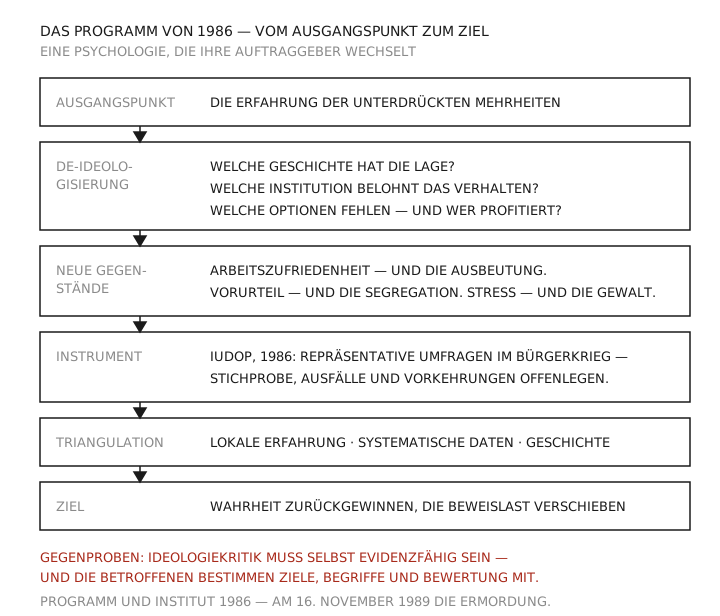
His answer was not to replace data with political opinion but to choose better objects: real problems, historical categories, and procedures that do not cut people out of their world. For every science selects what it examines. Measure job satisfaction but not exploitation, prejudice but not institutional segregation, stress but not state violence, and you produce a political picture by omission. Neutrality can confirm the normality of the powerful. This sharpens Kurt Lewin’s line about good theory being practical: practice must also ask whose problem gets to count as scientific in the first place.
What liberation psychology was meant to mean
In 1986 Martín-Baró stated the programme explicitly, and he put a condition before it:
a psychology of liberation requires a prior liberation of psychology, and that liberation can only come from a praxis committed to the sufferings and hopes of the peoples
What he meant was a psychology that starts from the experience of oppressed majorities, recovers historical truth and advances social change. “Liberation” was not a therapy with a manual but a direction for research and practice, shaped by liberation theology, critical pedagogy and Marxist social analysis.
Its operative core is called de-ideologisation. Ideology here does not mean merely a mistaken party line. What is meant is the effect by which socially produced conditions come to look natural: the poor are poor because they lack drive; violence answers an innate aggressiveness; political calm proves consent. A psychology that measures individual attributes and nothing else props up such stories without intending to. De-ideologisation instead reconstructs the history of a situation and asks which institution rewards a behaviour, which options are missing, and who profits from an explanation.
This is no licence to wave away any unwelcome number as ideology. The critique of ideology must itself be open to evidence; it becomes scientific where it makes hidden assumptions explicit and testable. And it carries a danger of its own: paternalistic representation. An academic can claim to speak for the people and smooth away their variety in doing so. Liberation psychology stays credible only where those concerned have a hand in setting the aims, the concepts and the assessment.
The institutionalised lie
In war, institutions control information. Massacres are denied, victims described as combatants, criticism recast as support for the enemy. When an official lie is repeated constantly through media, authorities and fear, it organises social life. Martín-Baró called this the institutionalised lie: not everyone believes it, but everyone has to take a position towards it. Silence then looks like agreement, private certainty finds no public confirmation, and shared reality falls apart.
The war was therefore fought over words as well. “Terrorist”, “subversive”, “order” and “peace” were not neutral descriptions but assignments of role; anyone calling for negotiations could be declared an enemy by them. Psychology works with labels too. “Aggressive”, “dependent” or “resigned” can be a concrete observation of behaviour or a political disqualification. Martín-Baró wanted to historicise concepts: when did the category arise, who uses it, which action does it make likely?
Hannah Arendt had written about organised lying in politics, Paulo Freire about conscientisation. What was particular to Martín-Baró was the joining of both traditions to empirical social psychology. He wanted not merely to expose ideology but to measure how it structures action and self-image. More recent terms such as epistemic injustice touch on related phenomena but should not be loosely equated with it. The core is political: power decides which experience may count publicly as true.
In 1986 Martín-Baró founded the Instituto Universitario de Opinión Pública, the IUDOP. It ran surveys designed to be representative on political attitudes, living conditions and the war. In a polarised society that was democratic infrastructure: a way of making private refusal publicly visible and therefore shareable.
Surveys in a civil war are methodologically hard. People fear the consequences, regions are unreachable, questions are answered strategically. Sample, non-response and security precautions have to be disclosed. Precisely because such data carry political force, their limits must not disappear — a false finding damages the cause it was gathered for longer than no finding at all.
The same holds for the second source he defended: the knowledge of the population. People know their work, their danger and their community better than any outside researcher does. That does not make experience automatically free of error; rumour, prejudice and imbalances of power exist inside oppressed groups too. The methodological gain lies in triangulation: local experience, systematic data and historical analysis correct one another.
Fatalism, fear and psychosocial trauma
His best-known substantive contribution is the analysis of fatalism — the expectation that one’s own action changes little and that fate or power has already decided. An individualist psychology would read that as low self-efficacy or a passive personality type. In a society where protest is lethal, land reform blocked and poverty inherited, low control is a realistic thing to have learned. Fatalism is socially produced. That does not make it immutable: collective organisation can make efficacy experienceable again. The analysis guards against blaming the victim, but it must not typecast people all over again as passive sufferers — even under duress there is humour, resistance, care and strategy.
Political terror also works far beyond its individual victims. One disappeared person sends a message to thousands: do not speak, do not organise, do not trust. Unpredictable violence makes self-censorship a survival strategy. Clinically this vigilance can persist once the danger has ended — while the danger lasts it is appropriate. Treatment must therefore first establish whether safety has in fact been secured.
For the consequences of the war Martín-Baró coined the term psychosocial trauma. Violence alters not only individuals but families, trust, language and institutions. A community in which denunciation is possible loses social security; mourning stays dangerous for as long as the perpetrators hold power. The term does not devalue individual treatment. People need sleep, stabilisation and trauma-focused help. Social truth, justice and material security are further levels, not alternatives to it.
The night on campus
On 11 November 1989 the FMLN launched a large offensive in San Salvador. The city was gripped by fighting and fear, and parts of the military leadership regarded the intellectuals of the UCA as ideological enemies because they argued for negotiations and structural reform. On the night of 16 November a unit entered the campus. Those murdered were Ignacio Ellacuría, Ignacio Martín-Baró, Segundo Montes, Amando López, Juan Ramón Moreno and Joaquín López y López, together with Elba Ramos and her daughter Celina. The names of the two women must not stand as a footnote: their murder shows that the violence took in witnesses and lives held to be expendable.
The massacre was carried out by members of the Atlacatl Battalion, an elite unit formed in 1980 at the US School of the Americas; the order came from Colonel Guillermo Alfredo Benavides. The UN Truth Commission later reconstructed the chains of command and the cover-up; the legal reckoning dragged on across decades, countries and political resistance.
The act was not a spontaneous lapse by individual soldiers. Training, orders, enemy images and impunity made it possible. Psychological explanations invoking obedience or dehumanisation can illuminate mechanisms; they may neither push the responsibility onto the institution nor load it on the men who pulled the triggers alone. To say the system did it is to forget that people gave orders, carried them out, covered them up — or refused.
What remains
What is documented is a body of work, not a holy picture. Secure are the founding of the institute in 1986, the surveys, the programme of 1986 and the concepts that came out of it: the institutionalised lie, de-ideologisation, socially produced fatalism, psychosocial trauma. Much of that stays contested or open as a measure — the concepts are broad, causal evidence is limited, and the closeness to liberation theology does not transfer to every context. Martyrdom does not improve any of this. A murdered author is not immune to professional argument, and a science honours him better by testing him than by canonising him. The danger of internationalisation lies exactly here: a method that insists on local voices contradicts itself the moment universities in the North define what liberation means in the South.
In ordinary work you recognise his question by where an investigation draws its boundary. A study measures job satisfaction and leaves out the form of contract. A programme trains resilience and does not mention housing. A questionnaire measures passivity without asking what acting has cost so far. In each of these cases a decision has been taken that is rarely declared as one. Martín-Baró did not ask how poor people might be motivated to endure an unjust order. He asked how the order produces fatalism. That question was dangerous to the powerful not because it sounded radical, but because it arrived with samples, margins of error and a date of publication.
Sources, and why they are here
Martín-Baró, I. (1994). Writings for a Liberation Psychology, ed. A. Aron & S. Corne. Harvard University Press.
The English collection of his essays and the source of the quotation — the sentence in which the liberation of psychology stands before the psychology of liberation.
Martín-Baró, I. (1986). Hacia una psicología de la liberación. Boletín de Psicología, 22, 219–231.
The programme in the original, a year before its English reception. Here de-ideologisation stands as the operative core.
Martín-Baró, I. (1983). Acción e ideología: psicología social desde Centroamérica. UCA Editores.
His principal work in social psychology — and the evidence that liberation psychology came out of the discipline and not out of politics.
Freire, P. (1970). Pedagogy of the Oppressed. Herder & Herder.
The pedagogical line he takes up: the forming of consciousness as shared work, not as instruction.
Arendt, H. (1972). Crises of the Republic. Harcourt Brace Jovanovich.
The source of the term with which the article describes the Salvadoran situation: the institutionalised lie.
Lykes, M. B., & Sibley, E. (2014). Liberation psychology and pragmatic solidarity: North–South collaborations through the Ignacio Martín-Baró Fund. Peace and Conflict: Journal of Peace Psychology, 20(3), 209–226.
What became of it after him — and the most honest account of the question of transfer that the article leaves open.
United Nations Truth Commission for El Salvador (1993). From Madness to Hope: The 12-Year War in El Salvador.
The official report on the night on campus. An article about a murdered man must take the deed from a source that is not his own side.
Universidad Centroamericana José Simeón Cañas: biography of Ignacio Martín-Baró and archive.
The institution where he taught, researched and died — and which preserves his surveys to this day.