The Journal10 August 20267 min read
Two Candidates, One Day Apart, No Certainty
The search for the child on whom Watson demonstrated fear
Public domain · Wikimedia Commons
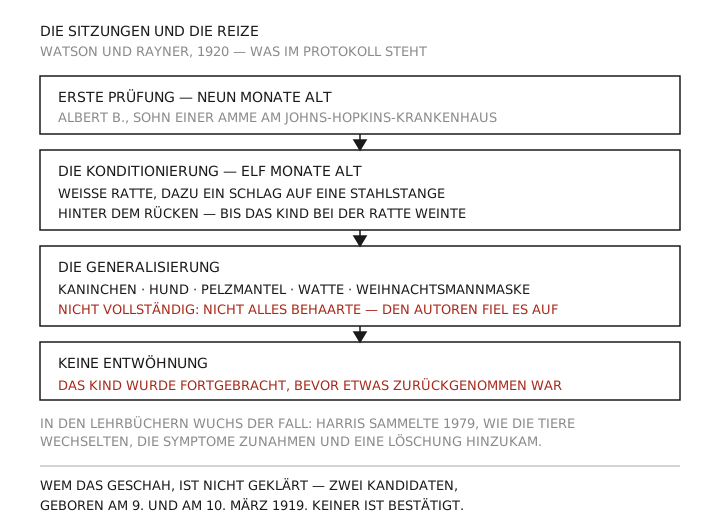
The most famous infant in psychology has no surname. The 1920 report calls him Albert B., nine months old at the first test, son of a wet nurse at the Johns Hopkins hospital. Then the mother moved away, and the field lost sight of the child. A century later there are two candidates for his identity. They were born on 9 and 10 March 1919, one day apart, in the same building, to two women who did the same work there. That is precisely why age is no help in deciding between them.
What the 1920 record says
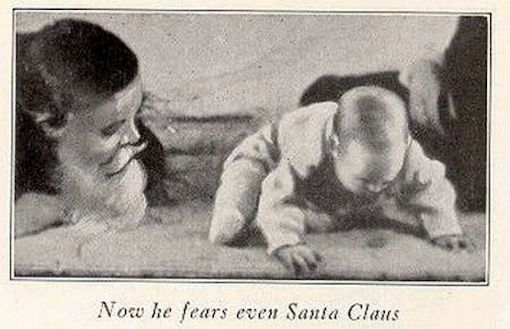
John B. Watson and Rosalie Rayner showed the child, by then eleven months old, a white rat and struck a steel bar behind his back until he cried at the mere sight of the rat. Afterwards he also feared a rabbit, a dog, a fur coat and cotton wool — and, in the test the still above this text shows, the Santa Claus mask. The generalisation was not complete, however: it did not extend to everything hairy, as the authors themselves noticed. Even the core result was blurrier than the later story made it.
A deconditioning of the fear never took place. The report says so in a single subordinate clause on which everything hangs:
Unfortunately Albert was taken from the hospital the day the above tests were made
The child was taken away before anything had been undone. Textbooks nevertheless often say otherwise, and that is not the carelessness of individuals but a documented process. In 1979 Ben Harris assembled the record of how the case was rewritten in introductory works over the decades — the animals changed, the symptoms grew, and an extinction of the fear was invented that had never happened. The classic was a palimpsest as a text before anyone began looking for the child.
The first candidate: Douglas Merritte
In 2009, after years of archival work, the psychologist Hall Beck presented a name. From hospital payrolls, census data and birth registers emerged a wet nurse who lived there at the relevant time: Arvilla Merritte, mother of a son named Douglas, born on 9 March 1919. A photographic comparison with the film frames seemed to support the likeness.
The story darkened when medical records surfaced. Douglas Merritte died in 1925, six years old, of hydrocephalus. In 2012 came the sharpening: Alan Fridlund and Beck himself read the papers as showing that the illness had been present from birth. In that case the experimental child was already neurologically ill in 1920, and Watson would have passed off an impaired infant as “healthy and stolid.” The ethically dubious study would have become a scientifically worthless and additionally dishonest one. Whether the illness was congenital or acquired later is disputed to this day — Beck himself had still spoken in 2009 of an acquired hydrocephalus. Nancy Digdon, Russ Powell and Ben Harris worked through the record against the congenital thesis in 2014; that does not settle the question.
The second candidate: Albert Barger
Also in 2014, Powell and colleagues produced a second candidate, and the chain of circumstantial evidence was uncomfortably good. In the same period, at the same hospital, lived a second wet nurse — and her son was in fact called Albert: William Albert Barger, carried in the records under his middle name, born on 10 March 1919.
The two candidates cannot be separated by age. Both dates fit the report’s age entries to the day, because a single day’s difference disappears in a figure like “eleven months.” What speaks for Barger is other things: the given name, plus weight and developmental entries that fit the sturdy, phlegmatic child of the film. Barger died in 2007 at the age of 87, without ever learning who he might have been for the textbooks. His niece reported to the researchers a family observation that nobody should over-read and nobody forgets: her uncle had a lifelong aversion to animals, dogs included.
The scholarly debate that followed was sharp and productive. The Merritte thesis rests on reconstruction and image comparison; the Barger thesis on name, registers and developmental records. Expert assessments of the photographic identification made clear what face comparison on low-resolution infant film can deliver: little — the biometric comparison counts as inconclusive at best. The quarrel is not settled. The Barger side holds the Merritte thesis finished; the Merritte side has hit back and declared its thesis expressly alive. This archive carries both candidates and neither as confirmed. The irony is complete: of all things, the search for the child of the most famous study of classical conditioning became a case about confirmation bias in the searchers.
Why one trail had the better press
Lay the two dossiers side by side and it is quickly clear why the Merritte trail went through the newspapers and the Barger trail barely did. The Merritte thesis offers a tragedy with a culprit: the sick child, the researcher who concealed it, the early death. The Barger thesis offers administrative prose: a matching name, a matching archival finding, a long, unremarkable life. As journalism that is an unequal contest; as evidence it is a very equal one — and as evidence it is open. Histories of science with perfect dramaturgy deserve the same suspicion as studies with perfect results; they are two forms of the same suspicion.
What is left of the study itself
Of the original study’s scientific substance little remains, and the archive says so plainly in the Watson file: one child, no control condition, the fear described rather than measured. The theory behind it has also turned out to be a fragment. In 1977 Stanley Rachman summarised where the pure conditioning account of anxiety fails. Many phobias arise without a triggering event. Most terrible events produce no phobia. And fear can also be acquired by observing others and by mere information — three routes instead of one.
What lasted is the reversal. As early as 1924 Mary Cover Jones showed with little Peter that fear can be dismantled again through stepwise approach — the primal scene of exposure therapy, which is standard to this day. The therapeutic yield came from the opposite direction of the study, not from the study.
And the ethics? Little Albert is the precedent by which introductory lectures explain what ethics committees are for: an infant deliberately taught a fear, with no documented consent, no reversal, no follow-up. It pays to set the dates side by side. In 1920 the study appears in a journal without anyone objecting. In 1964 Diana Baumrind opens the field’s ethics debate over Milgram. Today no board in the world would approve the arrangement; the study is therefore unrepeatable in principle. It is a classic that is methodologically weak and ethically untenable — and historically irreplaceable, because in it one can see what has changed.
A quiet side lesson concerns the films. That the hunt was possible at all is because Watson had the sessions filmed — probably less as documentation than as publicity material with which he hoped to raise money for a children’s laboratory. The footage that made the study famous became the material on which its claims were checked, its candidates compared and its textbook legends refuted. What a researcher puts on display can testify against him a hundred years later.
What remains
Who was Little Albert? The honest answer is that this has not been settled. Two candidates are in play, their birth dates lie one day apart, and neither can be ruled out on age. For Barger there are the given name and the developmental records, for Merritte the reconstruction and the image comparison, and the image comparison is worth little with this footage. Anyone who passes on either answer as established repeats exactly the error the hunt exposed.
In everyday life this error is recognisable by one sign: the story closes too neatly. A bundle of clues that yields a rounded narrative feels stronger than one that yields only a list — although in terms of evidence the opposite holds. The better news in the case is that the quarrel is fought inside the field, with file numbers and register extracts instead of anecdotes. The files keep the last word — even when they have not yet spoken it. In an archive, that is how it should be.
Sources, and why they are here
Watson, J. B., & Rayner, R. (1920). Conditioned emotional reactions. Journal of Experimental Psychology, 3(1), 1–14.
The report itself. Both quotations come from it: the sentence about the child being taken away and the mocking passage about the Freudians — both read in the original.
Harris, B. (1979). Whatever happened to Little Albert? American Psychologist, 34(2), 151–160.
The demonstration that the case was already being rewritten as a text long before anyone searched for the child: changing animals, growing symptoms, an invented extinction.
Beck, H. P., Levinson, S., & Irons, G. (2009). Finding Little Albert: A journey to John B. Watson's infant laboratory. American Psychologist, 64(7), 605–614.
The first candidate, Douglas Merritte, reconstructed from payrolls, census data and birth registers.
Fridlund, A. J., Beck, H. P., Goldie, W. D., & Irons, G. (2012). Little Albert: A neurologically impaired child. History of Psychology, 15(4), 302–327.
The sharpening that brought the case into the newspapers: had the illness been congenital, Watson would have passed off a sick child as a healthy one.
Powell, R. A., Digdon, N., Harris, B., & Smithson, C. (2014). Correcting the record on Watson, Rayner, and Little Albert: Albert Barger as „psychology's lost boy“. American Psychologist, 69(6), 600–611.
The second candidate — and the uncomfortably good chain of circumstantial evidence: the same place, the same time, the same work by the mother, and this time the matching first name.
Digdon, N., Powell, R. A., & Harris, B. (2014). Little Albert's alleged neurological impairment: Watson, Rayner, and historical revision. History of Psychology, 17(4), 312–324.
The counter-examination of the congenital thesis on the same documentary record. It does not settle the question — but it shows that the question is not settled.
Cover Jones, M. (1924). A laboratory study of fear: The case of Peter. Pedagogical Seminary, 31, 308–315.
The opposite direction, four years later: fear can be dismantled step by step. The case's therapeutic yield comes from here, not from Watson.
Rachman, S. (1977). The conditioning theory of fear acquisition: A critical examination. Behaviour Research and Therapy, 15(5), 375–387.
Shows where the pure conditioning explanation fails — and names the three routes by which fear is actually acquired.