The Journal29 August 202613 min read
Acting while the fear remains
Morita's therapy and what the evidence actually supports
In 1919 Shōma Morita began treating patients as inpatients in his own house. Anyone admitted first spent several days in bed: no reading, no conversation, no occupation. Light work followed, then heavier work, and finally the return to ordinary life. The point of that order was not that the fear should disappear. It was that the fear should be allowed to stay while the person did what needed doing.
An anxious person usually waits for the inner state that permits action: calm first, then the examination; confidence first, then the conversation; no more panic, then the train journey. Morita reversed that order. His principle of arugamama — things as they are — is easily sold today as a Japanese precursor of modern acceptance therapy. That is partly plausible and historically too smooth. To understand his idea, philosophy, clinic and power have to be looked at together.
Kōchi, Tokyo and an imported psychiatry
Morita was born in 1874 in Kōchi Prefecture, studied medicine in Tokyo, specialised in psychiatry and later taught at Jikei University. Biographical accounts describe him as sensitive, preoccupied with his body and under pressure from his family to succeed. The story is often told that he overcame his own neurosis when financial hardship and the pressure of examinations forced him to work despite his fear. The scene fits the later therapy perfectly — which is exactly why the sources need scrutiny. Founder biographies like to arrange early episodes so that the theory is already visible in the child. What is documented is his clinical interest in people who watched their bodily signals, their doubts and the judgement of others with great intensity.
The Meiji and Taishō eras changed Japan’s institutions, its education and its self-understanding. Western medicine was actively imported, and German psychiatry carried great weight. At the same time, specialists were looking for approaches that did not treat Japanese experience and philosophy as a mere deviation from Europe. Morita therefore cannot be told as an unadulterated “Eastern” therapist set against the West. He was a modern physician, read Western psychiatry and developed his method in an urban academic world. Zen, everyday ethics and Japanese concepts played their part, but not outside international science. The interesting question is not whether his therapy is Eastern or Western, but how an imported discipline produced new local problems, concepts and practices.
Shinkeishitsu and the loop of self-observation
Morita treated people with shinkeishitsu, often translated as a nervous disposition, neurasthenia or Morita neurosis. The range covered social anxiety, obsessions, phobias, health anxiety and intense self-observation; the term fits no present-day DSM or ICD diagnosis. Behind it Morita described a sensitive, perfectionist temperament with a strong desire to live. It was precisely the wish to be healthy, safe or accepted that could intensify the fear: the person monitors the inner state, discovers more deviation and tries to control it harder still. This is no verdict on character. Sensitivity and conscientiousness can be strengths. What becomes a problem is the rigid loop in which every feeling turns into a test of one’s own fitness.
For that loop Morita had a term of his own, seishin kōgo sayō: the mutual reinforcement of attention and sensation. Check your heartbeat and you notice it more clearly; the clearer signal seems dangerous; attention rises further. Blushing, breathing, doubt or sleep can be monitored in the same way. The mechanism sounds modern, and research on anxiety disorders does show that selective attention, safety behaviour and the misinterpretation of bodily signals can keep symptoms going. Morita’s description was won in the clinic rather than established by today’s experimental methods — but it caught a real feedback loop.
The solution is not to switch attention off. Order yourself not to think about your heartbeat and you monitor, without noticing, whether the thought has gone. That matches the ironic process of mental control: to check whether an unwanted thought has vanished, part of the mind has to look for it, and under strain the search is exactly what keeps it available. Hence fear of fear, shame about shame, sleeplessness out of the effort to sleep. Morita therefore moved the point of reference: away from the inner state, towards activity and environment.
His reading of the fear itself is worth noting. Behind it he saw a strong desire to live — to be healthy, to succeed, to belong, to keep control. Fear was not simply an enemy but the shadow of a value. Those with nothing to lose fear less; those who want to live are vulnerable. The reframing reduces shame without declaring every fear useful: its energy can be traced back to a real task. It is more precise than the label “an overly anxious personality”, because it asks which goal lies hidden in the attempt to control.
Four phases: bed, light work, heavy work, everyday life
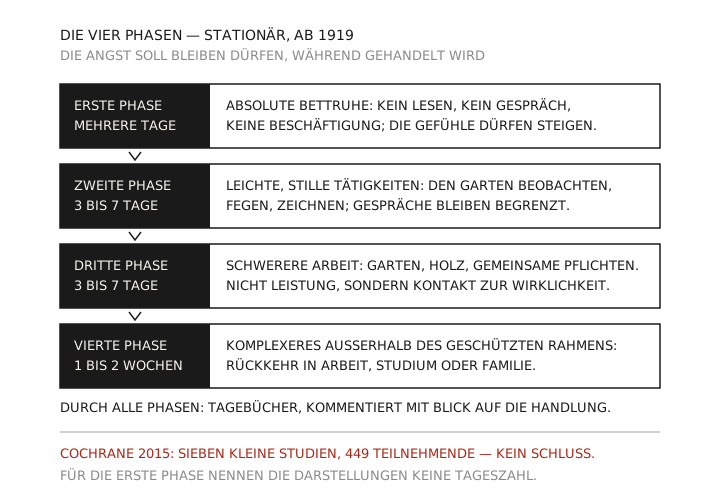
The first phase was absolute bed rest over several days, with reading, speaking and occupation severely restricted. The person was not to avoid the inner state through constant activity; feelings could rise, shift and eventually become boring. Seen from today, this phase is both fascinating and troubling. It resembles an intensive exposure to inner experience, but it can do harm in depression, trauma, psychosis or physical illness, and isolation as much as medical authority limits autonomy. Modern adaptations of Morita therapy often drop absolute bed rest or alter it.
Light, quiet activities followed, and after them heavier work, in accounts of the method for three to seven days each: watching the garden, sweeping, drawing; later gardening, woodwork or communal duties. Conversation stayed limited. The aim was not achievement but contact with spontaneous curiosity and outer reality. Activity did not serve as distraction in the sense of “don’t think about the fear”. The person was to bring the fear along and respond to concrete demands. A floor can be swept although the body is restless — and out of that comes experiential knowledge: feeling and action need not point in the same direction. The model follows the logic of behavioural activation. Motivation need not be fully present before the act; acting can change motivation and competence.
The fourth phase, one to two weeks, practised more complex activities outside the sheltered setting and prepared the return to work, study or family. The therapy did not aim at a permanently symptom-free interior but at a working life with changing feelings. Avoidance shrinks the day; returning widens it. Symptom reduction still matters, though: if fear diminishes through new experience, that is no betrayal of acceptance. The problem lies only in making the decrease a precondition for every action.
Running through all the phases were diaries about activity and experience, which Morita or his staff annotated — mostly with an eye on the concrete act rather than on endless symptom analysis. Writing can create distance and continuity. But it can itself become an act of control: how strong was the fear? Was I accepting enough today? Sensible feedback therefore points not at a perfect inner balance sheet but at environment, task and learning. And what counted in the clinic as “heavy work” must not become an ideology of hardship: being overtaxed can confirm the fear, aggravate physical illness or produce shame. Whether a task is therapy or obedience depends on purpose, voluntariness and relationship.
Arugamama is not fatalism
Arugamama is translated as “things as they are”. What is meant is not replacing facts and feelings with wishful thinking. The rain is there, the fear is there, a task is there; acceptance saves the extra fight against what already exists. Fatalism says: because it is so, I can do nothing. Morita’s acceptance says: because this is the starting position, I can act appropriately. It separates the present, which cannot be changed, from the next action, which can. Acceptance is not emotional assent — nobody has to like panic in order to take a step with it.
The distinction matters politically too. No one should “accept” violence, discrimination or exploitative work as though these were natural events. An inner readiness to bear fear must not legitimise outward obedience.
Morita knew Buddhist and especially Zen-adjacent ways of thinking; ideas such as non-attachment and immediate reality suit his therapy. He himself, however, stressed medical observation and did not want his method understood as religious practice. International accounts frequently exoticise him: the wise East accepts feelings, the controlling West fights them. That opposition is historically false. Japan held a variety of therapies, and Western Stoics, phenomenologists and behaviour therapists developed ideas of acceptance as well — paradoxical intention, for instance, asks for precisely the thing a person is afraid of.
Even the founder’s name is a question of translation: Western texts call him Shōma Morita, though his given name is also read as Masatake. Japanese characters, name readings and transcription systems produce variants. The footnote points at a larger problem. Terms such as shinkeishitsu and arugamama often stay untranslated because no English word carries all of it — which preserves precision and markets exoticism at the same time. A foreign word is no proof of deeper wisdom; its value lies in carrying a distinction that is easily lost in the target language.
What the evidence supports
Morita therapy has been applied and altered in Japan and internationally. There are case series, clinical trials and reviews, but methods, diagnoses and interventions are heterogeneous. A Cochrane review from 2015 found, for anxiety disorders, seven small trials — all of them Chinese — with 449 participants in total, rated the evidence as very low, and drew no conclusion about effectiveness:
we graded the evidence as very low quality and were unable to draw conclusions on the effectiveness of Morita therapy in the treatment of anxiety disorders
The evidence base is thus smaller and harder to compare than for the large manualised standard treatments.
Positive results may come from specific principles — or from intensive care, structure, expectation and the selection of motivated patients. Without good control conditions the shares cannot be separated. Cultural fit can raise the acceptability of a treatment, but it is no proof of effect. The honest conclusion is neither “centuries-old wisdom, scientifically confirmed” nor “unproven and worthless”: there are plausible mechanisms and a clinical tradition, and for specific diagnoses high-quality, transparent comparisons are needed.
Then there is the question of whom the method was meant for in the first place. Classical Morita therapy grew out of neurotic anxiety and obsessional problems. Acute psychosis, severe suicidality, mania, substance withdrawal or medically unexplained complaints require different or additional care, and absolute bed rest can worsen depression and physical risks. Nor does the method fit culturally by default: some people experience sparse therapeutic comment as respectful, others as cold; work can give meaning or recall exploitation. And acceptance must never serve to avoid necessary medical investigation. A cardiac symptom can be anxiety and must be examined physically when warning signs appear.
Kinship with exposure, behavioural activation and ACT
Exposure therapy confronts avoided situations and lets new expectations form. Behavioural activation encourages meaningful activity despite low motivation. Metacognitive approaches examine the relationship to thoughts. In all three there are clear parallels with Morita — and the mechanisms are still not identical. Classical Morita therapy draws on a comprehensive understanding of life and nature, on residential phases and on a particular therapeutic authority; modern behaviour therapy states its hypotheses more operationally and works more collaboratively. The same holds for acceptance and commitment therapy. The sentence “the feeling may be there, the action follows the value” sounds Moritan, yet ACT grew out of functional contextualism and relational frame theory and has its own exercises and research programmes. Morita developed his approach decades earlier in a different clinical and cultural context. ACT is not simply Western Morita therapy, and Morita is not an early announcement of ACT.
Three examples show what the shared logic looks like. In social anxiety, someone who fears blushing watches their face, their voice and the reaction of others; that inner camera consumes attention and makes the conversation more awkward. The apparent piece of evidence — “I was clumsy” — is partly an effect of the attempt at control. Morita’s answer would not be to talk oneself into composure but to turn towards the task: listen, ask a question, say your piece. The blush may come along.
Obsessive-compulsive problems, in turn, demand certainty. Is the door really shut? Was the thought dangerous? Checking relieves in the short run and reinforces the significance of the doubt in the long run. Exposure with response prevention counts today as a particularly well-supported treatment: meet the trigger, do not perform the ritual. It has to be planned, dosed and, where needed, professionally accompanied — acceptance is no invitation to ignore real risks. And sleep is the plainest example of indirect control: force yourself to sleep now and you check how awake you are and generate tension. Cognitive behavioural therapy for insomnia uses stimulus control, sleep restriction and altered beliefs for this; it has its own evidence and must not be replaced by general advice about acceptance. The shared insight remains that sleep cannot be compelled — and that removes guilt. Sleeplessness is not a lack of discipline. Too much effort is often part of the loop.
The authority built into the method
Morita’s clinic was hierarchical. The doctor determined phases, activity and contact. In the Japanese medicine of the time such authority was more ordinary than in today’s collaborative psychotherapy; some patients will have found the structure a relief, others had little room to object.
A therapy that preaches acceptance carries a particular risk of misuse: refusing the treatment can be reinterpreted as neurotic resistance. Modern practice therefore has to check consent repeatedly and treat criticism as possible information. The core of the method — do not control feelings, act in relation to meaning — needs no unlimited authority. A jointly agreed goal can even strengthen it, because the action then follows from the person’s values rather than from obedience.
A philosophical point hangs on this. The weather metaphor suits Morita: rain cannot be argued away, but umbrella, route and destination can be chosen. It prevents the moral grading of feelings — fear is not a failure, joy not an achievement. Yet feelings are not only weather. They carry information about relationship, danger and need, and acceptance must not mean never understanding them. For Morita, the free person is not the one who orders up every feeling but the one who can choose an action under the given conditions. That freedom is limited, but practical.
What remains
Morita died in 1938, but institutes and various schools carried his work on. International adaptations combined it with Naikan, with counselling or with Western psychotherapy and tried it on conditions Morita had never treated — in 1993 LeVine described Morita-based work with bulimia nervosa across cultural boundaries. The origin story itself stayed in motion as well: a Japanese paper from 1991 looks for the roots of the method in Morita’s relationship with the haiku poet Shiki. With every translation the procedure shifted, from a residential ordering of life to flexible outpatient principles. That can be development or the hollowing-out of a brand. If every recommendation to act despite fear is called “Morita”, the term loses its historical edge; if only the rigid four-phase setting counts as genuine, a method turns into a museum.
What holds is the mechanism, not the programme: a Japanese psychiatrist described early and precisely how attempts at control and self-observation intensify fear, and built from that a treatment that uncouples action from feeling. Parts of it coincide with principles that are well supported today. What remains contested is the effectiveness of the whole package — the 2015 Cochrane finding simply permits no conclusion, and the historical setting has ethical limits as well as empirical ones. In everyday life the difference shows in how success is defined. Someone who asks after a talk whether they were calm is measuring the interior; someone who asks whether they stated their argument clearly is measuring the action. Morita’s sentence to the present is not “feel nothing”. It is: life does not wait for the perfect inner state.
Sources, and why they are here
Morita, S. (1928/1998). Morita Therapy and the True Nature of Anxiety-Based Disorders (Shinkeishitsu). State University of New York Press.
The foundational text in its English edition — here the loop of self-observation and the four-phase structure stand in Morita's own account.
Kitanishi, K., & Mori, A. (1995). Morita therapy: 1919 to 1995. Psychiatry and Clinical Neurosciences, 49, 245–254.
The development of the method across three generations: what survived of the inpatient four-phase form once it moved to outpatient care.
Kitanishi, K. (2005). The philosophical background of Morita therapy. In W.-S. Tseng, S. C. Chang & M. Nishizono (eds.), Asian Culture and Psychotherapy (pp. 169–185). University of Hawaii Press.
Places arugamama in its intellectual history — necessary because the term is regularly mistaken in the West for fatalism.
Moriyama, N. (1991). Shoma Morita, founder of Morita therapy, and haiku poet Shiki: origin of Morita therapy. Japanese Journal of Psychiatry and Neurology, 45(4), 787–796.
The biographical trail to Masaoka Shiki — it shows that the method's stance is older than its clinic.
LeVine, P. (1993). Morita-based therapy and its use across cultures in the treatment of bulimia nervosa. Journal of Counseling & Development, 72(1), 82–90.
An early attempt at transfer across cultural borders — and an example of how much the method changes in the process.
Wu, H., Yu, D., He, Y., Wang, J., Xiao, Z., & Li, C. (2015). Morita therapy for anxiety disorders in adults. Cochrane Database of Systematic Reviews, CD008619.
The source of the quotation and the article's most sober finding: seven small trials, all of them Chinese, evidence of very low quality, no conclusion on effectiveness.