The Journal29 August 202612 min read
The village instead of the asylum
How Lambo organised psychiatry without walls in Abeokuta
When Thomas Adeoye Lambo took charge of the psychiatric hospital at Aro near Abeokuta in 1954, a modern building project existed on paper while the care did not exist in reality. Beds were scarce, money was scarce, patients were there. Lambo made a decision that was organisationally simple and conceptually radical: residents of neighbouring villages took people with mental illness into their houses for payment. By day the patients came for treatment; in the evening they returned to an ordinary social life.
The Aro Village System became internationally famous. It seemed to reconcile opposites: hospital and community, Western medicine and Yoruba context, scarce resources and more humane care. Yet it is precisely that success which invites legend. Was Aro an indigenous alternative, a pragmatic makeshift, a modern clinic with outsourced accommodation, or all of these at once? The answer does not only tell the story of Lambo. It tells who gets to decide what universal psychiatry means.
Abeokuta, Birmingham, Maudsley
Lambo was born in 1923 in Abeokuta into a Yoruba family. He attended Baptist Boys' High School from 1935 to 1940, studied medicine at the University of Birmingham and specialised from 1952 at the Maudsley Hospital and the Institute of Psychiatry in London. He therefore commanded the language of the very institutions that had so often described the African psyche from the outside. His position was nonetheless not that of a mediator between two finished cultures. Nigeria was on its way out of British colonial rule; cities, education, religions and family forms were changing. “Western” and “traditional” were not sealed blocks. That multiple belonging gave Lambo access and created pressure: in London he had to assert scientific equality, in Nigeria to build up care, and internationally to explain cultural difference without confirming colonial stereotypes.
What he found was a literature that read psychological difference as racial inferiority. In 1953 the British psychiatrist J. C. Carothers claimed, in a monograph published by the World Health Organization, The African Mind in Health and Disease, far-reaching peculiarities of the “African mind” and tied them to primitive brain function. Such texts gave domination a medical language. Lambo contradicted them. In a 1955 paper on the role of cultural factors in paranoid psychosis among the Yoruba he argued for fundamental commonalities in the human psyche alongside culturally varied forms of expression. Racial hierarchy was neither a necessary nor a scientifically good explanation. Culture was to be taken seriously, but not as an exotic defect.
That produced a theoretical dilemma which never left him. Stress universality and Western diagnoses can become the world’s standard without being tested. Stress difference and people can be locked into rigid cultures. Lambo moved between the two dangers: equal humanity without cultural blindness.
How the village system worked
Early colonial institutions in Nigeria served mainly to house people considered dangerous or disruptive. General practitioners rather than psychiatrists ran them, and therapeutic provision was limited. The asylum protected public order rather than organising personal recovery. Aro Mental Hospital, opened in 1954, was meant to be more modern — but a building alone does not create care. Staff, medication, accommodation and trust all had to be built first, and Lambo saw that a fully European model of the large asylum was expensive and socially alienating.
The solution therefore arose from ethics and scarcity at the same time. That matters: more humane care need not be born of pure idealism, and economic constraint can trigger innovation. What counts is whether a saving improves rights and quality of life or merely shifts the burden invisibly onto families. Households in the surrounding area let rooms to patients and received payment; family members could come along, and medical staff remained responsible for treatment and supervision. Patients moved between clinic and village, took part in everyday activities and lived less isolated than on locked wards. The social environment was not scenery but part of the care. The system began in 1954 and quickly drew international interest; in 1960 the film The Healers of Aro was made about it.
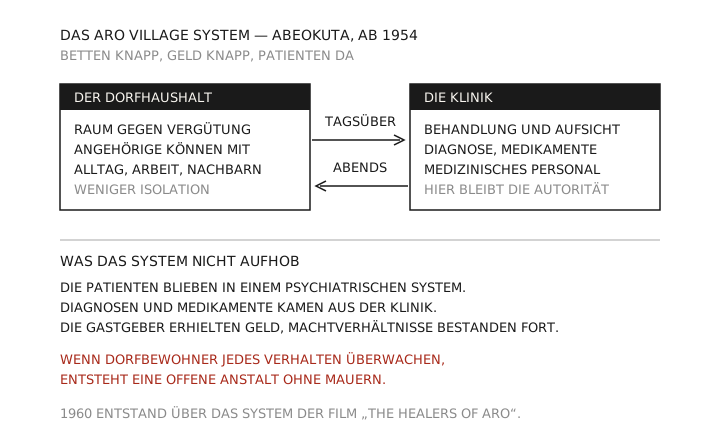
The arrangement did not amount to full freedom. Patients remained inside a psychiatric system, diagnoses and medication came from the clinic, the hosts received money, and relations of power persisted. “In the village” must not automatically mean “self-determined”. Community-based psychiatry emphasises relationships, familiar language and everyday roles; families can notice symptoms early, support medication and preserve belonging. But families are not always safe. Conflict, violence, shame and exhaustion can worsen illness, and unpaid care falls mostly on women. A system that romanticises community may be saving money at the expense of those whose work goes uncounted. Aro tried to pay its hosts and to keep clinical structures in place. Any transfer to the present must still ask: can the patient choose? Are there routes for complaint? Who inspects the quality of the housing?
Healers, language and the limits of translation
People in Nigeria sought and still seek help from several systems: from families, religious communities, traditional healers and biomedical clinics. Lambo recognised that Western psychiatry could not simply displace this reality, and took an interest in local explanations and practices. Historical accounts exaggerate, however, when they claim that Aro integrated all traditional healers into the clinic as equals. Cooperation and demarcation shifted, and the biomedical institution kept its authority. A precise history avoids the image of harmonious fusion. Cooperation remains complex today as well: some rituals give meaning and social support, other practices can mean coercion, financial exploitation or physical harm — and biomedicine, conversely, has risks of its own. Cultural humility does not mean approving every custom, but examining benefit, harm and rights together with those involved.
Language is more delicate still. Psychiatric assessment hangs on words for voice, thought, body and person. An expression that carries religious or social meaning in Yoruba can sound like delusion in an English-language interview; conversely, clinicians can miss a severe disorder if they explain everything as culture. A symptom is neither culture-free nor arbitrary. Hearing voices can carry different meanings and different burdens in different contexts, while loss of function, danger and subjective suffering remain important clinical questions. Qualified translation therefore involves more than words. It asks who in the community shares an experience, how it is judged and what has changed for the person. The interpreter is not a language cable but part of the diagnostic situation.
Lambo made his main case with the severe psychotic illnesses. He wanted to show that people in Africa do not possess a fundamentally “primitive” different psyche: comparable patterns of disorder could occur in Nigeria and in other societies, even where contents and courses were culturally shaped. The diagnosis of schizophrenia, however, has a European history of its own and criteria that have changed; it is no immutable object of nature. The scientific task is to test comparability without forcing local experience under a foreign grid. Lambo’s universalism was politically progressive because it rejected racial inferiority — and it could at the same time install Western categories as the common core.
Cornell-Aro: Nigeria and Canada compared
In the early 1960s Lambo worked in the Cornell-Aro Mental Health Research Project alongside, among others, Alexander Leighton; the joint report appeared in 1963. The project compared mental health and social conditions in Yoruba communities with data from Stirling County in Canada. What was to be tested was not exotic deviation but a shared relationship between social disintegration and suffering. That was conceptually bold. An African place was not merely an object on which Western theory was tested; the findings were meant to change general psychiatry.
Methodological problems remained. Diagnostic translation, sampling and differing institutions make direct comparisons of rates difficult, and ecological associations prove no individual cause. Even so, the project shifted the frame of reference: at the centre stood no longer “culture contact” as the defect of an African, but the breaking of social networks as a human risk.
That was also a statement about the era. Nigeria became independent in 1960; decolonisation meant political hope, institutional reconstruction and conflict. People moved to cities, educational routes and labour markets changed, old and new elites negotiated power. Psychiatry liked to explain this as “modernisation” or “culture conflict” — terms that are too coarse. It is not change as such that makes people ill. What matters is loss of support, violence, poverty, insecurity and the question of who benefits from the change. A tight village can grant belonging and exercise control; a city can produce isolation and offer freedom.
From the village to the WHO
Lambo did not stop at the Aro project. In 1967 he became vice-chancellor of the University of Ibadan and remained so until 1971, organising research, training and international networks. From 1971 he worked at the World Health Organization, from 1973 to 1988 as its deputy director-general. That career contradicts the role of local informant so often assigned to African professionals. Lambo acted at the centre of global health policy — and moved at the same time within organisations whose resources and standards remained strongly shaped by Europe and North America.
Global organisations can spread standards, research and attention. They also risk exporting solutions from resource-rich countries as universal. Lambo’s career embodies that tension. Aro could serve as evidence that community-based care is possible even with scarce means. It could equally be misread as an argument that poor countries need fewer professional resources. “Low cost” is not an ethical measure of quality. An inexpensive intervention is good if it is effective, voluntary and humane — not because a population is to be accustomed to low spending.
What can be measured at Aro — and what cannot
Contemporary reports described favourable courses and reintegration. But historical evaluations do not correspond to today’s randomised trials. Patients were selected, diagnoses were heterogeneous, follow-up could be incomplete. Whether particular symptoms receded because of village life, medication, expectation or natural fluctuation cannot be separated case by case — a textbook instance of confounding. The most plausible benefit of the model lies in less isolation, in a preserved social role and in flexible accommodation. A fair assessment needs several endpoints: subjective well-being, symptoms, coercion, housing stability, burden on the hosts, social participation and long-term safety. Discharge alone can simulate success if the burden moves unnoticed into a household.
The effect on stigma is similarly double-edged. Living in an ordinary village could take the drama out of mental illness; neighbours met patients during everyday activities rather than only behind clinic walls. Yet a house known as the “patients' house” can mark people just as well, and hospitality for payment can be care, a source of income, or both. If villagers monitor every behaviour, an open asylum without walls comes into being. Stigma does not vanish through physical proximity. It changes through rights, roles and reciprocity: can the person taken in work, form friendships and disagree?
These questions can be answered only to a limited degree, and there is a simple reason. Numerous texts about Aro exist, written by doctors, historians and organisations; what is less accessible are connected accounts by the people treated. This is a general problem of archives — systems document their innovation, and patients appear as figures or as successful examples. Without their perspective, housing quality, coercion and meaning cannot be judged. A family may see integration where the person experiences control. Conversely, accommodation that looks modest from outside may offer more belonging than a technically modern ward.
A model and a warning for global psychiatry
Present-day programmes try to expand mental health care in countries with few specialists, for instance through trained lay workers and integration into primary care. Aro appears there as an early forerunner of task-sharing; the Lancet Commission on global mental health referred explicitly to the system in 2018. The parallel is useful when it stresses local design, supervision and social resources. It becomes dangerous when “community” serves as free substitute psychiatry. People in Nigeria have the same claim to effective medication, qualified professionals and human rights as people in rich countries. And global aid has to move knowledge in both directions: community models from Africa are not merely cheap solutions for Africa, they can serve as a critique of over-institutionalised systems elsewhere.
The historian Matthew Heaton has drawn a conclusion for this whole field that holds for Aro as well:
the history of transcultural psychiatry might have more to tell us about the politics of the „transcultural“ than the practice of „psychiatry“ in post-colonial contexts
Lambo’s conflict later turned into a training goal called “cultural competence”: professionals are to know the values and communication styles of different groups. This can reduce errors, but it easily reduces people to checklists — “Yoruba believe X”, “Africans explain Y” — and overlooks internal variety. Cultural humility is the better supplement: examine your own assumptions, ask about individual meaning, acknowledge the gradient of power. Lambo had to argue against Western doctors who believed they knew Africa without treating Africans as equal producers of knowledge. The answer to that cannot be a new rigid essence of the Yoruba mind.
Behind this stands a philosophical question. Human rights rest on universality: nobody may receive less protection, autonomy or treatment because of their culture. Psychological meanings are at the same time historically and linguistically shaped. A workable universalism therefore fixes no single normal biography. It universalises rights and the duty to give reasons, not every theory of the self, and it permits different goals of healing as long as the person is involved and harm is examined. Lambo fought against a false universalism that mistook European categories for human nature, and against a false relativism that treated Africans as possessing a fundamentally different psyche.
What remains
Lambo died in 2004. What holds of Aro is less than the legend and more than an anecdote: a barely funded hospital organised treatment in ordinary households, reduced social isolation and called the international hierarchy of knowledge into question. The village was no timeless African idyll in this. It came into being next to a modern clinic, worked with cash payments and medical treatment and responded to colonial problems of infrastructure; its residents were not a natural therapeutic resource without interests of their own. Nor did Lambo speak for all Nigerian cultures — Nigeria comprises numerous languages, religions and social worlds, and a Yoruba context cannot be generalised into African psychology. What remains contested above all is the effect: the contemporary evaluations cannot carry a modern verdict on effectiveness, and the voices of those treated are largely missing from the archive.
How to tell an Aro from custody under another name can be put as a set of questions. Who chooses where to live? How are hosts selected, paid and inspected? What medical and psychosocial help stays within reach? How are violence, exploitation or relapse detected? What voice do those affected have in evaluation and governance? Does the model open real social roles or merely relocate confinement? These questions transfer Aro not as a finished recipe but preserve its invention as a principle: treatment takes place in a social life, not only in a brain or in a building. Good global psychiatry therefore begins not with the export of an answer but with redistributing who is allowed to ask the questions.
Sources, and why they are here
Lambo, T. A. (1955). The role of cultural factors in paranoid psychosis among the Yoruba tribe. Journal of Mental Science, 101, 239–266.
Lambo's dissent in scholarly form: basic commonalities of the human mind beneath culturally different forms of expression — against a literature that read differences as a ranking.
Carothers, J. C. (1953). The African Mind in Health and Disease: A Study in Ethnopsychiatry. World Health Organization, Monograph Series 17.
The position Lambo wrote against — and the reason it counted: it appeared under the name of the World Health Organization.
Asuni, T. (1967). Aro hospital in perspective. American Journal of Psychiatry, 124(6), 763–770.
The view from inside the institution by Lambo's successor — more sober than the later story and closer to the reality of care.
Jegede, R. O. (1981). Aro Village System of community psychiatry in perspective. Canadian Journal of Psychiatry, 26(3), 173–177.
The balance after a quarter of a century: what the village system carried, where it depended on staff and money, and why it did not remain in this form.
Leighton, A. H., Lambo, T. A., Hughes, C. C., Leighton, D. C., Murphy, J. M., & Macklin, D. B. (1963). Psychiatric Disorder among the Yoruba: A Report from the Cornell-Aro Mental Health Research Project. Cornell University Press.
The comparison between Nigeria and Canada — the first attempt to answer the universality question with collected data rather than assertions.
Heaton, M. M. (2013). Black Skin, White Coats: Nigerian Psychiatrists, Decolonization, and the Globalization of Psychiatry. Ohio University Press.
The disciplinary history showing that Nigerian psychiatrists were not recipients of a Western discipline but co-authors of its rewriting.
Heaton, M. M. (2018). The politics and practice of Thomas Adeoye Lambo: towards a post-colonial history of transcultural psychiatry. History of Psychiatry, 29(3), 315–330.
The source of the quotation — and the sharpest sentence about the whole field: its history may say more about the politics of the “transcultural” than about the practice of psychiatry.
Antić, A. (2021). Transcultural psychiatry: cultural difference, universalism and social psychiatry in the age of decolonisation. Culture, Medicine, and Psychiatry, 45(3), 359–384.
Places Aro within an international movement — and shows that the question of universality and difference was being asked everywhere at once.
Lancet Commission on Global Mental Health and Sustainable Development (2018).
The present-day frame in which Aro is cited as a model — and the test of whether appeals to it also name the conditions under which it worked.