The Journal30 August 202613 min read
Eight hundred soldiers and a new discipline
How Luria built neuropsychology out of war injuries
In the summer of 1942 a forty-year-old doctor took charge of a neurosurgical rehabilitation hospital at Kisegach in the Chelyabinsk region, on the eastern edge of the Urals, far behind the front. By then he had founded a psychoanalytic society, measured reaction times, put syllogisms to peasants in Uzbek villages, and only taken up medicine in his mid-thirties. In the not quite two years he stayed, Alexander Romanovich Luria saw around eight hundred men with gunshot and shrapnel wounds to the head.
One of them could see letters and still not join them into a readable word. Another could think, but could not bring the thought into a stable sequence of sentences. A small lesion, that was the lesson of those years, does not simply destroy one ability in one place. It interrupts a fabric of perception, language, action and experience — and anyone who wants to know what has broken has to watch how the person fails, not only that they fail.
Out of this work came a discipline. Luria wanted to play neither the brain against culture nor culture against the brain. Higher mental functions, for him, arise in social activity, are mediated by language and other signs, and acquire an organised neural basis. After an injury one therefore asks not only which site is damaged but which activity has fallen apart and which route can reorganise it.
It seems surprising that the science of psychology has avoided the idea that many mental processes are social and historical in origin, or that important manifestations of human consciousness have been directly shaped by the basic practices of human activity and the actual forms of culture.
From Kazan to the Moscow troika
Luria was born in Kazan in 1902 and died in Moscow in 1977. His father Roman Luria was a doctor, later a professor at the University of Kazan and founder of its institute for medical postgraduate training. The family belonged to an educated Jewish minority in the Russian Empire that knew legal and institutional restrictions. The revolution of 1917 opened and destroyed structures at the same time; young students could take academic paths unusually fast.
Luria started early with psychology and took an interest in psychoanalysis. With little formal training he founded a psychoanalytic society in Kazan, corresponded briefly with Freud, and later became secretary of the Russian Psychoanalytic Society. The episode shows intellectual energy and the openness of a period of transition. It also shows the danger of reading later greatness back into every early initiative.
From 1923 he worked at the Moscow Institute of Psychology and developed there the combined motor method: participants responded to words while carrying out a hand movement. Conflict or hidden emotional significance was supposed to show up as irregularity in the movement. The work was published in English in 1932 as The Nature of Human Conflicts; the Russian version appeared in print only in 2002.
The method has occasionally been presented since as a forerunner of the lie detector. The term is misleading. Bodily arousal indicates significance, stress or attention, not reliably a lie. An innocent person can react strongly, a practised deceiver can stay calm. What announces itself here is rather Luria’s basic move: to look for a measurable trace of something that escapes measurement — and to keep the limits of the trace in view.
At a psychoneurological congress in 1924 Luria met Lev Vygotsky. Together with Alexei Leontiev they formed a working group that later became known as the “troika”. Their aim was a psychology that joined biological development, social history and concrete activity. The group was larger than three men; numerous colleagues contributed. The legendary name makes remembering easier and shrinks the network.
Vygotsky argued that higher functions are first organised between people and only later within the person. A child at first remembers with the help of an adult, a knot or a word; later the sign becomes part of inner self-regulation. Culture, in this picture, is not decoration on a finished brain but the medium of its functional development.
A physical tool changes the material environment, a sign the organisation of an action. A shopping list extends memory, a diagram orders relations, language makes plans and rules possible. When someone plans reliably with a calendar, the calendar is not merely an aid to an isolated ability — it belongs to the real system of remembering. Modern approaches to the extended mind formulate related thoughts, in other terms and without the Marxist-historical grounding of the Moscow group.
Luria translated the programme into experiments. Children often talk audibly to themselves while solving problems; he and Vygotsky understood this private speech not as an immature disturbance but as the transition from social instruction to one’s own planning. A child can repeat a rule correctly and still find it hard to use it to guide action. Between knowledge and control lies development. Luria saw the same gap again later in the clinic: after frontal lesions a person can recite the instruction and hold on to the old pattern in what they do.
Uzbekistan 1931 and Cole’s objection
In the early 1930s Luria led two research expeditions to Central Asia, in 1931 and 1932, to Uzbekistan and to the mountain pastures of Kyrgyzstan. Collectivisation, literacy campaigns and new schools were changing life in a short space of time. The team compared people with differing experience of schooling and work on tasks of perception, sorting and inference.
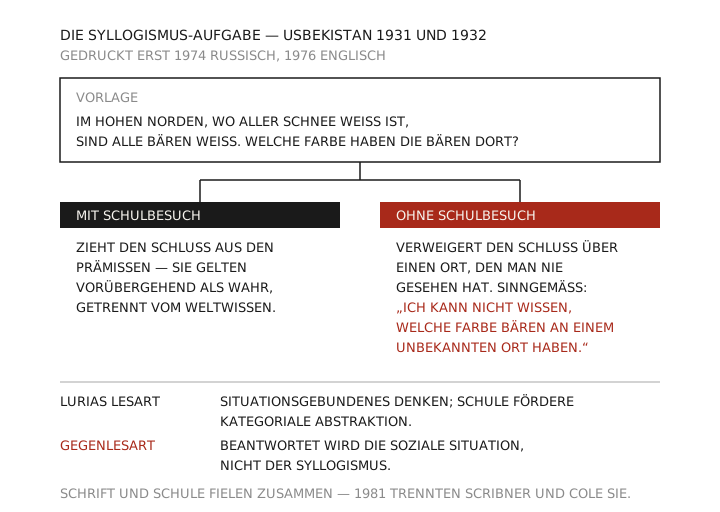
The answers to abstract syllogisms became famous. Some participants without schooling declined to draw a conclusion about a place they had never seen. The canonical task asks what colour the bears are in a far north where all snow is white. Luria read the refusal as thinking more strongly bound to the situation; schooling, he held, promotes categorical abstraction.
The same answers can be read differently. Someone who says they cannot know what colour bears are in an unfamiliar place may be following a rule of conversation: assert nothing without experience. The participant is then answering the social situation rather than the formal syllogism — a classic case of demand characteristics. School examinations, by contrast, teach people to treat premises as provisionally true and to separate them from world knowledge. Anyone familiar with that culture of examination looks more abstract. It is a real cognitive practice, but not the only measure of sound thinking.
The study was theoretically innovative and politically delicate at once. If education changes mental functions deeply, that could count as confirmation of socialist transformation; equally, the differences could be made to look as though whole populations were “backward”. The questions came from Soviet researchers in the middle of a violent campaign of modernisation. Publication was held back accordingly: the Russian original appeared in 1974, the English edition in 1976 — more than forty years after the data were collected.
The editor of that English edition was Michael Cole, and he subsequently qualified Luria’s interpretation on a decisive point. In The Cultural Context of Learning and Thinking (1971), Cole, John Gay, Joseph Glick and Donald Sharp reported studies among the Kpelle in Liberia. Their finding: whether someone classifies or infers “as in the test” depended less on a general stage of thinking than on the format of the task, familiarity with the material and practice at the examination-style exchange.
The sharper cut came with The Psychology of Literacy by Sylvia Scribner and Michael Cole (1981). The Vai in Liberia have a syllabic script of their own, learned outside school from relatives and neighbours. That made it possible to separate what had been inseparable in Central Asia: writing and schooling. Those who commanded only the Vai script acquired narrowly bounded skills tied to the particular literacy practice. The general effects Luria had described — categorical sorting, going along with a hypothetical premise, giving reasons for one’s own answer — depended instead on schooling.
Luria’s central comparison is thereby shown to be confounded. In his samples literacy, schooling, collectivisation and form of employment coincided; what he called “culture” was in large part school. That does not devalue the observations. It only shifts what they report on: not the stages of thinking of populations, but an institution that teaches people to handle questions in a particular way.
From the decree of 1936 to the Kisegach hospital
In 1936 a decree of the Central Committee banned paedology, the field in which testing, developmental psychology and educational research had worked together. Anyone who had published there was exposed. Luria began to study medicine and graduated in 1937. Cole attributes the change explicitly to a wish to withdraw from public view during the purges.
The step was at the same time a genuine theoretical continuation. A brain lesion takes apart precisely those functional systems whose social development he had investigated with Vygotsky. Medical training gave him anatomy, clinical responsibility and access to patients; he combined qualitative tasks with careful analysis of lesions. The question was no longer only whether a person reaches a test score, but what kind of error they make and what help changes it.
A change of career can be tactical and intellectually productive at once. People rarely act from a single motive, especially under political pressure. Demanding moral purity from a position of later safety is easy; making the compromises invisible would be just as wrong.
Vygotsky had died of tuberculosis in 1934 at thirty-seven; parts of his work were restricted or became known internationally only decades later. When the war began, Luria was the bearer of their shared programme — and he carried it into a military hospital.
The eight hundred men at Kisegach offered a tragic abundance of focal brain lesions. The team had to diagnose quickly and develop routes back to speech, reading, writing and work. War thus produced data that nobody would be permitted to create ethically. Scientific gain is no justification of suffering; the appropriate formulation is that Luria used injuries that already existed in order to improve care. The patients did not owe science their wounds.
Rehabilitation was for him also an experimental test. If a targeted strategy rebuilt a function, that said something about how the function was organised. Speaking aloud to oneself can guide an action, writing can be supported through other sensory cues, an external marker can secure spatial orientation. Compensation, in this logic, is no second-rate trick but a new organisation — a thought that matches present-day rehabilitation, where participation counts rather than a return to the identical neural route.
Talk of plasticity must nonetheless promise no miracles. Extent of injury, age, health, intensity of therapy and environment all limit recovery. Hope becomes ethical when it shows possibilities without shaming the loss.
| Detail | Value |
|---|---|
| Expeditions to Uzbekistan and Kyrgyzstan | 1931 and 1932 |
| Russian original of the Central Asian data | 1974 |
| English edition, edited by Michael Cole | 1976 |
| Completion of his medical studies | 1937 |
| Brain-injured men at Kisegach, from summer 1942 | about 800 |
| Duration of the hospital work | almost two years |
Functional systems instead of small centres
Luria’s chief theoretical move dates from the war years. He turned against crude localisationism — the idea that a complex ability sits entirely in a small area — and equally against a holism that credits the whole brain with every achievement alike. His alternative was the functional system.
Writing, for instance, requires speech sounds, visual letter forms, motor programmes, spatial arrangement, attention and control of the goal. Different regions make specific contributions to it. That is why a lesion can disturb the same visible task in quite different ways, and “cannot write” is not yet a neuropsychological explanation. The primary defect and the secondary difficulties that follow from it have to be told apart.
In The Working Brain (1973) Luria grouped the brain into three large functional units: systems for activation and wakefulness, posterior systems for receiving and processing information, frontal systems for programming, regulation and control. The model orders complex findings intelligibly, but it is coarse. Today’s neuroscience knows finer networks and dynamic connections; the same region can make different contributions depending on the task. The lasting value lies in the principle of multi-level cooperation.
His syndrome analysis belongs with this. In standardised tests what usually counts is the number of wrong answers; Luria listened to the quality. Does the person confuse similar sounds? Do they lose the spatial arrangement? Do they stick to the first rule? Does a particular kind of help improve performance? On this basis he also distinguished several forms of aphasia by the impaired functional factor, departing from the Western Broca-Wernicke schemes. Not all of his categories are used unchanged today, and the method demands great expertise, which limits its reliability. Best practice combines the two: standardised comparability and qualitative hypotheses about the route of the error.
Two patients, two books
After the war, Soviet science policy demanded a stronger orientation towards Ivan Pavlov’s theory of reflexes; the joint session of the academies in 1950 made this binding. Luria consequently used Pavlovian language in part, without giving up his functional and cultural programme. In the late Stalin years the antisemitic campaigns then caught him: he temporarily lost his position at the Institute of Neurosurgery and worked, among other things, with children with developmental impairments. Only after Stalin’s death could he return to neuropsychology. The two books for which he became known outside the profession appeared only afterwards.
Lev Zasetsky was a soldier who suffered a severe left-sided brain injury in March 1943 at the battle of Smolensk. Afterwards he had difficulties with vision, space, reading, writing and bodily orientation, and kept a laborious diary over many years. Out of clinical observations and these texts Luria shaped The Man with a Shattered World (1972). The book gives the patient unusually much voice; Zasetsky appears as an agent trying to reconstruct his fragmented world. At the same time Luria selected, arranged and commented. Even an empathetic case history remains a joint construction with unequal authorship.
The Mind of a Mnemonist (1968) describes the reporter Solomon Shereshevsky, who could retain long series of numbers and words to an extraordinary degree. He used vivid synaesthetic images and spatial routes through memory. What looks like a superpower became a burden: unimportant details did not disappear, and abstract thinking and forgetting came hard. Forgetting is, after all, a function — it filters, abstracts and makes the present possible. Here too caution is needed: Shereshevsky’s profile was unique, modern diagnostic terms cannot be applied to him retrospectively, and an anecdote carries no theory of memory.
Luria called this way of working romantic science, in contrast to a classical science that seeks general laws by reduction. “Romantic” does not mean uncritical or sentimental here, but the attempt to understand a single phenomenon within a biography and an activity. The price is visible: qualitative inquiry can depend on the narrative of genius — the master sees what others overlook — and case histories leave out unclear courses more easily than registers do.
What remains
What is secure is the figure of thought, not every map. Complex abilities are systems with several contributions, which is why the same visible disturbance can have different causes and why the quality of an error tells more than the score. It is also secure that rehabilitation tests theory: whatever can be rebuilt by another route was never tied to a single place. Some of Luria’s anatomical assignments and categories of aphasia have been revised; his three functional units are a coarse ordering, not a network model. What has remained contested above all is the Central Asian part of his work. The qualification came from within his own camp: Michael Cole, the editor of his English edition, showed that the syllogism effects hang on schooling — not on literacy or “culture”.
In everyday life the legacy can be recognised by a certain way of asking. When someone fails an examination, a test or a job interview, the Lurian question is not how many points are missing but what the person was actually attempting and what help changes the result. A quiet room, a note, a practised routine can make a performance possible that is absent in the bare test — the environment belongs to the disability as much as to the rehabilitation. And where a procedure sorts whole groups, the second question is worth asking: what exactly is the variable here? In Uzbekistan the answer was school, not culture. Luria himself did not see the difference; the discipline he founded was strong enough to find it.
Sources, and why they are here
Luria, A. R. (1976). Cognitive Development: Its Cultural and Social Foundations. Cambridge: Harvard University Press.
The report on the expeditions of 1931 and 1932 — and the source of the quoted opening sentence on the social and historical origin of mental processes.
Luria, A. R. (1973). The Working Brain: An Introduction to Neuropsychology. Harmondsworth: Penguin.
Sets out the three functional units and the criticism of crude localisation in the version the section on functional systems rests on.
Luria, A. R. (1972). The Man with a Shattered World: The History of a Brain Wound. New York: Basic Books.
The case history of Lev Zasetsky, including the details of the wound, the course and the diaries kept over years.
Luria, A. R. (1968). The Mind of a Mnemonist: A Little Book about a Vast Memory. New York: Basic Books.
The case history of Solomon Shereshevsky; the basis for the description of the synaesthetic mnemonic technique and its costs.
Cole, M., Gay, J., Glick, J. A., & Sharp, D. W. (1971). The Cultural Context of Learning and Thinking: An Exploration in Experimental Anthropology. New York: Basic Books.
The Kpelle studies, which tie classification and inference to task format and familiarity rather than to a general stage of thought.
Scribner, S., & Cole, M. (1981). The Psychology of Literacy. Cambridge: Harvard University Press.
The Vai study, which separates literacy from schooling — the evidence that Luria's Central Asian comparison was confounded.
Cole, M., Levitin, K., & Luria, A. (2006). The Autobiography of Alexander Luria: A Dialogue with The Making of Mind. Mahwah: Lawrence Erlbaum.
Cole's commentary on Luria's move into medicine during the purges and on the emergence of “romantic science”.
Homskaya, E. D. (2001). Alexander Romanovich Luria: A Scientific Biography. New York: Springer.
The biographical landmarks: Kazan, the Moscow institute, the loss of his position in the late Stalin years and the return to neuropsychology.
Akhutina, T., & Pylaeva, N. (2020–2021). Luria in Kisegach, parts 1–3. Lurian Journal.
Reconstructs the work at the Kisegach rehabilitation hospital, its period, the number of wounded men and the methods developed there.
Laboratory of Comparative Human Cognition, UC San Diego: Luria Archive — biography and list of works.
The chronology of the works and their delayed publication, among them <em>The Nature of Human Conflicts</em>, published in English in 1932.