The Journal29 August 202612 min read
The analyst who contradicted Freud
Bose, Calcutta, and a wish that ran the other way
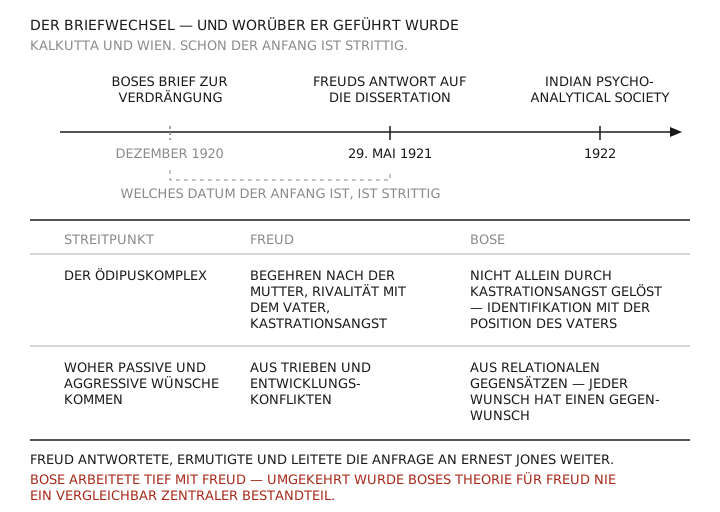
In December 1920 a doctor in Calcutta writes to Sigmund Freud in Vienna. Girindrasekhar Bose sets out ideas about repression that he has developed largely outside the European psychoanalytic circles. Freud replies. What follows is an exchange lasting years — and Bose uses it to contradict the founder of psychoanalysis on one of his most famous claims: the Oedipus complex is not everywhere the same core of human development. Even the date, incidentally, is disputed. Part of the literature has the contact begin only in 1921, with Bose sending his dissertation and Freud replying on 29 May.
The usual story has psychoanalysis flowing out from Vienna into the world: a finished theory is translated and locally adapted. Bose’s biography tells of a more complicated movement. Ideas travelled to Calcutta, met Bengali languages, Hindu philosophies, colonial medicine and clinical observation of his own — and came back as an objection. Translation was not copying but the production of theory.
A scientist in colonial Bengal
Bose was born in 1887 in Darbhanga, in what was then the Bengal Presidency; some accounts say 1886. He studied medicine and psychology at a time when British university and health systems ordered knowledge hierarchically. European science counted as universal; Indian traditions were either romanticised or dismissed as pre-modern. His academic career crossed that boundary. In 1917 he took a master’s degree in psychology; in 1921 The Concept of Repression earned him an early doctorate in psychology at an Indian university — on the common account, the first.
Bose reported that he had initially developed his theory of repression without detailed knowledge of Freud’s writings. His dissertation examined how unbearable wishes are excluded from consciousness and go on working in symptoms; when he read Freud, he recognised both proximity and difference. Parallels of this kind are historically hard to weigh. Ideas rarely arise without indirect influences, and colonial educational worlds carried European concepts even outside direct reading. It would nonetheless be wrong to dismiss Bose’s work as a belated reception of Freud. The more interesting question is what a concept gains when it is reformulated in a different philosophical and clinical field. For Bose, “repression” was not merely translated German vocabulary. It joined itself to models of self, of opposites and of states of consciousness that formed a theoretical architecture of their own.
Read as a person, then, Bose is no straightforward figure of cultural resistance. He sought recognition from Freud and from international organisations while asserting concepts of his own. Dependence and contradiction existed at once — more typical of science under colonial conditions than any choice between imitation and complete autonomy.
What the letter to Vienna risked
A letter to Freud was risky both scientifically and symbolically. Freud held international authority, access to journals and a movement with clear allegiances. Bose came from a colony whose intellectuals were easily treated by European professional worlds as interesting informants rather than as theorists of equal rank. Freud responded openly and encouraged the exchange; the surviving correspondence nevertheless shows no symmetrical partnership. Freud determined which deviations seemed capable of being integrated into his movement, and Bose often framed his objection within a language of deference.
Freud was fascinated by particular Indian motifs but sceptical about religious and mystical interpretations. Bose sent him texts and a gift carrying Indian symbolism. Curiosity stayed unevenly distributed: Bose worked deeply with Freud, while Freud did not make Bose’s theory a comparably central component of his own work. This cannot be explained by personal arrogance alone. Scientific centres possess institutional inertia. Theory from the periphery is read as a cultural variant, while theory from the centre remains “general”. So the periphery has to prove its universality; the centre never has to explain its locality.
Added to this is what the so-called Matthew effect describes: recognition accumulates. Whoever already stands at the centre is read more often and thereby becomes more central still. Bose’s case adds a geopolitical dimension. Contributions from colonies could be classified as regional even when they concerned general theory. A present-day correction of the canon should therefore read his ideas closely rather than merely add his name — representation without engagement with the substance makes him a symbol again instead of an interlocutor.
The theory of opposite wishes
Bose’s characteristic idea was that a wish can be accompanied by a counter-wish. One side becomes conscious while the other stays repressed: to strike and to be struck, to love and to be loved, to submit and to bring about submission. Psychic conflict arises when both sides cannot be borne at once. Therapeutically, free association was to make the hidden counter-position visible. When a person acknowledges both wishes simultaneously, the oscillation of repression loses its compulsive force. Bose was thereby describing not merely ambivalence but a general dynamic principle.
The difference grows sharpest where Bose does not dispute the castration threat but withdraws its cause:
I do not deny the importance of the castration threat in European cases; my argument is that the threat owes its efficiency to its connection with the wish to be a female
The difference from Freud was more than terminology. Freud’s theory explained certain passive or aggressive wishes in terms of drives and developmental conflicts; Bose wanted to understand them as relational opposites. A wish to strike and a wish to be struck were for him connected to each other, not necessarily derived from a primary sadistic drive. That shifted the location of the cause: from a universal dramaturgy of the drives to a structure of reciprocal positions. Freud remained sceptical but for a time offered Bose opportunities to publish.
Empirically the theory is hard to test. Almost any wish can be supplemented after the fact with an opposite. If agreement and resistance both count as confirmation, unfalsifiability threatens. Even so, the model captures a real experience: people want closeness and distance, control and relief, recognition and independence all at once.
The Oedipus complex in a different family order
Freud described in the boy a desire for the mother, rivalry with the father and castration anxiety. Bose reported from his clinical work that among Indian patients the wish to become female oneself, or to love the father from a different position, could play a different role. He questioned the supposed universality of the classical solution. Among his patients the resolution of the conflict could not be explained by castration anxiety alone: the boy could not only fear the father as a rival but identify with his position and work through opposite wishes. Psychic development was thus less a linear defeat of desire than a rearrangement of positions.
Families in Bengal were not simply the opposite of Vienna. Kinship, multi-generational households, religion, gender and authority formed different fields of relationship. A model originating in a bourgeois European nuclear family cannot be taken without examination as the biological drama of every childhood. But nor may Bose’s alternative absolutise “the Indian family”: caste, class, region and religion produce variety, and cultural comparison needs more than two stereotyped pictures of family life.
Clinical case reports, moreover, supply no culture-wide proof. Analysts listen from within their theory; questions and interpretations influence which narratives emerge. When patients took up Bose’s concepts, that could be discovery or therapeutic co-construction. Modern developmental research does not regard Freud’s specific Oedipal theory as an empirically secured universal law either. Bose’s objection is therefore less an alternative theory confirmed today than an early instance of epistemic decentring. His lasting contribution is a question: which parts of a theory describe human development, and which describe its author’s family?
Society, language and the Indian texts
In 1922 Bose founded the Indian Psychoanalytical Society in Calcutta with colleagues. It received full membership of the International Psychoanalytical Association after Freud had passed the request on to Ernest Jones. The step created training, discussion and institutional durability; psychoanalysis was no longer correspondence between two men. The society worked in a colonial city shaped by the Bengal Renaissance, anticolonial politics and intense debate about modern subjectivity. Its members translated more than concepts: they had to decide in which language patients would speak, which family norms applied, and how religious ideas were to be handled analytically. Institutionalisation brings its own power with it. Who is allowed to become an analyst? Which European training standards apply? A society frees knowledge from a single individual and can at the same time create a new orthodoxy.
The question of language was no formality. Therapy hangs on nuance, wordplay, shame and forms of family address. An analysis conducted in English with a patient who thinks in Bengali changes the material — translation can increase social distance or open access to a less burdened form of expression. Bose wrote in English and in Bengali and drew on Indian texts. He thereby unsettled the one-way street on which only European categories get explained. At the same time, an Indian language is no guarantee of authenticity: Bengali has codes of class and education, and Sanskrit terms can carry scholarly authority.
How seriously he took those texts is evident from his bibliography. Bose wrote commentaries on the Bhagavad Gita — in 1931 and again in 1948 — wrote on the Puranas (1934) and on the Yoga Sutras; a book on dreams appeared under the title Svapna. Terms such as manas, buddhi, ahamkara and atman offered maps of mind, ego and self other than those of European drive theory. Translations of this sort harbour two errors. The first is Eurocentrism: Indian philosophy counts only as raw material confirming Western psychology. The second is romantic essentialism: millennia of differing schools become the one timeless Indian psyche. The same holds for dreams. A symbol has no fixed international translation; snake, mother, deity or water carry different associations in different traditions — and for two people within the same culture as well. The safe method begins with the dreamer’s associations, not with a dictionary of symbols. Bose criticised Europe’s universalism; his successors had to apply the same criticism to every standard Indian interpretation.
1933: one room, four hours a week
On 1 May 1933 a psychiatric outpatient clinic opened under Bose’s direction at Carmichael Medical College, today R. G. Kar Medical College. It ran under the Calcutta branch of the Indian Association for Mental Hygiene and counts in Indian professional history as the first psychiatric unit at a general hospital, and in some accounts as the first in Asia. The provision was modest: the college supplied room and furniture, the staff worked largely unpaid, and it opened twice a week for two hours at a time. In the first year 174 patients came.
The location mattered more conceptually than the numbers did. Psychiatry moved out of the closed asylum into ordinary medicine. People could seek help as outpatients without being removed entirely from family and city; physical and mental health lay institutionally closer together. Large specialist asylums were geographically remote and stigmatised, whereas a service in a general hospital reached people earlier, allowed for consultations and trained doctors. After independence, units of this kind spread through medical colleges and became a principal site of psychiatric training. The model has limits — short stays and a biomedical focus can neglect social rehabilitation, and people in rural regions remain far away. But it formulates a practical philosophy: mental suffering belongs in general health care, not in a separate space of social exclusion.
Bose stayed involved in building afterwards too. In 1939 the Indian Psychoanalytical Society opened an institution of its own, the Lumbini Park Mental Hospital. This connection between analysis and care matters, because in global history psychoanalysis easily appears as therapy for a small urban elite: language, time and cost limit access. Whether analytic practice really reached broad provision has to be assessed with historical caution — founding an institution is not the same as widespread access. But the ambition went beyond the private consulting room.
The limits of the case history
Bose’s theories rested on clinical observation and interpretive case examples. Data of this kind can make new patterns visible but are vulnerable to confirmation: the analyst decides which utterance counts as resistance, transference or counter-wish, and independent checking is difficult. The fair historical assessment is therefore not that Bose refuted Freud empirically. He showed that Freud’s claim to universality came out of a limited clinical culture, and he developed an alternative interpretation. Whether that alternative holds more generally is a separate question of proof.
In substance, too, his objection does not go as far as it might. Freud’s models and Bose’s both worked with masculine and feminine, active and passive, and with family roles shaped by their time. Bose’s counter-wishes could make rigid positions more mobile, but at times retained a binary gender order, and female experience mostly appeared mediated by male theorists. An anticolonial correction is not automatically feminist; cultural autonomy guarantees no freedom within the culture. A man can be marginalised in relation to British rule and privileged within family or profession.
Bose lived through the anticolonial movement, the Second World War, famine, Indian independence and the partition of 1947. These upheavals changed Calcutta profoundly. Their influence on any single one of his concepts can only be guessed at; what is certain is that the “self” he analysed lived in a society of colonial rule, nationalism, religion and violence. A therapy that looks only at family fantasy can privatise historical reality. Bose died in Calcutta in 1953; society and clinics continued, and his posthumous standing oscillated between regional veneration and international obscurity.
What remains
What remains of Bose is first of all a method, not a doctrine: the question of a theory’s cultural reach. His specific teaching about counter-wishes is no confirmed fundamental law, and his dialogue with Freud was not between equals. What holds is the institutional step of 1933: psychiatry in the general hospital, a model that shapes India to this day. And the demonstration that knowledge from a colonised country can address the centre without being reduced to folklore. Everything else remains contested: whether his clinic really showed what he saw in it, and whether his alternative is more than a second local theory.
How to recognise the argument today: whenever a psychological claim is made about “human beings” and the sample comes from a single country. Translation looks not for an identical word but for a workable relation between fields of meaning. Self, Ich, atman and ahamkara are not interchangeable. Whoever equates them loses the difference; whoever holds them incomparable ends the conversation. Bose’s work practised a third possibility: concepts are changed in contact. A global psychology needs no perfect Esperanto of the mind, but translations that disclose what they gain, lose and reinvent. The unconscious never had only one capital.
Sources, and why they are here
Bose, G. (1921). The Concept of Repression. Privately printed, Calcutta.
The work Bose sent to Vienna in 1921 — the beginning of the correspondence and the first working-out of his theory of opposite wishes.
Bose, G., & Freud, S., correspondence 1921–1937; Bose's letter of 31 January 1929 and Freud's reply of 9 March 1929 (Sigmund Freud Edition, freudedition.net).
The source of the quotation — and the evidence that the disagreement was aired openly: Freud conceded the connection, but not its direction.
Hartnack, C. (2001). Psychoanalysis in Colonial India. Oxford University Press.
The colonial frame, without which neither Bose's caution nor the attention from Vienna can be understood.
Hiltebeitel, A. (2018). Freud's India: Sigmund Freud and India's First Psychoanalyst Girindrasekhar Bose. Oxford University Press.
The fullest account of the relationship — and the source for what was never settled between the two men.
Dhar, A. (2018). Girindrasekhar Bose and the history of psychoanalysis in India. Indian Journal of History of Science, 53(4), T198–T204.
The brief disciplinary-historical placement: what remained of Bose's concepts in Indian psychiatry and what did not.
Mukherjee, S. (2018). Recovering wisdom of the „ancient rishis“: Girindrasekhar Bose and the psychoanalytic movement in colonial India. South Asian History and Culture, 9, 296–322.
Bose's recourse to the Indian texts — and the question whether he thereby founded a tradition of his own or legitimated a foreign doctrine.
Chadda, R. K., & Sood, M. (2018). General hospital psychiatry in India: history, scope, and future. Indian Journal of Psychiatry, 60(Suppl. 2), S258–S263.
Where care actually went: the article does not claim that Bose's school shaped it — this source shows what grew instead.