The Journal29 August 202613 min read
Thirty Men Nobody Could Tell Apart
Hooker's test and the long road out of the diagnostic manual
Sixty anonymised test protocols lay on the table, shuffled out of order. Three experienced judges — Bruno Klopfer, Edwin Shneidman, and Mortimer Mayer — were asked to do two things: rate each man’s psychological adjustment on a five-point scale, and match the protocols in pairs. Which man was homosexual, which was not? None of the three did better than chance. And in the adjustment ratings there was no difference between the groups.
The stack had been assembled by the psychologist Evelyn Hooker. During the 1950s she recruited 30 homosexual and 30 heterosexual men who were not psychiatric patients. Anyone in therapy, in prison, or with a military disciplinary record did not enter the study. The men were matched in pairs for age, education, and intelligence, and worked through Rorschach cards, the Thematic Apperception Test, and the Make-a-Picture-Story Test. Only then did the protocols go to the judges, without any label.
The impulse did not come from the clinic. A homosexual student and friend called Sam From had challenged Hooker to test scientifically, at last, whether homosexual people really were more psychologically disturbed. Through him she met men whom nobody had recruited as patients. From died in a car accident in 1956, shortly before the work appeared.
Why psychiatry found only the ill
When a science studies only people who are persecuted, committed, or sent into therapy because of a characteristic, it finds distress. It can then mistake the reason for the persecution for the cause. This selection problem is exactly what shaped early psychiatric claims about homosexuality.
The psychoanalytic and psychiatric literature rested largely on people who came into treatment because of conflict, criminal prosecution, or coercion. If they were depressed, anxious, or struggling in their relationships, that was attributed to their orientation. Comparable people outside clinical institutions were never asked in the first place.
Statistically this is selection bias: entry into the sample is itself already bound up with suffering and social pressure. From a collective selected in that way, no inference can be drawn about all members of the group. And diagnoses confirm their own filter. Whoever counts as ill is more likely to be referred; the clinic thereupon finds a great many ill people.
The error is a general one. Anyone who studies criminality only among the arrested, employability only among the unemployed, or personality only among those seeking therapy is mistaking institutions for populations. Hooker’s decisive step was therefore not a new test technique but a new door to the sample. At the same time her recruitment was not representative either: men who moved in subcultural circles and trusted a researcher did not stand for all. She dissolved the clinical bias, not every form of selection.
How desire ended up in a manual
Same-sex desire existed long before modern diagnoses, but it was understood very differently across eras and cultures. In nineteenth-century Europe a medical language emerged that increasingly classified behaviour as a property of a person. This could be directed against a purely punitive morality and at the same time create a new pathologisation. Richard von Krafft-Ebing catalogued sexual “perversions”; Magnus Hirschfeld campaigned for rights and a scientifically informed reform of sexual law. Freud did not regard homosexuality as a crime and warned against easy promises of cure, but his model in many places treated heterosexual development as the norm. Medicine could protect, explain, treat, and control — sometimes all at once.
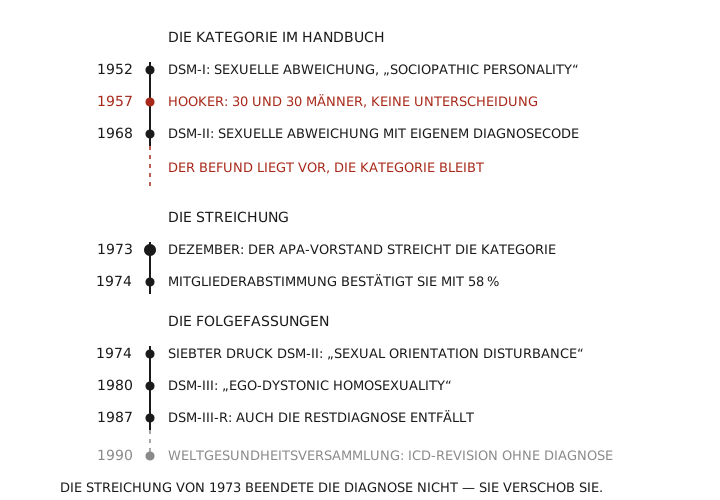
As psychiatric classifications gained influence in the twentieth century, moral deviance turned into an administrative code. The DSM-I, published in 1952, placed homosexuality among the sexual deviations within the “sociopathic personality disturbances”, tying it to a broad moral and social conception of disorder. In the DSM-II of 1968, homosexuality stood among the sexual deviations with a diagnostic code of its own. Such categories looked objective even though clear data for illness were missing; they reflected psychoanalytic ideas of development and social norms. The criteria were less operationalised than in later editions, and clinical authority filled the gaps.
The code took effect in clinics, insurance offices, the military, courts, and families. A diagnosis is therefore not merely a line in a manual; it distributes credibility and rights. Once a characteristic stands in the manual, textbooks, clinics, and examinations keep producing fresh confirmations. Removing it then takes more than a contrary finding: the institution has to correct its own authority.
Treatment followed accordingly. Long-term psychoanalytic therapy, aversive conditioning, hormones, and in some contexts surgery were meant to change orientation or behaviour. The reports of success suffered from missing comparison groups, unclear definitions, and social pressure. Less reported behaviour could mean concealment rather than altered desire. Anyone who begins therapy under threat of punishment, family pressure, or professional risk is not giving ordinary free consent. The self-report afterwards is influenced too: a patient knows which answer brings discharge or approval. This treatment history shows why efficacy and the legitimacy of the goal have to be examined separately. Even if an intervention did change behaviour, that would not show the goal to be medically or ethically justified.
What the blinded test showed — and what it did not
Blinding was the heart of the design. A judge who knows the orientation can read every ambiguous sign in its light, and projective tests leave a great deal of room for that. If even experienced clinicians could not reliably separate the groups without a label, the claim of an obviously pathological personality lost its plausibility.
“No reliable distinction” does not, however, prove that two groups are identical on every characteristic. A null finding can come from genuine similarity, from low statistical power, or from unreliable measurement. Hooker’s sample was small, it included only men, and the validity of projective methods remains contested to this day. By today’s standards one would demand more valid instruments, larger and more diverse samples, and preregistered analyses. The study also did not know today’s distinctions between gender and sexual identity. Historical significance is no substitute for methodological criticism; and methodological criticism does not remove the value of a good contrast design.
For the disease claim of the time, however, the burden of proof lay elsewhere. If homosexuality were in itself a broad personality disorder, it would have had to show up consistently in clinical judgements. The absence of the pattern was therefore damaging to the theory, even without proving universal health. Later research using other methods supported the conclusion that same-sex orientation is not a mental disorder. Science changed through cumulative evidence, not through one magical experiment.
Hooker herself was heterosexual and worked with homosexual communities at a time of high personal risk. She won trust, attended social gatherings, and did not treat participants as exotic cases. Anonymisation was no formality here: an admission that became known could cost a job, liberty, or family. Her achievement is sometimes so heroised that activists and participants disappear again. More precisely: she used her position to translate a criticism arising from the community into a convincing design.
The people who forced the decision
Data did not change the DSM by themselves. Frank Kameny was dismissed from the US civil service in 1957 because of his homosexuality, from the Army Map Service. He fought legally and politically, co-founded the Mattachine Society of Washington in 1961, and simply rejected the definition of illness. His slogan “Gay is Good”, in circulation from 1968, reversed the burden of proof: it was not for homosexual people to prove their normality but for institutions to justify their discrimination. Kameny distrusted the idea that doctors could decide about identity on their own. That stood in a certain tension with a strategy that argued from favourable psychological studies. Civil rights must not depend on a group appearing, on average, healthy, likeable, or well adjusted.
Barbara Gittings worked in lesbian organisations, published, protested, and helped to force discussions with psychiatry. Together with Kameny she brought openly homosexual professionals onto panels. She understood public images: picket signs, media work, and personal conversations translated the abstract harm of a diagnosis into biographies. Professionals thereby stopped seeing the people concerned only as case files.
At the 1972 APA convention the psychiatrist John E. Fryer spoke as “Dr H. Anonymous”. He wore a rubber mask, a wig, and an oversized dinner jacket; a microphone distorted his voice. He told the audience that homosexual psychiatrists had long been working in clinics and professional bodies but had to keep silent. Fryer had experienced professional damage and risked his career by speaking openly. The mask was protection and proof at once: a profession that diagnosed homosexuality was forcing a competent colleague into anonymity. His appearance refuted no diagnosis by means of a test score. It changed the epistemic situation in the room.
1973 was a process, not a switch
The psychiatrist Robert Spitzer played an important role in the internal debates. One central argument ran: a disorder ought to cause subjective suffering or a general impairment of social functioning. Homosexuality in itself did not meet that criterion, and conflict with social norms alone defines no illness.
In December 1973 the board of the American Psychiatric Association struck the general category from the DSM-II — and at the same time adopted a statement naming the reason:
WHEREAS HOMOSEXUALITY per se implies no impairment in judgment, stability, reliability, or general social or vocational capabilities
The sentence begins with a “whereas” because it is the ground of a resolution and not its result. What was resolved was therefore not merely a deletion. Following a petition, a vote of the membership in 1974 confirmed the decision with 58 per cent. Opponents criticised the procedure as politics by ballot. But classifications are always decided in committees. The question is whether their reasons are transparent and evidenced, not whether people took part in the decision.
The diagnosis had not thereby disappeared. Its place was taken, in the seventh printing of the DSM-II in 1974, by “sexual orientation disturbance”, and in 1980, in the DSM-III, by “ego-dystonic homosexuality” — for people who suffered under their orientation. This looked like a clinical compromise. But the suffering could arise precisely from rejection, religion, family, or danger. The residual diagnosis made the social cause appear once again inside the individual. Only in 1987, in the DSM-III-R, did it disappear as well. Categories for depression, anxiety, or relationship conflict remained available, without pathologising orientation itself.
Decades later Spitzer produced a methodologically weak study of his own on supposed change of orientation: a conference paper at the APA meeting in 2001, printed in the Archives of Sexual Behavior in 2003. In 2012 he declared the main criticism justified, asked for the study to be retracted, and apologised publicly. Scientific self-correction confers no lasting infallibility.
International classifications did not follow at the same time. In 1990 the World Health Assembly adopted an ICD revision in which homosexuality no longer appeared as a diagnosis; 17 May is observed internationally for that reason as the day against homophobia, biphobia, interphobia, and transphobia. Implementation took place over the following years. The later date shows that evidence travels through national, linguistic, and political institutions. A decision of the APA did not automatically hold worldwide; in some countries criminal prosecution and medical coercion continue to this day.
Minority stress, not a minority nature
Sexual orientation says little about personality, capacity for attachment, or morality. Differences in burden between groups nevertheless exist, and they call for an explanation that does not fall back into the old disease claim. Ilan Meyer’s model of minority stress distinguishes external burdens such as discrimination from anticipated rejection, concealment, and internalised stigma. These processes can raise psychological risk; community, a positive identity, and social support have a protective effect. The model shifts causality away from a supposed defect of orientation and towards burdensome social conditions.
This is not a claim that every queer person is traumatised. Burdens and resources vary, intersectional positions alter experience, and the general causes of mental disorder remain relevant. The gain lies in neither denying elevated group risks nor abusing them as proof of illness. A population can suffer more because it is treated worse.
The history stays practically current because conversion offerings still promise to change orientation. Robust evidence for a safe, reliable change is missing; reports show risks such as shame, depression, and suicidality. Some people change the label they use for their identity over the course of a life, or experience sexual fluidity. It does not follow that a professional could produce a predetermined direction. Affirmative therapy, conversely, prescribes no identity either. It creates a space in which clients can explore safety, relationships, values, and self-descriptions, without heterosexuality standing fixed as the measure of success.
Who defines a disorder?
Statistical rarity is not enough; left-handedness is rare and is no illness. Violation of a norm is not enough either; political dissent can be healthy. Suffering and impairment of functioning are important criteria, yet they too have to be examined for their cause. A racist environment can produce suffering without making skin colour a diagnosis.
Psychiatry moves between biological findings, subjective experience, and social values. Classification cannot be entirely free of values, because “function” always contains a conception of a life going well. What makes it honest is explicit criteria, evidence, the perspectives of those affected, and human rights. The removal of homosexuality does not show that diagnoses are only opinions. It shows that categories must be correctable when their claimed harm comes from norms rather than from the characteristic itself.
For research today this has consequences at the level of craft. Samples must be obtained outside clinics and platform bubbles. Whoever measures should distinguish whether they are recording identity, behaviour, or attraction; these levels do not coincide. Categories and language should not force participants into answers that miss their experience. Data protection remains particularly important where disclosure means legal or social danger. And international research must not carry categories from more liberal contexts, unprotected, into countries where data endanger people.
Above all, science needs criticism from those it studies. The people concerned possess no automatic methodological infallibility, but they do possess relevant knowledge about blind spots, recruitment, and harm. Hooker’s study became better because someone from the group under study changed the opening question. What today is called “participatory research” was here a conversation among friends, decades before there was a procedure for it.
What remains
Homosexuality did not vanish from the DSM because a lobby defeated science. An insufficiently evidenced assumption of illness lost its legitimacy through better samples, conceptual scrutiny, ethical criticism, and organised voices. Politics was not newly in play at that point — it was already there in the adoption of the diagnosis. For anyone who wants to know what still stands from Hooker: her finding was not a hidden difference in the test but the absence of the expected defect, after she had looked for people where they lived instead of where an institution had already made them into patients. The value of projective methods remains contested; the study convinces today as a contrast design, not as a measurement.
In everyday life the pattern can be recognised by a single question: where do the people being talked about come from? Whoever studies criminality in prisoners, the capacity for relationships in those seeking therapy, or the nature of a minority in its emergencies is also measuring the institution that brought these people together. The second question follows on: does the suffering lie in the characteristic, in co-occurring conditions, or in the reaction of the environment? The history of the DSM is no licence to delete uncomfortable categories by vote. It is a rule of examination — and it applies to the categories that look self-evident today as well.
Sources, and why they are here
Hooker, E. (1957). The adjustment of the male overt homosexual. Journal of Projective Techniques, 21, 18–31.
The blinded test that pulled away the foundation: experienced raters could not tell the protocols apart. What it shows and what it does not, the article sets out expressly.
American Psychiatric Association (1973). Position Statement on Homosexuality and Civil Rights, adopted by the Board of Trustees on 14/15 December 1973, prepared by Robert L. Spitzer.
The document the quotation comes from — and the evidence that 1973 was not a deletion but a fully formulated statement with reasons.
Bayer, R. (1981). Homosexuality and American Psychiatry: The Politics of Diagnosis. Basic Books.
The political prehistory of the decision — who forced it, by what means, and why it was a process and not a switch.
Drescher, J. (2015). Out of DSM: Depathologizing homosexuality. Behavioral Sciences, 5(4), 565–575.
The disciplinary history of the steps after 1973 — from “sexual orientation disturbance” by way of ego-dystonic homosexuality to its final disappearance.
Meyer, I. H. (2003). Prejudice, social stress, and mental health in lesbian, gay, and bisexual populations. Psychological Bulletin, 129(5), 674–697.
The explanation that took the place of the illness doctrine: raised distress is a consequence of rejection, not a property of those affected.
American Psychiatric Association Foundation. History of DSM and Homosexuality.
The professional association's own account — useful because it shows how an institution keeps the record of its own mistaken history, when it keeps it.