The Journal29 August 202613 min read
She refused to give electroshocks
Nise da Silveira and the images an asylum did not want to see
Rio de Janeiro, 1946. At the psychiatric centre in Engenho de Dentro, Nise da Silveira is given no prestigious ward but the occupational-therapy section — a marginal place in the system. The 41-year-old doctor has refused to administer electroshock. Lobotomy and insulin coma belong at the time to the vocabulary of therapeutic progress. Da Silveira does not answer with a spectacular counter-machine. She opens rooms for painting, modelling, woodwork, music and later contact with animals.
What sounds like a friendlier programme of pastimes changes the direction of the gaze. Patients are not merely carriers of symptoms. Their pictures show recurring forms, relationships, fears and attempts to order a shattered world. Da Silveira collects the works, documents series and founds the Museu de Imagens do Inconsciente in 1952. For her, art becomes neither decoration nor a mere diagnostic test. It becomes a way of entering into relationship with people whose language the institution can often no longer hear.
From Maceió to Rio, by way of prison
Nise Magalhães da Silveira was born in 1905 in Maceió, in the north-eastern state of Alagoas. From 1921 to 1926 she studied at the Faculdade de Medicina da Bahia in Salvador — the only woman among 157 men. With her husband, the doctor Mário Magalhães da Silveira, she moved to Rio de Janeiro. Medicine was formally open to women but culturally coded as male. A woman doctor had to demonstrate professional authority and negotiate expectations of femininity at the same time. When da Silveira later developed a psychiatry oriented towards relationship and care, it would nonetheless be too simple to explain that as “female empathy”. It was a professional and political decision against particular forms of treatment.
In 1936 she was arrested during the authoritarian government of Getúlio Vargas. A nurse had denounced her over Marxist literature. She spent 1936 and 1937 in the Frei Caneca prison, where she met, among others, the writer Graciliano Ramos, who later described her in his prison memoirs. After her release she remained excluded from the public service for years; only in 1944 did she return.
No simple causality should be constructed out of this — “because she was locked up, she understood patients”. But the imprisonment sharpens an institutional question: what happens when an authority defines a person entirely through file and suspicion? Prison and asylum are not the same, but they share practices of confinement, observation and disempowerment. What is historically certain is that da Silveira knew state power in her own body and afterwards worked in an institution that disposed of the bodies of others.
The transfer that became a programme
The biological psychiatry of the 1940s placed great hopes in procedures that massively altered consciousness or the brain: insulin coma, cardiazol and electroshock, and psychosurgery. For certain severe depressions, modernised electroconvulsive therapy later proved effective; it is not to be equated with the uncontrolled historical applications. Lobotomy, by contrast, caused irreversible damage and rightly lost its place as a routine.
Da Silveira rejected the aggressive shock procedures in her own practice. This stance is often condensed into a single scene: a superior is said to have ordered her to trigger an electroshock, she refused, and she was transferred to occupational therapy. Whether every detail of the anecdote has come down accurately cannot be established — the institutional conflict itself is documented. And the marginal department proved to be a productive place. Anyone excluded from the centre of therapeutic power can ask different questions. Da Silveira did not first ask how a disruptive patient could be made calm. She asked what form of activity makes expression, attachment and a return to a shared world possible.
In asylums, occupational therapy could mean nothing but discipline: repetitive work that fills time and keeps wards quiet. Da Silveira and her colleagues gave the activities a different sense. Materials became media of voluntary composition; products did not have to be useful or aesthetically approved in order to be taken seriously. The difference lies in the attitude. A task can compel conformity or open up agency. Whoever shapes clay chooses pressure, rhythm and form; whoever paints decides on colour and boundary. These small decisions are clinically relevant when institutional routine has taken almost every other decision away. The studio was therefore not a space free of power: staff observed, collected and interpreted. Its ethical value depended on whether expression was organised for the person or for the file.
Who decides whether a picture is art or symptom
The young artist Almir Mavignier was among the founders of the painting studio in 1946 and ran it until 1951; he brought the works into contact with the art world. His way of looking differed from the clinical one: he saw composition, colour and formal quality. A productive conflict arose from this. Are the pictures symptoms, therapeutic acts or works of art? Da Silveira’s own answer refuses to choose between these disciplines:
for us, the image is valid in itself, it speaks for itself, and it speaks in a loquacious way
A single answer would impoverish their ambiguity. The categories have consequences. “Patient art” can generate attention and devalue at the same time, as though the work stood outside art history; “art brut” or “outsider art” criticises academic boundaries but can form a new exoticising niche. The history of the team also shows that humane institutions do not arise from the empathy of a heroine. Rooms, materials, documentation and reliable collaboration require organisation.
Interpretation, too, followed a rule. Projective assessment often tries to read a hidden personality from a single picture. Da Silveira was more interested in series: how do motifs change over weeks? Which forms recur? What happens in parallel in the person’s life and relationships? A work was not a psychological fingerprint. This longitudinal perspective is methodologically wiser than immediate symbolic reading, but it remains interpretive. A circle can mean sun, protection, a formal preference or several of these at once; without a statement from the painter, interpretation has to be marked as hypothesis.
The clinical value exists in any case without a decoded code. Painting can concentrate attention, regulate affect, enable motor action and establish a relationship. If a picture counts as a window on the soul, the viewer believes he can see through it — but art is not a transparent finding; it is made form, whose meaning arises between maker, material, situation and audience. The picture does not simply reveal a hidden interior. It creates an object through which relationship becomes possible, and something can be shown without being fully explained. To respect a person does not mean to decipher them.
Adelina Gomes, Fernando Diniz, Carlos Pertuis
Adelina Gomes, born in 1916, entered psychiatry in 1937 after a severe crisis and created some 17,500 works there over decades; she died in 1984. Her pictures of flowers, figures and recurring transformations were intensively interpreted by da Silveira and by later authors. The temptation to translate motifs directly into a dramatic biography is strong. Readings of that kind can offer connections but easily lock the person into a single conflict. Adelina was not material for Jung’s archetypes and not evidence for a diagnosis. She worked, varied and made aesthetic decisions.
Fernando Diniz spent long years in psychiatric institutions and produced a large number of paintings and drawings. Interiors, geometrical structures and intense orders of colour appear frequently; the work can be read as an attempt to structure space and experience — and that too remains interpretation. His development shows how artistic practice can build a biography over decades that is not reduced to the onset of illness. Style changes through practice, material and dialogue. If every change counts only as the course of a symptom, the learning disappears. Leon Hirszman devoted separate episodes of his documentary series Imagens do Inconsciente to him and to Carlos Pertuis, making both known beyond the clinic.
Pertuis’s works are praised for cosmic figures and dense symbolic worlds — an attribution that comes above all from the museum’s reception of them and from the title of the episode devoted to him, A Barca do Sol. With him as with the others, the same question arises: who determines whether a work is exhibited as art, researched as a clinical document, or protected in private? The fair view allows for both. The psychiatric setting shaped how the works came into being and how they were archived, and the works possess formal and cultural qualities that no diagnosis exhausts. Recognition through film and exhibition is valuable but must not pretend that art healed the institutional loss. Productivity and disability exist at the same time.
A museum with 350,000 works
On 20 May 1952 the Museu de Imagens do Inconsciente was founded to preserve, to research and to make publicly accessible the growing collection. Today it holds around 350,000 works from the studios; of these, about 127,000 had been registered by the national heritage authority IPHAN by 2015. The name “Images of the Unconscious” points to the theoretical interpretation, but also to the recognition that these pictures carry knowledge.
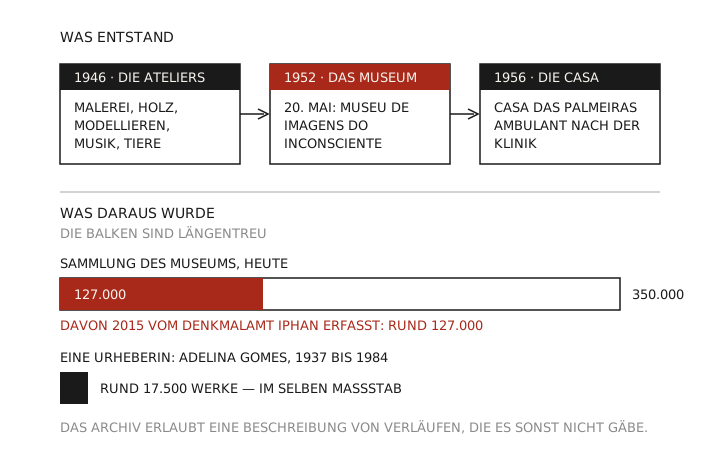
A museum changes status. What could count in the hospital as waste or symptom acquires an inventory number, conservation and exhibition. The maker becomes visible — and at the same time the work can once again belong to an institution. Questions of consent, copyright, proceeds and attribution are therefore central. Historical collections often came into being under standards that do not meet present-day requirements. Preserving them makes research and appreciation possible but obliges transparency about provenance: who made the work, under what conditions, with what consent — and who decides today about its reproduction?
Jung, animals and the way out of the asylum
Da Silveira engaged intensively with Carl Gustav Jung’s analytical psychology. Recurring circular and ordering forms in the studios reminded her of mandalas, which Jung interpreted as symbols of psychic centring. In 1954 she wrote to him; in 1957 works from Brazil were shown at the Second International Congress of Psychiatry in Zurich, which Jung attended. Jung’s theory offered her a language that did not treat pictures as meaningless waste: archetypes promised to connect individual works with universal symbolic forms. Scientifically, that universality is hard to test. Similar forms can arise from perception, material, culture or from basic conditions of human making. The historical usefulness of a theory and its present-day empirical strength are different questions.
Animals also belonged to the daily life of the studios; da Silveira called them, in effect, co-therapists. A dog or a cat can offer closeness without demanding any linguistic performance; feeding, caring and being recognised create responsibility and rhythm. Animal-assisted intervention is studied more systematically today. The findings point in some contexts to benefits for well-being and social interaction, but they are methodologically heterogeneous. Animals are not medicines with a guaranteed effect — allergies, fear, hygiene, animal welfare and personal preference all have to be taken into account. The strongest thought remains relational: an institution that treats attachment as a disturbance or an expense takes a central resource away from people.
In 1956 da Silveira founded, with colleagues, the Casa das Palmeiras, an outpatient facility for people after psychiatric hospitalisation. It was meant to support the transition into social life; activities, social encounter and expression stood at the centre, and the place avoided the atmosphere of an asylum as far as possible. In this she recognised a problem that persists today. Discharge is no endpoint when housing, work, relationships and a structured day are missing. Relapses are then easily read as individual failures of therapy, even though the environment offers no viable place. The Casa was not a controlled intervention, and its historical value lies in the model: participation as a therapeutic condition, not as a reward after cure.
What cannot be measured in the project
Da Silveira documented impressive individual cases and series of pictures. What was missing were control groups, standardised endpoints and independent assessment. Improvements could have come from relationship, activity, time, medication or selective attention. The archive permits rich description but not every causal claim. Jungian symbolic interpretation is also hard to falsify: if every circular form counts as an archetype and the absence of circular forms is explained theoretically as well, the hypothesis loses its testing power. One can say with high confidence that the studios made expression and activity possible, without claiming that they cured psychoses through a specific mechanism.
Something similar applies to artistic therapies in general. They can foster expression, affect regulation, self-efficacy and relationship, but the evidence varies with diagnosis, method and endpoint. Not every studio is therapy, not every act of art-making is an improvement in symptoms, and aesthetic quality is no clinical measure. The romantic story of the “mad genius” is as problematic here as the purely pathological one: it makes suffering exotic and expects creative compensation. Most people with mental illness are neither remarkable artists nor healed by art.
What the studios certainly did achieve was a limit against the total label. Many participants carried diagnoses from the schizophrenia spectrum. In large asylums such a diagnosis easily became total: every preference counted as a symptom, every protest as a lack of insight into one’s illness. Erving Goffman later described how “total institutions” reorganise identity. Da Silveira’s studios created at least limited areas in which an action did not have to be read immediately as a disturbance. This does not devalue biological treatment across the board — antipsychotic drugs can reduce acute symptoms and enable participation, with side effects that matter as well. Person-centred psychiatry combines medical, psychological and social help instead of making one level into an enemy.
A door that is not locked, material that is not taken away, another person who does not mock: details like these look unpolitical. In an authoritarian institution they redistribute power. Da Silveira’s resistance was therefore not merely a friendly style but an attack on the definition of efficiency. A lobotomy could make a ward quieter in the short term; a studio needed time, staff and tolerance for unpredictable results. The one fitted the logic of administration, the other a biography.
What remains
Da Silveira worked, taught and wrote into old age; she died in 1999. The museum and the Casa das Palmeiras continue, and in 2016 the feature film Nise: O Coração da Loucura made her story better known internationally. Feature films compress conflicts and people — the historical Nise was more complex than the lone heroine against a closed collective of men, and the Brazilian psychiatric reform came out of many movements, not out of one biography. What holds is more modest and more durable than the legend. The studios made expression and activity possible; the archive permits a description of trajectories that would not otherwise exist. The real achievement was the combination of refusal and construction. She did not merely say no to a procedure; she created spaces that carried a different practice for decades. What remains contested is what lies in the pictures themselves: the archetypal interpretation is not testable, and claims about the effects of artistic therapies are supported to differing degrees depending on the diagnosis.
How to recognise this in everyday practice: by the direction in which a treatment goal is formulated. Less agitation is an improvement only if initiative and dignity are not lost along with it. Expression is a source of data but no licence to interpret. Participation, relationship and a structured day are not soft extras alongside the “real” medicine. Patients' works must not become an institution’s brand without clear consent. And a humane idea has to be organised, funded and evaluated if it is to survive its founder’s departure — otherwise nothing is left of Engenho de Dentro but a fine story about a good heart.
Sources, and why they are here
Miguel, M. (2022). Inner world and milieu: Art, madness, and Brazilian psychiatry in the work of Nise da Silveira. In Cultural Inquiry, 29. ICI Berlin Press.
The source of the quotation and of the marginal note — both her own words, in English translation, from an openly accessible scholarly publication.
Frayze-Pereira, J. A. (2003). Nise da Silveira: imagens do inconsciente entre psicologia, arte e política. Estudos Avançados, 17(49), 197–208.
Sets side by side the three fields her work stands between — psychology, art, politics. Without the third, half the story is missing.
Dionísio, G. H. (2001). Museu de Imagens do Inconsciente: considerações sobre sua história. Psicologia: Ciência e Profissão, 21(3), 30–35.
The history of the museum as an institution — how treatment material became a collection, and what that step does to the pictures.
Magaldi, F. S. (2018). Psyche meets matter: Body and personhood in the medical-scientific project of Nise da Silveira. História, Ciências, Saúde–Manguinhos, 25(1).
Works out what her project claimed scientifically and what it did not — the basis for the open questions the article names.
Hirszman, L. Imagens do Inconsciente (documentary series, episodes on Fernando Diniz and Carlos Pertuis).
The pictures in motion, and the people who made them. An article about painting that quotes only text withholds its own subject.
Museu de Imagens do Inconsciente, Centro Cultural do Ministério da Saúde: institutional history and collection information.
The source for the holdings of some 350,000 works — and for the fact that the collection is maintained to this day.