The Journal29 August 202614 min read
The cure that never happened
Bertha Pappenheim behind the founding legend of the talking cure
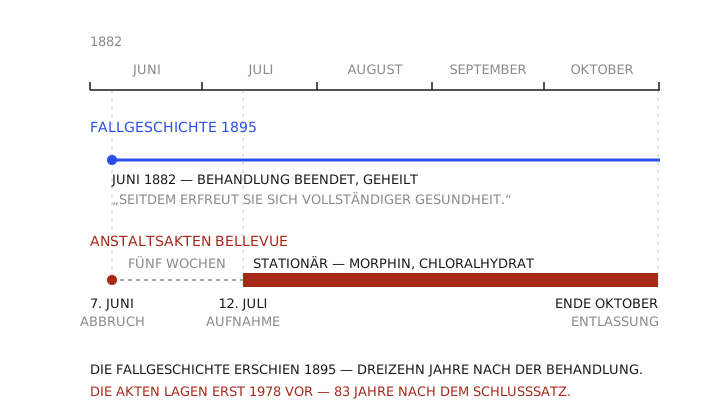
On 12 July 1882 Bertha Pappenheim was admitted to the Bellevue sanatorium in Kreuzlingen. Five weeks earlier, on 7 June, Josef Breuer had ended the treatment he would publish thirteen years later with a triumphant conclusion. The notes of the institution’s director, Robert Binswanger, do not describe a cured woman. Pappenheim was still gravely ill, was given morphine and chloral hydrate, and developed a documented dependence. She was not discharged until the end of October. Albrecht Hirschmüller produced this material in 1978 — almost a hundred years after the case history had become the origin scene of psychoanalysis.
In the case history she is called “Anna O.”. Pappenheim came from a wealthy Jewish family in Vienna; when her father fell ill in July 1880, she took over his care. It was during this period that the symptoms Breuer later described began: paralyses, disturbances of speech and vision, hallucinations and shifting states of consciousness. In 1895 Breuer and Sigmund Freud published the case in Studies on Hysteria. Out of it came the claim with which an entire discipline began: that telling can heal.
Seitdem erfreut sie sich vollständiger Gesundheit.
What Breuer treated — and what he wrote later
Breuer was a respected Viennese physician and physiologist. He treated Pappenheim with unusual intensity, at times daily and in long sessions. He listened to her accounts, used hypnosis and tried to trace individual symptoms back to their presumed origin. That attentiveness set the treatment apart from a purely authoritarian one — and it was itself part of what worked.
By tradition, Pappenheim called the conversations “talking cure” and “chimney sweeping” in English. That the name came from the patient matters: she was not simply material but described a method that developed within the relationship. The phrase is known, however, only through Breuer. No account of the treatment in Pappenheim’s own hand survives.
The procedure later called catharsis followed a clear pattern: under hypnosis the memory of a distressing situation was to re-emerge together with its associated affect, after which, on Breuer’s account, a symptom would disappear. Clinically that is impressive; methodologically it is fragile. Symptoms fluctuate, suggestion works, and clinicians recognise fitting episodes more readily than unfitting ones. Modern memory research describes remembering as reconstruction in any case: questions, expectations and repeated imagining shape what surfaces. High subjective certainty and historical accuracy are not the same thing.
This does not mean Pappenheim’s accounts were invented. It means that an origin scene narrated in trance has not been independently verified. The distinction still protects patients today: clinicians should take experience seriously without confirming supposedly repressed events through suggestive technique. Clinical significance is not forensic proof.
There is also the matter of elapsed time. The case history appeared thirteen years after the treatment. Between the encounter and the text lay memory, notes and a developing theory. Breuer was not copying out a transcript; he was composing a clinical course. The coherence a reader finds may therefore be partly a product of the presentation — Breuer took part in the events and at the same time determined how they would appear to posterity.
What the Bellevue records show
The published case history ends with a dramatic therapeutic conclusion. The Kreuzlingen documents contradict it. Pappenheim’s condition remained serious after the treatment ended; her recovery ran over years, not over a closing scene.
For her pain she was given morphine and chloral hydrate. Dose, duration and precise effect are not settled in every respect; the dependence is documented. That blurs the line between illness and treatment. Fatigue, confusion, withdrawal or shifts in mood can later appear as part of the original syndrome. Modern case analysis therefore lays out a timeline that sets symptoms, medication and interventions side by side.
The moral point is not that Breuer did harm deliberately. Opiates were medically widespread at the time and their risks regulated differently. But good intentions are no substitute for observing side effects. Present-day therapies, too, must treat iatrogenic consequences as data rather than as an interruption of the success story.
So why did the published case history end in triumph all the same? Clinical texts need an arc. A new method persuades more strongly when symptoms disappear one after another and the case is closed. Open-ended courses are scientifically more honest and rhetorically weaker. The Bellevue material does not make the talking cure worthless; it changes the claim about its efficacy. Short-term symptom change, therapeutic insight and lasting recovery are different endpoints.
A diagnosis at this distance cannot be drawn from the sources. In the nineteenth century “hysteria” bundled together very different paralyses, seizures, pains and alterations of consciousness with no discernible organic explanation. The term was coded as feminine and loaded with assumptions about sexuality and suggestibility. Some cases would today be discussed under functional neurological disorders, dissociation or epilepsy. For Pappenheim the record is not enough: historians continue to argue over neurological, pharmacological and psychological explanations, and no side can settle the question.
| Detail | Case history, 1895 | Bellevue asylum records |
|---|---|---|
| End of the treatment | June 1882, cured | 7 June 1882, broken off |
| Condition afterwards | complete health | admitted on 12 July 1882 |
| Medication | not mentioned | morphine, chloral hydrate |
| Discharge | — | end of October 1882 |
How a case became a founding legend
Among the most famous scenes of the case is one that probably never took place. In 1953 Ernest Jones related that at the end of the treatment Pappenheim developed symptoms of a hysterical pregnancy and that Breuer, alarmed, broke off the relationship. Freud passed on variants of the story. Direct contemporary evidence is missing; historians rate the episode as uncertain or legendary.
The story served several purposes at once. It made transference and sexuality the hidden engine, cast Breuer as a man who recoiled from his own discovery, and prepared the ground for Freud as the braver successor. A good founding legend explains the theory and the change of leadership in the same breath. That a story feels psychologically apt, however, is not evidence. A discipline that interprets hidden motives needs strict source criticism above all — otherwise irrefutability becomes a stylistic device.
Part of the legend is a simple confusion: Freud did not treat Pappenheim. He knew the case through Breuer and worked it into their joint publication. In popular accounts “Anna O.” nevertheless becomes Freud’s first patient. That is wrong, and the error is telling. Because Freud became the central figure, memory assigns him the forerunners.
Studies on Hysteria was not a book with a single voice either. Breuer emphasised altered states of consciousness and “hypnoid” states; Freud pushed defence, sexuality and psychic conflict to the fore. Free association is not identical with Breuer’s hypnosis, and drive theory came later. It is historically more accurate to speak of an important junction than of a birth.
The life after the case history
Pappenheim moved to Frankfurt am Main and became something that does not appear in Breuer’s file: a public figure. She published stories, plays and works on social policy. She translated the memoirs of Glückel of Hameln from Yiddish, making an early modern Jewish woman’s voice available to a new readership.
In 1904 she co-founded the Jewish Women’s Association and became its first chair. The organisation joined together women’s rights, education, welfare and Jewish community life. In Neu-Isenburg she founded and ran a home for girls at risk, unmarried mothers and their children; it was to offer protection, education and occupational prospects. She travelled to Eastern Europe and the Middle East, investigated the conditions of migration, poverty and sexual exploitation, and wrote about them.
Her positions were not free of tension. She criticised trafficking and prostitution in moral categories that present-day debates judge differently, and on some questions she stayed within the bourgeois and religious norms of her time. Reforming institutions carry power too: rules about sexuality, motherhood and conduct combine care with control. Historical recognition demands neither canonisation nor disparagement, but attention to aims, means and room for manoeuvre.
This biography is not the case history continued by other means. Her later capacity to act does not prove that Breuer cured her; nor does her continued illness make her later achievement unreal. The lapse of time and the unclear chain of treatment carry no causation in either direction. Personality is a course, not a snapshot.
It is often said that Pappenheim rejected psychoanalysis and banned it from her home. The sources are read in different ways. A distanced attitude is plausible; a detailed public self-interpretation of her role as “Anna O.” we do not have. Precisely because she was so formidable a writer, her silence about the case stands out. It may mean protection, refusal, social convention or simply another priority. Without evidence, no more can be said.
Who owns a case history?
During her lifetime Pappenheim was not publicly named as Anna O. Ernest Jones spread the identification in 1953, seventeen years after her death. With that, a recognised social reformer became posthumously a psychiatric patient once more. Historical research needs the connection — without it the legend could not be tested. But it has to ask whose perspective the records preserve. We know Breuer’s interpretation; Pappenheim’s own relation to this case history remains largely unknown.
The pseudonym protected her at first. After the identification, every new biography became an occasion to negotiate intimate medical detail in public. The dead have less data protection depending on the jurisdiction, yet ethical obligations towards dignity, family and historical accuracy remain. Case histories are particularly delicate here, because intimate information is mixed with interpretation. Readers often cannot tell which sentence comes from a contemporaneous record, which from a late recollection and which from a theoretical reconstruction. Transparency about levels of evidence is part of protecting the person. In unique cases anonymisation alone is not enough: biographical details can be combined until a person is identifiable again.
That leaves the harder question of whether a narrative can be true without being accurate. A therapeutic story can help someone order their experience even if it is not a historical photograph. The danger arises when the clinician’s narrative becomes the only admissible one. Breuer’s text gave Pappenheim’s symptoms meaning and at the same time took from her any control over their later interpretation. Medical record, subjective experience, social history and later life can contradict one another without any one level cancelling the others.
Pappenheim’s complaints began in a heavily burdened caring situation. Her father fell seriously ill, she kept watch at his bedside, and she lost him in 1881. That supplies a plausible connection between grief, exhaustion, family duty and bodily expression. It does not prove Breuer’s particular theory. People respond to the strain of caring with sleeplessness, anxiety, depression, physical symptoms or nothing visible at all; a context is not an unambiguous cause.
In bourgeois Vienna the scope for young women to act was narrow. Pappenheim’s education, imagination and energy met expectations of domesticity and obedience. Later authors therefore read her symptoms as coded rebellion. That reading can make social constriction visible and remains, nevertheless, a reading. To declare every paralysis a political message is to deny the sufferer once again that illness can also be something that simply befalls a person.
“Hysteria” was not only a diagnosis but a cultural stage. Doctors described female bodies as especially suggestible; literary and medical portrayals influenced one another. Patients learned which symptoms were intelligible, without therefore producing them deliberately. Suffering takes the forms for which a society holds language, attention and institutions ready. This thought neither explains every seizure nor exposes it as playacting. It connects body, relationship and historical expectation.
Breuer visited Pappenheim over a long period with extraordinary frequency. The treatment therefore did not consist of hypnosis alone. It offered rhythm, attention and an interlocutor who took the symptoms seriously. Any improvement may have arisen from several elements: expectation, relief, structure, care, the spontaneous course of the illness, or the telling itself. The case does not allow these factors to be separated.
That very inseparability later became theoretically productive. Psychoanalysis made the relationship between patient and clinician its own object. Transference denotes not merely romantic infatuation but the reactivation of earlier relational patterns in a present encounter. Countertransference describes the clinician’s reactions. With that it became clinically visible that observers do not stand outside the events.
Yet a theory that treats every reaction as material can immunise itself against contradiction. If a patient agrees, she confirms the interpretation; if she disagrees, the resistance counts as further proof. Methodologically, therapy therefore needs ways out of the closed loop: alternative hypotheses, jointly defined goals, measurement of progress, and a real possibility of rejecting an interpretation.
Power belongs to the relationship as well. Breuer was older, a doctor, socially established and in command of medical language. Pappenheim depended on care and on family decisions. That she is said to have named the “talking cure” shows her part in shaping it, but does not abolish the imbalance. Cooperation and asymmetry can exist at once.
A responsible reconstruction separates at least four groups of sources. First there is Breuer’s published case: detailed, theoretically ordered, but late and committed to a thesis of success. Second, there are contemporaneous medical documents from Bellevue: closer to the later course, likewise written from a doctor’s point of view and not complete. Third stand the recollections of Freud and later biographers: important for how the legend formed, weak on intimate detail. Fourth there is Pappenheim’s public work and documented social work: rich on her later activity, almost mute about the treatment.
No source is simply “the truth”. The Bellevue file refutes the claimed smooth conclusion of a cure but cannot stand in for Pappenheim’s inner life. Breuer’s text preserves details of the sessions and shapes them at the same time. Late recollections show what a movement wanted to say about its own origins. The later life proves the capacity to act, not a retrospective diagnosis.
For journalistic analysis of a person this yields a scale of evidence. A contemporaneous date can count as documented. A motive attributed by a participant decades afterwards has to be marked as an assertion. A modern diagnosis drawn from old symptoms remains speculation. The language of “possibly”, “according to Breuer” and “not documented” is not a stylistic weakness but part of the accuracy.
The popular story knows two states: ill before the talking cure, cured after. Real courses consist of functions. Could Pappenheim sleep, read, sustain relationships, travel, organise? Which complaints stayed, which returned, which lost their significance? For long stretches the systematic data are missing.
A person may go on having symptoms and lead an effective life. She may have fewer symptoms and still feel governed by others. Modern health services research therefore considers symptom burden, social participation, quality of life, self-determination and personal goals separately. Pappenheim’s biography illustrates that separation, without a modern measurement scheme being applicable in retrospect.
Her later organisational force invites a second myth: the woman who overcame everything, whose suffering had prepared her for a mission. That narrative, too, uses illness as a literary preliminary stage. People do not have to extract a higher purpose from their suffering for their later actions to be valuable. Meaning can arise; it must not be prescribed as a duty.
As chair, author and head of an institution, Pappenheim moved among institutions and conflicts. That corrects the passive image of the case file. It does not justify a retrospective character diagnosis such as “strong-willed all along”. Personality shows itself according to role and opportunity. A woman can be dependent in a sickroom and assertive in an organisation without either observation being false.
Especially interesting is the shift from private conversation to social reform. The talking cure individualised suffering; Pappenheim’s work aimed at education, poverty, trafficking and institutional protection. Both are levels of response. A person may need a language for inner conflict and, at the same time, changed external conditions. Psychology loses reality when it treats social violence merely as fantasy; social criticism loses persons when it reads individual experience merely as a consequence of structure.
Pappenheim represented norms of her own in this and exercised power. Her home was a place of refuge and an institution of upbringing. A fair historical account makes her neither a flawless feminist icon nor a mere agent of bourgeois discipline. She was a political figure within the contradictions of her time.
What remains
Four things are well documented: that Breuer treated Pappenheim from 1880 to 1882; that her symptoms were severe and shifting; that she was afterwards cared for as an inpatient and that the published cure did not take place in that form; and that she later became one of the most effective Jewish social reformers in Germany. The diagnosis and the phantom pregnancy remain uncertain. What she herself thought about the published case remains unknown.
What follows for practice is not that the talking cure should be discarded, but that a distinction should be drawn. Listening, relationship and biographical meaning are clinically relevant; symptoms sit in life stories and not only in organs. What cannot be sustained is the certainty that behind every symptom lies a single scene that the right technique will lay bare. Anyone wishing to judge a therapy asks about the course after the last session, not about the elegance of the case history.
In everyday life the pattern shows in how closed a success story sounds. Cases in which everything comes out even — cause found, symptom gone, treatment concluded — have almost always been ordered after the fact. “Anna O.” denotes a literary-medical figure in a founding text, Bertha Pappenheim a historical person who was more than that figure. The two names are connected and not interchangeable.
Sources, and why they are here
Breuer, J., & Freud, S. (1895). Studien über Hysterie. Leipzig and Vienna: Deuticke.
The founding text itself — and the source of the closing sentence the asylum records contradict.
Hirschmüller, A. (1978). Physiologie und Psychoanalyse in Leben und Werk Josef Breuers. Bern: Huber.
The first to publish the medical records of the Bellevue sanatorium; every detail on admission, medication and discharge comes from here.
Ellenberger, H. F. (1970). The Discovery of the Unconscious. New York: Basic Books.
Places the case within the prehistory of dynamic psychiatry and separates tradition from evidence.
Borch-Jacobsen, M. (1996). Remembering Anna O.: A Century of Mystification. New York: Routledge.
Traces how a broken-off treatment became a story of cure — the reception history of the case.
Kaplan, M. A. (1979). The Jewish Feminist Movement in Germany: The Campaigns of the Jüdischer Frauenbund, 1904–1938. Westport: Greenwood.
Documents Pappenheim's own work — the women's league, the girls' home, the campaign against trafficking — beyond the role of patient.