The Journal19 July 20267 min read
Six Days of Experiment, Fifty Years of Story
What remains of Zimbardo's prison once you listen to the tapes
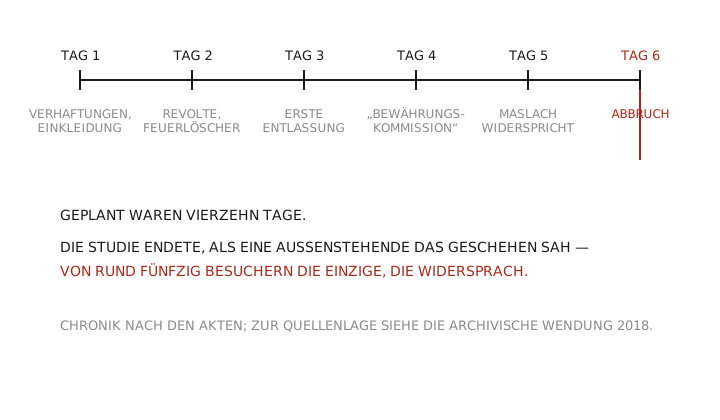
Seventy-five young men answered an advertisement in the summer of 1971; twenty-four were taken, the most unremarkable after tests and interviews. Nine were to be guards, nine prisoners, with three of each held in reserve. Who got which role was decided by chance. The setting was a basement corridor in Stanford’s Jordan Hall, converted into cells and funded by the Office of Naval Research. Two weeks were planned; the arrangement ran from 14 to 20 August 1971 and was called off on the sixth day.
What is left of those six days are tapes, duty rosters, notes and invoices that have sat in Stanford ever since and that almost nobody read for half a century. The story that travelled the world instead is familiar to everyone: put ordinary people into uniforms and roles, and within days guards turn into sadists and prisoners into broken men. The situation, not the character, is what makes evil.
Why this was not an experiment
The story had a problem of form from the outset: it describes an experiment that was none. There was no control group and no comparison condition. The man running the study played the prison superintendent and so stood in the middle of what he meant to measure. This is not hindsight scoring points — it is the reason the study has always served in methods seminars as a warning rather than as evidence. A single arrangement without a comparison can illustrate the basic claim of situationism, but it cannot test it. The images were strong, the reading was catchy, and the textbooks printed it.
What lay in the holdings
In 2018 the French researcher Thibault Le Texier published the first systematic analysis of the Stanford holdings, first as a book in French, then in 2019 as a paper in American Psychologist. The files contradicted the legend at its most sensitive point: spontaneity. The guards did not invent their harshness — they were given an orientation that sketched the role out for them, with expectations of arbitrariness and harassment; anyone who stayed too mild was pressed by the research staff to come on harder. On one tape David Jaffe, the student installed as superintendent, calls a hesitant guard to order:
We really want to get you active and involved because the guards have to know that every guard is going to be what we call a „tough guard“
Zimbardo concedes the address. How far that influence went is something he and Le Texier dispute to this day. The situation that supposedly escalated of its own accord was staged and steered.
The most famous breakdown of a prisoner, shown in every documentary, stands beside the shifting accounts of the man himself. In 1992, in the film Quiet Rage, Douglas Korpi called those days the most harrowing experience of his life; in 2017 he said he had acted the crisis out in order to be released and study for an exam. Zimbardo considers the later version the less credible one. Both accounts come from the same person, both are memory — the dispute is not settled by them but by the tapes. Zimbardo contradicted the holdings and defended his reading; the tapes and papers are public, and the argument over them is conducted with file numbers, not with recollections.
| Point | What the story says | What the holdings say |
|---|---|---|
| The harshness of the guards | arose of itself out of the role | sketched out in an orientation and steered by an address |
| The famous breakdown | a genuine crisis | two contradictory accounts by the same man, 1992 and 2017 |
| The ending | Maslach the only one among some fifty visitors | earlier objection: a guard quit, prisoners asked to be released |
| The form | an experiment | no control group, the investigator as superintendent |
| The criticism | came in 2018 | has stood published in the literature since 1975 |
| The textbooks | report the dispute | 11 of 13 covered the study, 6 named an objection |
What the restagings showed
Even before that, new versions of the arrangement had produced a different picture. In 1979 S. H. Lovibond and colleagues in Australia set three prison regimes side by side — the first version with a comparison condition — and found the climate depended on how the institution was organised, not on the people in it. For the BBC study, conducted in 2001, broadcast in 2002 and published in 2006, Stephen Reicher and Alex Haslam rebuilt the arrangement under independent ethical oversight, expressly not as a replication but as a counter-test. What they got was not automatic role decay but group dynamics: the prisoners organised themselves, the guards fell apart over their role, and what stood at the end was no tyranny of the uniform but a struggle over leadership and legitimacy. One can argue about that study’s television conditions, and Zimbardo denied it any scientific value; what it did not show is that uniforms alone produce sadists.
The objection that sat for forty years
The prehistory of the criticism belongs in the file, because it shows how long an objection can sit unused. As early as 1975, Ali Banuazizi and Siamak Movahedi set out how easily the participants could guess what the arrangement expected of them. Anyone placed as a guard in a mock prison knows which role the script calls for; the design then measures not what uniforms do to people but how well people play a script they already know. The technical term for this is demand characteristics. The objection was published, cited and without consequence; it stood in the literature for forty years while the legend stood in the textbooks. Only when the tapes surfaced, with the steering audible on them, did the old argument get its evidence delivered.
The economics of the case deserve a paragraph too. The study was funded by the Office of Naval Research, in the context of the prison debate of its day. In October 1971, a few weeks after the shutdown, Zimbardo testified before a congressional subcommittee on prison reform. That was the beginning of the study’s second life as a political argument — depending on the camp, as proof that prisons cannot be reformed or that guards are corrupt. An investigation that serves as evidence for everything ought to arouse suspicion; that holds for studies as much as for legends.
How the legend got into the textbooks
In 2014 Richard Griggs examined thirteen American introductory textbooks: eleven covered the study, only six mentioned any of the objections at all. The criticism had been in print since the 1970s; it rarely made it into the chapter, and then only briefly. Why did the legend last so long? Because it served three needs at once. It absolved: if the situation makes evil, nobody is a bad person. It warned: watch what institutions make of you. And it entertained: there is footage. Against that package, methodological criticism stood no chance for decades — until the criticism itself became a story, with an archive, tapes and a find. Corrections prevail when they become tellable.
What remains
Little is settled about prisons and a good deal about the research enterprise. The ethical precedent stands: a study approved under the rules of its time went out of control without any oversight taking hold. Even its ending is disputed. On Zimbardo’s account, Christina Maslach was the only one among some fifty visitors who objected, and her objection ended the whole thing. Le Texier holds against this that objection came earlier: a guard quit before the start, prisoners asked to be released. The arrangement was finished anyway, because the guards had lost control. That oversight failed while everyone involved felt they were behaving correctly is the durable finding. It is not about uniforms but about roles within the research enterprise itself.
What the six days show about people remains contested. At most they carry a smaller claim than the famous one: that people take on a definition of the situation when an authority issues it — which moves the study closer to Milgram than its own story wanted. Not spontaneous role decay but obedience to a director’s plan. The solid numbers for that come from Milgram’s series and their repetitions, not from this basement; the archive therefore files the study as a historical event of the first order and as evidence of the second. In everyday life the case is recognisable by a pattern: the more often a study is cited as an image and the more rarely its methods section is, the more likely it has become a story.
Zimbardo answered Le Texier point by point and held to the core claim until his death in October 2024; his reply stands publicly beside the holdings, and this archive’s file records both. Two things must be granted him. He kept his material instead of tidying it away — without the tapes there would be no revision. And with the heroism research of his later years he undercut his own thesis of the overwhelming situation: anyone who founds programmes to train civil courage evidently believes that people can withstand a situation.
Sources, and why they are here
Haney, C., Banks, C., & Zimbardo, P. (1973). Interpersonal dynamics in a simulated prison. International Journal of Criminology and Penology, 1, 69–97.
The original report. It is the standard against which the holdings are measured — and it contains neither a control group nor a comparison condition.
Banuazizi, A., & Movahedi, S. (1975). Interpersonal dynamics in a simulated prison: A methodological analysis. American Psychologist, 30, 152–160.
The objection that sat for forty years: participants could guess the expectations of the setup without effort. Published, cited, without consequence — until the tapes supplied its evidence.
Lovibond, S. H., Mithiran, & Adams, W. G. (1979). The effects of three experimental prison environments on the behaviour of non-convict volunteer subjects. Australian Psychologist, 14(3), 273–287.
The first version with a comparison condition — and its finding: the climate depends on how the institution is organised, not on the persons.
Reicher, S., & Haslam, S. A. (2006). Rethinking the psychology of tyranny: The BBC prison study. British Journal of Social Psychology, 45(1), 1–40.
The counter-test under independent ethical supervision. No automatic collapse into role, but a struggle over leadership and legitimacy.
Griggs, R. A. (2014). Coverage of the Stanford Prison Experiment in introductory psychology textbooks. Teaching of Psychology, 41(3), 195–203.
Counts how the legend got into teaching: eleven of thirteen textbooks covered the study, six named any objection at all.
Le Texier, T. (2019). Debunking the Stanford Prison Experiment. American Psychologist, 74(7), 823–839.
The first systematic analysis of the holdings — and the source of the address to the hesitant guard the quotation comes from.
Zimbardo, P. (1992). Quiet Rage: The Stanford Prison Experiment [documentary]. Stanford University.
The version generations have seen — including Douglas Korpi's 1992 account, which he contradicted in 2017.
Zimbardo's reply to Le Texier, published at prisonexp.org/response.
It stands publicly beside the holdings, and this archive records both. Anyone carrying only one side carries the legend on, merely with the sign reversed.
The Stanford holdings on the prison study (tapes, instructions, duty rosters, notes), Stanford University Libraries.
The material itself. That it exists at all is to Zimbardo's credit — without the tapes he kept there would be no revision.